Showing posts with label inchoative verbs. Show all posts

Monday, August 25, 2025

26.11.25: Level 3; Theodorus [1]; text; notes [i] inchoative verbs (review)

Cȳrēnaeum Theodōrum philosophum praeclārissimum nōnne mīrāmur? Lȳsimachō rēgī crucem minantī, "Istīs," inquit, "ista crūdēlia mināre prīmōribus tuīs: haec ad Theodōrum nihil attinent: humī putrēscere aut in aere, idem est."

[1] note the use of ‘istīs’ and ‘ista’ which had a derogatory sense in Classical Latin.

[2] crūx, crūcis [3/f]: a wooden frame on which criminals were crucified which usually, but not always, was in the shape of a cross; it can refer to a gallows or execution in general

[3] putrēscō, -ere[3]: rot; decay

This is an example of an inchoative verb (also known as an inceptive verb) with the distinctive -sc- in the stem. They were discussed at:

20.04.24: inchoative verbs

https://adckl.blogspot.com/2024/05/200424-inchoative-verbs.html

20.04.24: inchoative verbs [2]

https://adckl.blogspot.com/2024/05/200424-inchoative-verbs-2.html

puter, putris: rotten

putreō, -ēre [2]: be rotten

putrescō, -ere [3]: rot; become rotten; the inchoative verb expresses the beginning of the action and / or a change of state i.e. something is becoming something else e.g.  frīget: it’s cold > frīgēSCit: it’s getting cold

[4] Lȳsimachō rēgī [dative] ¦ crucem minantī, [dative]…  inquit │ He said to King Lysimachos ¦ who was threating him with the gallows

[5] "Istīs," inquit, "ista crūdēlia mināre prīmōribus tuīs

minor, -ārī, -ātus sum [1/deponent]: threaten (1) somebody [dative] (2) with something [accusative]:

(1) istīs … (2) ista crūdelia mināre (1) prīmōribus tuīs │ threaten (2) these cruelties (1) to those nobles of yours = Threaten (1) those nobles of yours (2) with these cruelties

In the sentence ‘mināre’ looks like an infinitive but it is an imperative i.e. he is telling the king to make threats: “istīs,” inquit “ista crūdelia mināre prīmōribus tuīs” │ Threaten these cruelties to those nobles of yours.

This brings us to a feature of Latin that is not commonly found, but needs to be recognised; the next post explains it.

____________________

Surely we admire Theodorus of Cyrene, the celebrated philosopher? [ = We admire …., don’t we?]. He said to King Lysimachos who was threating him with the gallows: “Threaten these cruelties to those nobles of yours; these things do not concern Theodorus: to rot on the ground or in the air is the same thing.”

Saturday, May 4, 2024

20.04.24: inchoative verbs [2]

A nice use of the inchoative verbs is with colour:

albus, -a, -um: white > albēscō, albēscere [3]: become white; turn pale

non aequore verso tam creber fractis albescit fluctus in undis (Silius) ¦ Thick and fast they come, like the billows on a stormy sea that whiten amid the breaking waves

So, we can combine this with a quick recap on some of the colour adjectives in Latin:

niger, nigra, -um: black > nigrēscit: it turns / it’s becoming black

ruber, rubra, -um: red > rubēscit: it turns red; can also refer to blushing

flāvus, -a, -um: yellow > flāvēscit: it turns yellow

viridis, -e [3rd declension adjectīve; coming soon]: green > viridēscit: it turns green

All the inchoative verbs are 3rd conjugation; most of them are unlikely to be found in any other person except the 3rd singular or plural since they primarily describe changes happening to inanimate objects. A nice one, though, is canēscō, canēscere [3]: become white; turn grey; it’s from the adjective cānus, -a, -um, ‘grey’ with reference to hair. You can use it in this way: canēscō: I’m growing old, I’m growing grey with age.

Have a look at the images posted and match them with these simple phrases:

folium, -ī [2/n]: leaf

frōns, frondis [3/f]: foliage; leafy branch

1. Abōrēs frondēscunt.

2. Caelum nigrēscit.

3. Caelum rubēscit.

4. Capillus albēscit.

5. Folia autumnō rubēscunt.

6. Herba flāvēscit.

20.04.24: a nice poetic example of an inchoative verb

20.04.24: inchoative verbs

You possibly never knew that, when you eat a croissant, you’re eating an inchoative verb, but before I talk about that, here are the opening lines of O Fortuna (Codex Buranus circa 12th century) which is also the first piece of Carl Orff’s Carmina Burana

O Fortuna ¦ Oh Fortune

Velut luna ¦ Just like the moon

Statu variabilis ¦ variable in state [(you are) changeable]

Semper crescis ¦ You’re always growing [waxing]

Aut decrescis; ¦ Or you’re decreasing [waning]

Vita detestabilis ¦ hateful life

OK, now you have what you need to look at inchoative verbs!

Croissant “increasing” with, in terms of the food item, reference to a crescent moon, a moon that is increasing < French croître: grow; increase. The verb, through Old French, is derived from Latin: crescēns (growing) which, in turn, is from the verb you see in the O Fortuna extract: crēscō, crēscere [3]: rise; increase; come to be:

Semper crescis: you’re always growing [waxing]

Aut decrescis: or you’re always decreasing [waning]

If you are interested in music, you may know the Italian term crescendo meaning that what you’re playing starts getting louder and the musical symbol for that (<) illustrates it.

If something is growing or decreasing, it is changing state.

Latin has a number of verbs which convey this idea and are known as inchoative.

Inchoative verbs (from Latin incohō ‘begin’), also known as inceptive verbs (Latin: incipiō ‘begin’) describe a change of state i.e. something becomes something else, for example it changes in size, shape, colour, appearance etc; in English this idea is very often expressed by the verbs ‘become’, ‘grow’, ‘turn’ and, commonly in speech ‘get’ together with an adjective:

It’s getting dark.

The leaves are turning brown.

It’s growing warm now.

The same idea can also be expressed by English verbs such as ‘darkEN’, ‘lightEN’ where the suffix -en can have the same inchoative idea.

It’s brightening up now. (It’s getting bright.)

His face reddened. (His face turned red.)

These verbs also mark the beginning of an action:

The sun is beginning to shine.

The day is dawning.

What to look out for is -sc-

crēscō, crēscere [3]: increase

It’s still hiding in the croissant < crēscēns …

and it’s even more obvious in crescendo

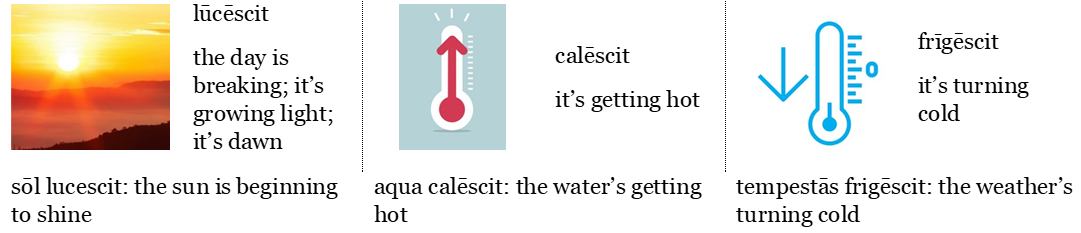
calet: it’s warm / hot > calēSCit: it’s turning warm / hot

frīget: it’s cold > frīgēSCit: it’s getting cold

liquet: it is liquid > liquēSCit: it melts

lūcet: it shines; it’s dawning > lūcēSCit: the day is breaking

tenebrae [f. pl]: darkness > tenebrēSCit: it grows dark

tepet: it’s warm > tepēSCit: it’s growing warm

vespera, -ae [1/f]: evening > vesperāSCit: it’s becoming evening