Showing posts with label topic: school. Show all posts

Sunday, May 25, 2025

01.09.25: topic; Dialogī puerīlēs (Simon Roeth: 1556) [2] dē scholā (iii) links for review

verb conjugations: present tense

interrogō, -āre [1]: ask

recitō, -āre [1]: recite

rūminō, -āre [1]: think over

doceō, -ēre [2]: teach

respondeō, -ēre [2]: reply

taceō, -ēre [2]: be quiet

canō, -ere [3]: sing

colligō, -ere [3]: collect

legō, -ere [3]: read

repetō, -ere [3]: repeat

scrībō, -ere [3]: write

oboediō, -īre [4]: obey

1st conjugation

https://mega.nz/file/yYtDTBJb#x6MNIqoFJb_As9X2_9BsmnGZOzMOaoxAj7K-B4lG3uo 

2nd conjugation

https://mega.nz/file/mQFijRxD#aCvwzNlq3dHeEP7hr7VGmdLry_1z6cCoGYFAhdh8K6g

3rd and 3-iō conjugation

https://mega.nz/file/PZFEAIaL#rAlmUqjUcF0fjIlKKbqo0F0MWGj0FQB5zIvwHM2EpVo


4th conjugation

https://mega.nz/file/jUVwAQaT#HnIrEIqAdtRrB4xOxakJ0v80ekm6Y60xt6xXhp0q5pA

[2] eō, īre [irr.] go,  and its compounds

Quō eunt bēluae. │ (And) beasts / brutes go there.

Redeunt hominēs. │ Men return.

https://mega.nz/file/2YlhgZAI#ND1ssYsC85ylcjS9EVHKcY2d4GthuGxSua7P-lG9Ebw

16.03.24: eō, īre [irregular]: go; compounds of eō, īre

https://adckl.blogspot.com/2024/04/160324-eo-ire-irregular-go-compounds-of.html

https://www.facebook.com/groups/latinforstarters/posts/407788755165732/

15.05.24: review; eō, īre: go [1]

https://adckl.blogspot.com/2024/05/150524-review-eo-ire-go-1.html

https://www.facebook.com/groups/latinforstarters/posts/443145798296694/

16.05.24: review; eō, īre [2]

https://adckl.blogspot.com/2024/05/160524-review-eo-ire-2.html

https://www.facebook.com/groups/latinforstarters/posts/443763864901554/

17.05.24: eō, īre with prefixes [1]

https://adckl.blogspot.com/2024/05/170524-eo-ire-with-prefixes-1.html

https://www.facebook.com/groups/latinforstarters/posts/444399821504625/

17.05.24: eō, īre with prefixes [2]

https://adckl.blogspot.com/2024/05/170524-eo-ire-with-prefixes-2.html

https://www.facebook.com/groups/latinforstarters/posts/444400401504567/

01.09.25: topic; Dialogī puerīlēs (Simon Roeth: 1556) [2] dē scholā (ii) vocabulary, notes, exercises

[1] belua, -ae [1/f]: (large) beast; monster; (referring to people) beast; brute. It’s a rather negative view of school children! The original German is unvernünftige Tiere: ‘unreasonable’ or ‘unwise’ animals.

[2] littera, -ae [1/f] [i] letter (i.e. of the alphabet) [ii] in the plural [a] ‘letter’ i.e. a written communication which, although plural in Latin, can refer to one or more letters [b] literature [c] knowledge; scholarship e.g. a man of letters

[3] museum, -ī [2/n]: this word as meaning ‘school’ occurs in other works from this period (Comenius uses it in 1658 to refer to a ‘study’ room); from Anc. Gk. Μουσεῖον [Mouseîon: a shrine of the Muses]

Originally a temple of the Muses, then a place dedicated to the works of the Muses. In this sense the most remarkable and most important museum of antiquity was that established at Alexandria by Ptolemy Philadelphus in the first half of the third century B.C., or perhaps by his father, Ptolemy Soter. This institution contributed very largely towards the preservation and extension of Greek literature and learning.

https://www.perseus.tufts.edu/hopper/text?doc=Perseus:text:1999.04.0062:entry=museum-harpers

The nouns schola, -ae [1/f] (the title of the dialogue) and lūdus, -ī [2/m] are the nouns used to refer to a school.

[4] Nouns that refer to character or attitude can have far wider meanings than they may at first suggest, derivatives often being more specific than was the case in original CL.

pietās, pietātis [3/f]: in Roth’s original 16th century work he uses: Gotsforcht [= Modern German Gottesfurcht: fear of God] and so ‘piety’, ‘duty to God’ is what he means. The noun, however, can also refer more generally to dutiful conduct (a sense of duty), loyalty (e.g. to one’s parents), patriotism i.e. although it is used in the text in a religious sense, it may not have that implication elsewhere.

[5] mōs, mōris [3/m]: behaviour; conduct; habit; custom

[6] Note the two different and common ways in which Latin forms adverbs from adjectives:

avidus, -a, -um: (here) eager, enthusiastic > avidē: eagerly; enthusiastically

dīligens: diligent; careful > dīligenter: diligently; carefully

fidēlis, -e: faithful > fidēliter: faithfully

[7] Match the English with the Latin in the word cloud

answer

ask

be quiet

go

learn

listen

obey

read

recite

repeat

return

sing

speak Latin

teach

think over

write

auscultāre; canere; discere; docēre; interrogāre; īre; legere; loquī latīne; obēdīre (oboedīre); recitāre; redīre; repetere; respondēre; rūmināre; scrībere; tacēre


01.09.25: topic; Dialogī puerīlēs (Simon Roeth: 1556) [2] dē scholā (i) text and translation

DIALOGUS QUĪNTUS dē scholā  │ FIFTH DIALOGUE concerning the school

A: Quid est schola? │ What is a school?

B: Conventus honestissimus. │ A very honourable meeting.

Officīna hominum. │ A workshop of men.

Quō eunt bēluae. │ (And) beasts / brutes go there.

Redeunt hominēs. │ Men return.

A: Quid agitur in mūseō? │ What is done / happens in a school?

B: Lūdīmagister docet. │ The schoolmaster teaches …

dīligenter │ diligently (carefully)

sēdulō │ purposely (busily; zealously)

fidēliter │ faithfully (honestly)

sine intermissiōne. │ without a break.

A: Quid tandem docet? │ What does he teach, then?

B: Prīmum pietātem. │ First of all, piety.

Deinde bonōs mōrēs. │ Then good morals.

Postrēmō bonās litterās. │ Finally good learning (scholarship).

Discipulī vērō dīligenter auscultant. │ But the pupils diligently listen.

Et discunt avidē ... │ And they eagerly learn …

colligere litterās │ to spell [= literally: to pick up letters]

legere │ to read

scrībere │ to write

loquī latīne │ to speak in Latin

canere  to sing

tacēre │ to be quiet

obēdīre [also: oboedīre] │ to obey

recitāre │ to recite

repetere │ to repeat; recall

rūmināre │ to ‘chew over’; think over

respondēre  │ to reply

interrogāre │ to ask

A: Bene est. │ That’s good.


Saturday, May 17, 2025

29.08.25: topic; Dialogī puerīlēs (Simon Roeth: 1556) [1] dē tempore (ii) vocabulary, notes, exercises

[1] Vocabulary: nouns

[a] clock time

hōra, -ae [1/f]: hour

sēmihōra, -ae [1/f]: half an hour

sēsquihōra, -ae [1/f]: hour and a half

[b] day; parts of the day

aurōra, -ae [1/f]: dawn; sunrise

dīlūculum, -ī [2/n]: dawn; daybreak

merīdiēs, -ēī [5/m]: midday

vesper, -ī [2/m], or vesper, -is [3/m]: evening

nox, noctis [3/f]: night

diēs, -ēī [5 m/f]: day

hebdomas, hebdomadis [3/f]: week; the most common word in Latin for ‘seven’ is septem although this word could have that meaning, but it generally refers to a period of seven days i.e. a week (Late Latin: septimāna, -ae [1/f]). We can ‘dig’ a little because the word is originally from Anc. Gk. ἑβδομάς [hebdomás] ‘a group of seven’ (including days) < ἕβδομος [hébdomos] ‘seventh’ and ultimately from ἑπτά [heptá] ‘seven’ as in the Engl. deriv. heptagon

[c] seasons

vēr, -is [3/n]: spring

aetās, aetātis [3/f]: summer

autumnus, -ī [2/m]: autumn

hiems, -is [3/f]: winter

[d] months

[i] mēnsis, -is [3/m]: month

[i] -ius e.g. Iānuārius, -ī [2/m]

[ii] -er e.g. September, Septembris [3/m]

[iii] Aprīlis, -is [3/m]

[e] years

annus, -ī [2/m]: year

saeculum, -ī [2/n]: century

decennium, -ī [2/n]: decade (similarly quīnquennium, triennium, biennium)

Notes:

nudius tertius │ the day before yesterday; note the use of the ordinal number tertius (third)

The literal meaning of nudius is: ‘It is now the Xth day since ….’  i.e. Latin includes today in the calculation:

[1] today │ hodiē > [2] yesterday │ heri > [3] day before yesterday │ nudius tertius [it is now the third day]

This concept can be extended:

Hēia, nūdius quīntus nātus ille quidem est (Plautus) │ Why, indeed it is now the fifth day since he was born.

nam [i] heri et [ii] nudius tertius, ¦ quārtus, quīntus, sextus … (Plautus) │ for [i] yesterday and [ii] the day before yesterday, ¦ (and) the day before that, and the day before that, and the day before that

[2] Vocabulary: match the English words and expressions with the Latin in the word cloud

  • autumn
  • century
  • dawn
  • day
  • day after tomorrow
  • day before yesterday
  • daybreak
  • evening
  • every day
  • half an hour
  • hour
  • hour and a half
  • midday
  • month
  • night
  • only just
  • recently
  • spring
  • summer
  • today
  • tomorrow
  • week
  • winter
  • year
  • yesterday

aetās; annus; aurōra; autumnus; cotīdiē; crās; diēs; dīlūculum; hebdomas; heri; hiems; hodiē; hōra; iam prīmum; mēnsis; merīdiēs; nox; nudius tertius; nūper; perendiē; saeculum; sēmihōra; sēsquihōra; vēr; vesper

[2] Phrases

Loquāmur dē [+ ablative] │ Let’s talk about …

Quid est …? │ What is …?

Quot sunt annī partēs? │ How many (parts of the year) are there?

Quandō fuistī in scholā? │ When were you in school?

Tempus quōmodo dīviditur? │ How is time divided?

Ēnumerā (mihi) … │ Count (for me) …

Recēnsē (mihi) … │ Go over / review / revise (for me) …

Recēnsē ōrdine. │ Go over (them) in order.

Fac igitur. │ Do it, then / Therefore, do (it)

Dīc minōrēs annī partēs. │ Say (the smaller parts of the year)

Perge dīcere. │ Continue / carry on saying (them).

Quattuor sciō. │ I know four.

[3] Questions: can you answer the questions of a 16th century school teacher? You can see that the author designed them to provide one word or short phrase answers.

[i] Recēnsē mihi quāsdam speciēs temporis.

[ii] Quot sunt annī partēs? Ēnumerā mihi.

[iii] Annus quot mēnsēs habet? Recēnsē ōrdine.

[iv] Dīc minōrēs annī partēs.

[v] Quandō fuistī in scholā? │ When were you in school? > Fuī … │ I was …

[vi] Quandō [i] mē [ii] tēcum dūcēs? │ When will you take [i] me [ii] with you? > [i] Tē [ii] mēcum dūcam … │ I will take [i] you [ii] with me …

29.08.25: topic; Dialogī puerīlēs (Simon Roeth: 1556) [1] dē tempore (i) text and translation

If, for example, we were learning French, it’s highly unlikely we would use a book written in the 16th century. Even in Latin we may be wary of considering anything written in the style that the images show. However, the Latin used in these dialogues contains a wide range of vocabulary and phrases, and when we see them presented in a more contemporary way, it becomes obvious that the 16th century kids are learning to speak Latin. The dialogues are topic based, Roeth providing specific questions and options in terms of answers. 

The original text is in Latin and German, and so the image is only for quick reference. The English translations and macrons are mine. Features of spelling influenced by, for example, the (Late) Middle Ages e.g. seculum rather than saeculum, hyems instead of hiems, preciosissimus instead of pretiosissimus I have changed.

The book itself (the only online copy I could find) is available at:

https://books.google.co.th/books?id=6Bp63CiwqSEC&pg=PP5&hl=th&source=gbs_toc_r&cad=2#v=onepage&q&f=false

DIALOGUS QUĀRTUS dē tempore │ FOURTH DIALOGUE concerning the time

A: Loquāmur dē tempore. │Let’s talk about time.

B: Lubēns hoc faciō. │ I like doing that. [ = literally:  I do that willingly]

A: Quid est tempus? │ What is time?

B: Pretiōsissimus thēsaurus. │ A very precious treasure.

A: Tempus quōmodo dīviditur?  │ How is time divided?

B: In variās speciēs. │ Into various kinds.

A: Recēnsē mihi quāsdam. │ Go over some for me.

B: Saeculum, decennium, quīnquennium, triennium, biennium, annus │ century, decade, a period of five years, a period of three years (triennium), a period of two years, year

A: Quot sunt annī partēs? │ How many parts of the year are there?

B: Quattuor sciō. │ I know four.

A: Ēnumerā mihi. │ Count (them) for me.

B: Vēr, aetās, autumnus, hiems │ Spring, summer, autumn, winter

A: Annus quot mēnsēs habet? │ How many months does a year have?

B: Duodecim. │ Twelve.

A: Recēnsē ōrdine. │ Review (them) in order.

B: Faciam perīculum. │ I’ll try. [ = literally: I’ll make an attempt / I’ll take a risk]

A: Fac igitur. │ Do it then / so, do it [= literally:  therefore do (it)]

B: Iānuārius, Februārius, Mārtius, Aprīlis, Maius, Iūnius, Iūlius, Augustus, September, Octōber, November, December │ January, February, March, April, May, June, July, August, September, October, November, December

A: Dīc minōrēs annī partēs. │ Say the smaller parts of the year.

B: Hebdomas, diēs, nox, aurōra │ Week, day, night, dawn

A: Haec apta studiīs. Perge dīcere. │These (are) suitable for study. Carry on saying (them).

B: Hōra, sēmihōra, sēsquihōra, dīlūculum, merīdiēs, vesper, nudius tertius │hour, half an hour, hour and a half, daybreak, midday, evening, day before yesterday

A: Quandō fuistī in scholā? │ When were you in school?

B: Heri, hodiē, nūper, iam prīmum │ Yesterday, today, recently, just now

A: Quandō mē tēcum dūcēs? │When will you take me with you?

B: Crās, perendiē, cotīdiē, aut quandō lubet. │ Tomorrow, the day after tomorrow, every day, or when you want [= literally:  when it pleases].

A: Grātum mihi erit. │I’ll like that [= literally:  it will be pleasing to me]


Wednesday, October 30, 2024

30.01.25: level 1; topic; school [31]; classroom instructions [4]

For [A], [B] and [C]: In which order were these instructions given?

[A]

scrībe trānslātiōnem in tabulā ātrā

posteā accēde ad tabulam ātram

lege sententiam

converte hanc sententiam ex Latīnō in Anglicum

aperī librum

[B]

audīte dīligenter verba nova

convertite oculōs in mē

dēsinite loquī et …

eīsdem verbīs mihi reddite

[C]

claudite iānuam

cōnsīdite

intrāte

[D] Match the commands with the images

accēde ad tabulam ātram

recitā versum flexā vōce

scrībe versum in tabulā ātrā

surge

verte tē


28.01.25: level 1; topic; school [30]; classroom instructions [3]

3rd conjugation verbs: -e / -ite

cōnsīdō, -ere [3]: sit down > cōnside! cōnsidite!

  • Cōnsīde ¦ quaesō; the inclusion of quaesō (literally: I beg) after the command simply means please; the phrase amābo tē (literally: I shall love you) also has the same meaning

surgō, -ere [3]: rise; stand up

ostendō, -ere [3]: show > ostende! ostendite!

trādō, -ere [3]: hand over) > trāde! trādite!

  • ostende / trāde mihi pēnsum │ Show / hand me [= to me] the homework

distribuō, -ere [3]: hand out > distribue! distribuite!

scrībō, -ere [3]: write > scrībe! scrībite!

The prefix per- can be used to intensify a verb:

perscrībō, -ere [3]: write out (in full) > perscrībe! perscrībite!

legō, -ere [3]: read > lege! legite!

perlegō, -ere [3]: read (through); read thoroughly > perlege! perlegite!

inquīrō, -ere [3]: search for; look up (e.g. in a dictionary) > inquīre! inquīrite!

attendō, -ere [3]: pay attention to > attende! attendite!;  in Modern English the derived verb ‘attend’ means ‘to care for’, ‘be present at’ or ‘deal with’ but, in older English including the Victorian period, it had the sense of ‘pay attention to’ or ‘listen to’: “Attend to me and shed a tear or two” (W.S. Gilbert)

  • attende dicta mea! │ listen to my words [= to what I’m saying]

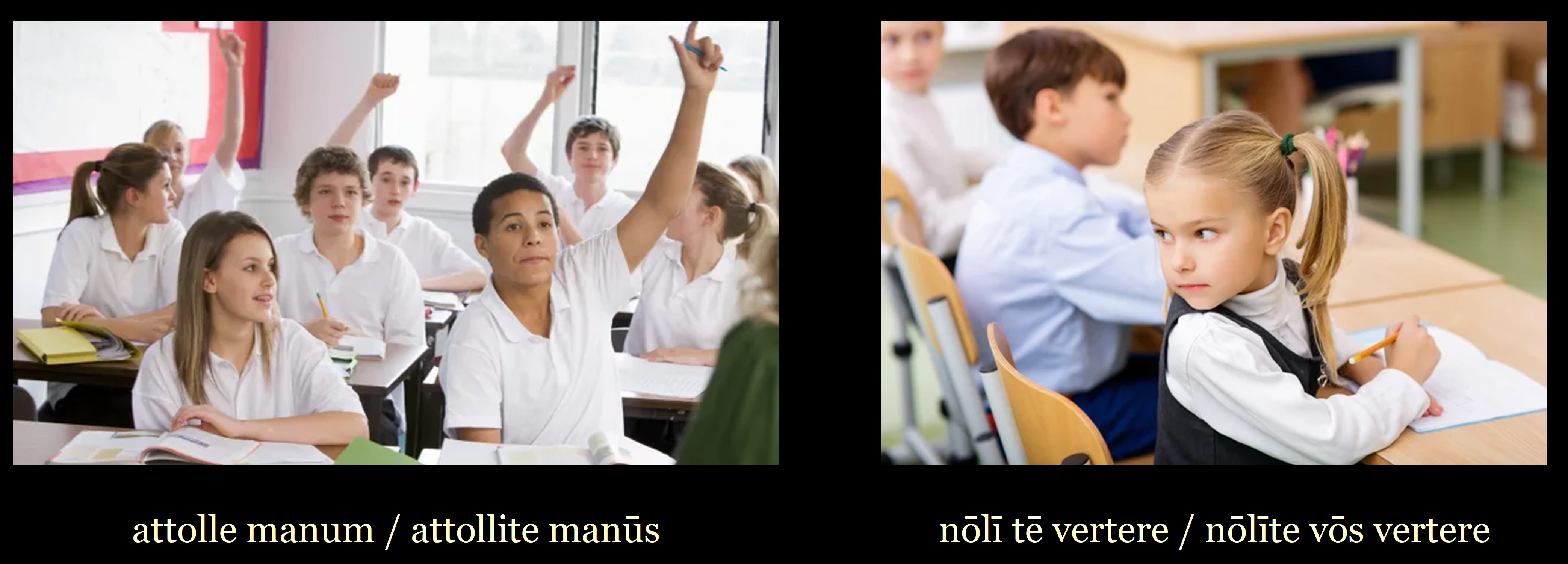
vertō, -ere [3]: turn > verte! vertite!; it can be used with a reflexive pronoun: verte tē: turn (yourself) i.e. turn round or turn e.g. in a particular direction; vertite vōs!

convertō, -ere [3] > converte! convertite!; the verb can refer to turning something upside down or inverting something but it also can mean ‘translate’ i.e. ‘convert’ a word in one language into another

  • converte hanc sententiam ex Latīnō in Anglicum │ translate this sentence from Latin into English

accēdō, -ere [3]: approach > accēde! accēdite!

attollō, -ere [3]: raise; lift up > attolle manum! │ raise (your) hand; attollite manūs! │ raise (your) hands

claudō, -ere [3]: close > claude! claudite!

repetō, -ere [3]: repeat > repete! repetite!

reddō, -ere [3]: [i] give back and, by extension [ii] repeat i.e. give back words (that have been said)

  • eīsdem verbīs mihi redde │ literally: give back to me with the same words i.e. repeat the words

dēsinō, -ere [3]: stop > dēsine! dēsinite! (and what you need to stop doing is expressed by the infinitive):

  • dēsine / dēsinite scrībere! │ stop writing
  • dēsine mē vexāre! │ stop annoying me

Note:

The only verb that behaves differently from all the verbs covered in this and the previous post is:

loquī (to speak) which, of course, is an important verb in a classroom context

loquī is a deponent verb, a group of verbs that conjugate differently from all other verbs and will be discussed in a later post

  • loquere! (talking to one person); loquiminī! (talking to more than one person) │ speak!
  • Nōlī(te) loquī! │ Don’t speak!


26.01.25: level 1; topic; school [29]; classroom instructions [2]

What is the Latin for each of these instructions?

26.01.25: level 1; topic; school [28]; classroom instructions [1]

When giving instructions, you use the imperative (command) form of the verb; the use of the exclamation mark – which did not exist in Classical Latin – is simply a marker for a command; it does not imply a raised voice

first conjugation verbs: -ā / -āte

auscultō, auscultāre [1]: listen > auscultā! (talking to one person) auscultāte! (talking to more than one person)

indicō, indicāre [1]: point out > indicā! indicāte!

intrō, intrāre [1]: enter > intrā! intrāte!

recitō, recitāre [1]: recite > recitā! recitāte!

  • recitā(te) carmen / versūs! │ recite the song (poem) / verses

second conjugation verbs: -ē / -ēte

respondeō, respondēre [2]: answer > respondē! respondēte!

  • respondē(te) mihi / … ad meum interrogātum │ answer me (reply to me) / … to my question

sedeō, sedēre [2]: sit > sedē! sedēte!

taceō, tacēre [2]: be quiet > tacē! tacēte!

fourth conjugation verbs: -ī / -īte  (we’ll do the third conjugation in the next post because there are a lot of 3rd conjugation verbs that apply to classroom instructions)

aperiō, aperīre [4]: open > aperī! aperīte!

audiō, audīre [4]: listen > audī! audīte!

  • audī(te) dīligenter │ listen carefully

veniō, venīre [4]: come > venī! venīte!

____________________

Nōlī (to one person) / nōlīte (to more than one person) + the infintive: don’t (do something)

rogō, rogāre [1]: ask > rogā! rogāte! (ask!) > nōlī(te) (mē) rogāre! │ don’t ask (me)

aperīte librōs vestrōs │ open your books

nōlīte aperīre librōs vestrōs │ don’t open your books


Friday, October 25, 2024

24.01.25: level 1; topic; school [27]; the sky [2]; sun, moon, light and darkness

[1] Dē sōle

Lūmen magnum in caelō vidēmus. Id lūmen candidum est. Id sōl vocātur. Sōl nōn plānus vidētur. Is globōsus vidētur. Sōl nātūrā rotundus est. Is quoque globus vocātur. Sōl parvus vidētur. Magnus autem est. Sphaera magna est. Terra et sōl globī magnī sunt.

[2] Dē lūnā

Aliud lūmen in caelō videō. Id lūmen quoque magnum est. Id nōn candidum est. Suāve est. Id lūmen lūna dīcitur. Lūna nōn plāna vidētur. Ea globōsa vidētur. Lūna rotunda est. Ea quoque globus dīcitur. Lūna magna est. Ea globus est magnus. Terra et lūna magnae sunt. Eae globī magnī sunt.

[3] Dē lūce et tenebrīs

Lūx diēs dīcitur. Nox tenebrae vocātur. Tellūs nōn lūcida est. Ea obscūra est. Lūcem ab sōle accipit. Lūcem quoque ā lūnā accipit. Sōl interdiū terrae lūmen dat. Lūna noctū lūmen dat. Is interdiū,  ea noctū terram illūminat. Lūmen sōlis candidum et ārdēns est. Lūmen lūnae suāve est.

[a] Find the Latin:

[i] Nominative

  • The light is called day
  • It is also called the globe
  • They are large spheres

[ii] Genitive

  • The light of the sun
  • The light of the moon

[iii] Dative

  • The sun gives light to the earth

[iv] Accusative

  • The sun gives light to the earth

[v] Ablative

  • about / concering the light
  • about / concering the sun
  • about / concering the moon
  • It receives light from the sun
  • It receives light from the moon

[b] Review 1st / 2nd declension adjective endings; a common error when starting Latin is seeing some connection between 1st / 2nd declension adjectives and 1st / 2nd declension nouns because they share the same endings – but that is where the comparison stops. 1st / 2nd declension adjectives are used with nouns of any declension. Below some nouns from the text are in two groups i.e. 1st / 2nd declension nouns and 3rd declension nouns. Complete each phrase by using the adjectives listed at the very end of the exercise. Each adjective can only be used once.

[i] 1st / 2nd declension nouns

  • a large globe │ globus __________
  • a round moon │ lūna __________
  • a spherical moon │ lūna __________
  • a large moon │ lūna __________
  • large spheres │ globī __________
  • the Earth and Moon are large │ terra et lūna __________ sunt

[ii] 1st / 2nd declension nouns

sōl, -is [3/m]: sun

tellūs, tellūris [3/f]: earth; the Earth

lūmen, lūminis [3/n]: light

  • a round sun │ sōl __________
  • the dark Earth │tellūs __________
  • the Earth is not bright │ tellūs nōn __________ est
  • a large light │ lūmen __________
  • a bright white light │ lūmen __________

candidum; globōsa; lūcida; magna; magnae; magnī; magnum; magnus; obscūra; rotunda; rotundus

Notes

is, ea, id; plural: eī, eae, ea

There have already been many posts concerning these words and so below is simply a summary:

These words can have two uses:

[i] as pronouns i.e. he / she / it / they

[ii] demonstratives i.e. this / that / these / those

Latin uses these to refer to someone / something previously mentioned i.e. as in English:

“Have you met the new boss?” > “Yes, I’ve met him.”

is, ea and id agree in gender with the noun they are referring to e.g. is can mean ‘he’ or ‘it’ depending on whether the noun is animate (referring to a living being) or inanimate (referring to an object)

  • Sōl [masculine] nōn plānus vidētur. Is globōsus vidētur. The Sun does look seem flat. It looks spherical.
  • Lūna [feminine] nōn plāna vidētur. Ea globōsa vidētur. │ The moon does not look flat. It looks spherical.
  • Tellūs [feminine] nōn lūcida est. Ea obscūra est. │ The Earth is not bright. It is dark.
  • Lūmen [neuter] magnum in caelō vidēmus. Id lūmen candidum est. Id sōl vocātur. │ We see a large light in the sky. That light is shining white. It is called the Sun.

Latin does not need to use these if it is clear who / what is being referred to. Look at the last sentence of this extract.

  • Aliud lūmen in caelō videō. Id lūmen quoque magnum est. Id nōn candidum est. Suāve est│ I see another light in the sky. That light is also large. It isn’t shining bright. It’s agreeable / pleasant, i.e. the last sentence omits id with no change in meaning.

Two examples from the text show other forms of these words:

  • Terra et lūna magnae sunt. Eae globī magnī sunt. │ The earth and the moon are big. They / these are large spheres.
  • Sōl interdiū terrae lūmen dat. Lūna noctū lūmen dat. │ During the say the Sun gives light to the Earth. The Moon gives light to it at night.

The full declension table is given below:

It is better to become familiar with these as you come across them when reading; two, however, to note straight away are: [i]  eius (his / her / its) and [ii] eōrum / eārum (their) i.e. they function as possessive adjectives.

All previous posts on is, ea, id:

https://drive.google.com/file/d/1LsKpv7nwA3-rwgzn88bzoOGgPMV8Kqj-/view?usp=sharing

Latin tutorial:

https://www.youtube.com/watch?v=74R9hHFr0JI


22.01.25: level 1; topic; school [26]; the sky [1]

Complete the Comenius text with the words listed below

Caelum, │ The Heaven,

rotātur, & │ is wheeled about, and

ambit [1] __________, │ encompasseth the Earth,

stantem in [2] __________. │ standing in the middle.

[3] __________, │ The Sun,

ubi ubi* est, │ wheresoever it is,

fulget [4] __________, │ shineth perpetually,

ut ut dēnsa [5] __________,│ howsoever dark Clouds,

ēripiant eum ā [6] __________; │ may take it from us;

facitque suīs [7] __________, │ and causeth by his Rays,

Lūcem, Lūx [8] __________. │ Light, and the Light, Day.

Ex oppositō, │ On the other sīde, over against it,

sunt Tenebræ, │ is Darkness, 

inde [9] __________ │ and thence Night.

[10] __________ │ In the Night

splendet [11] __________, │ shineth the Moon,

& [12] __________, │ and the Stars,

micant, [13] __________. │ glister and twinkle.

[14] __________, │ In the Evening,

est Crepusculum: │ is Twilight:

[15] __________ │ In the Morning,

[16] __________, │ the breaking,

& Dīlūculum. │ and dawning of the Day.

* ubi ubi: wherever; colloquial rather than standard Classical Latin; ‘wherever’ is normally expressed by ubicumque

aurōra; diem; lūna; māne; mediō; nōbīs; nocte; nox; nūbila; perpetuō; radiīs; scintillant; sōl; stēllæ; terram; vesperī

Notes

[1] tenebrae, -ārum [1/f/pl]: although referring to a singular idea in English (darkness) the Latin noun is plural

[2] a further example of the passive voice:

Caelum rotātur │ the sky is turned around (rotated)

[3]

lūx, lūcis [3/f]: light; the third declension noun is used in two cases in the same sentence; endings are added to the stem of the genitive case i.e. lūx, lūis > lūc-

Sōl …facit … lūcem [accusative] (et) lūx [nominative] (facit) diem │ the Sun makes light and the light makes day

nox, noctis [3/f] night; again, the ending is added to the stem of the genitive case i.e. nox, noct¦is > noct-

ablative: nocte │ in the night; at night

[3] Sōl .. facit suīs radiīs lūcem │ the Sun creates light by means of its rays

Latin uses the ablative case to state by what means something is done.


20.01.25: level 1; topic; school [25]; the world [2]

In tellūre habitāmus. Tellūs plāna vidētur. Ea autem nōn plāna est. Nātūrā rotunda est. Nōs tellūrem globum vocāmus. Globus et sphaera vocātur. Tellūs magna est. Ea globus magnus est. Tellūs et terra vocātur.

Notes:

[1] tellūs, tellūris [3/f]: the Earth; world; remember that 3rd declension nouns, as soon as an ending is added, will add that ending to the stem of the noun which comes from the genitive case which is why 3rd declension nouns are always listed both with their nominative and genitive singular:

nominative singular: tellūs

> genitive singular: tellūr¦is

> tellūr- [stem; all endings are added to this]

nōs tellūrem globum vocāmus │ we call the Earth the globe

in tellūre habitāmus │ we live on Earth

[2] The little text contains an important feature of Latin known as the passive voice:

Globus et sphaera vocātur │ A globe is also called a sphere

Tellūs plāna vidētur │ The Earth seems [= is seen] flat

[3] Nātūrā [ablative] rotunda est │ It is round by nature [= naturally round]