Showing posts with label interrogatives. Show all posts

Tuesday, May 13, 2025

18.08.25: Level 3; review; direct questions [8]; translation practice [i]

In this exercise, note [a] interrogative pronouns, and [b] interrogative adjectives being compared:

[1]

[a] Quis hoc scrīpsit?

[b] Quī poēta hoc scrīpsit?

[2]

[a] Quis in culīnā labōrat?

[b] Quae serva in culīnā labōrat?

[3]

[a] Quis in hortō labōrat?

[b] Quī servus in hortō labōrat?

[4]

[a] Quid accidit?

[b] Quod oppidum oppugnātur?

[5]

[a] Quid scrīpsit?

[b] Quod carmen scrīpsit?

[6]

[a] Quem amās?

[b] Quam fēminam amās?

[c] Quem librum tibi dedit?

[7]

[a] Quōcum labōrās?

[b] Cum quō mīlite vēnistī?

15.08.25: Level 3; review; direct questions [7]; interrogative adjectives [ii]

Apart from quī, quae and quod, there are other interrogative adjectives to note:

[1] quot?: how many?; quot is indeclinable

Quot erās annōs gnātus*, quom [ = cum] tē pater ā patriā āvehit? (Plautus) │ How many years old were you when your father took you from your native country?

* archaic: nātus

Quot sunt satis? (Plautus) │ How many are sufficient?

Quotiēns et quot nōminibus ā Syrācūsānīs statuās auferēs? (Cicero) │ How often and for how many individuals will you take statues from the Syracusans?

[2] quotus, -a, -um? is a 1st / 2nd declension adjective. It is unusual as it has no specific equivalent in English. The question asks which or what number when referring to a numerical sequence. In English we convey this in different ways, for example:

Which US president was Ronald Reagan? He was the fortieth president.

Similary, we may say “Where did he come in the race?” “He finished third.”

In Latin, it is quotus which expresses this idea:

Quotus imperātor Nerō fuit? Quīntus. │ Which emperor was Nero [i.e. was he the first, second etc.]? The fifth.

The word is used when asking the time since clock time is expressed in Latin using ordinal numbers:

Quota hōra est? Tertia. │ Which hour is it? The third.

Quotā hōrā? │ At what time?

[3] quantus, -a, -um?: how big / large?

Quantus est exercitus Caesaris? │ How large is Caesar’s army?

Quantī eam emit? (Plautus) │ For how much did he buy her?

[4] Both quot and quantus can be used as exclamations:

Quot quantāsque virtūtēs ... collēgit et miscuit! (Pliny the Elder) │ How many and how great virtues he acquired and mixed!

[5] quālis, -e?: what kind / sort of?; a 3rd declension adjective:

Quālis est tibi liber? │ What sort of book do you have?

Quālēs sunt eī librī? │ What sort of books does he have?

[6] uter, utra, utrum?: Which (of two)?

This interrogative adjective was discussed in detail here together with many examples and exercises.

https://adckl.blogspot.com/2025/04/250725-level-3-pronominal-adjectives-6.html

https://www.facebook.com/groups/latinforstarters/posts/907899478487988

Uter igitur est divitior? (Cicero) │ Which (of the two) is wealthier?

Utra lex antiquior? (Quintilianus) │ Which law (of the two laws) (is)

Utrum librum vīs? │ Which book [i.e. which of the two books] do you want?

Translation practice:

  1. Cum quālibus comitibus iter faciēs?
  2. Hoc mihi dēdit, sed ... post quot labōrēs?
  3. Immō vērō quantus exercitus!
  4. Quālī virō Cloēlia nūbet?
  5. Quot annōs nātus / nāta es?
  6. Quālēs amīcōs habēs?
  7. Uter est pēs dextra?
  8. Quālia sunt haec dōna?
  9. Quot oppida in Syriā, quot in Macedoniā dēvorāta sunt!
  10. Quālis homō es?
  11. Utra est manus sinistra?
  12. Quot estis?
  13. Quot librōs scrīpsit?
  14. Utrī potentiōrēs sunt? Rōmānī aut Carthāginiēnsēs?
  15. Quot mīlitēs pugnāvērunt?
  16. Quot ovēs sunt in agrīs?
15.08.25: Level 3; review; direct questions [6]; interrogative adjectives [i]

The interrogative adjective translates as which? what? what kind of?

In general, adjectives have the function of narrowing the field of reference, for example:

I really like that car? > Which car? > The blue one.

Therefore, interrogative adjectives refer to known nouns but ask to specify which noun:

Which car did you buy? What kind of music do you like?

There is very little distinction between the interrogative adjectives and the interrogative pronouns in the previous post except that:

[i] the interrogative adjective has all three genders in the singular which is logical because the adjective has to be able to agree with nouns of all three genders.

[ii] the neuter singular (nominative and accusative) is quod and not quid.

In the plural, the interrogative adjectives and pronouns are identical.


NOMINATIVE

Quī vir mē vocat? │ Which / what kind of man is calling me?

Quae bella gerunt? │ What sort of wars do they wage?

GENITIVE

Cuius fēminae domus est? │ Literally: Of which woman is the house? [ = Which woman does the house belong to?]

Dē factīs quōrum hominum fābulam nārrās? │ Which / whose men’s deeds [ = the deeds of which men] are you telling a story about?

DATIVE

Cui puerō / puellae dōnum dedistī? │ To which boy / girl did you give a gift?

Quibus magistrīs librum lēgit? │ To which teachers did s/he read a book?

ACCUSATIVE

Quod oppidum vidēs? │ What town do you see?

Quōs mīlitēs vocat rēx? │ Which / what soldiers is the king calling?

ABLATIVE

  1. In quō locō urbs erit? │ In what place will the city be?
  2. Dē quibus librīs loqueris? │ What / which books are you talking about?
  3. Translation practice:
  4. Quī homō vocat?
  5. Quem virum amās?
  6. Quod templum vidēs
  7. Quōs librōs lēgistī?
  8. In quibus oppidīs vīxistis?
  9. Quod animal in agrō erat?
  10. Cum quā fēmina ambulābat?
  11. Quibus tēlīs cōpiae nostrae eguērunt?
  12. Quae prōvinciae ā Rōmānīs occupātae sunt?
  13. Cuius scūtum habēs?
  14. Quibus virīs deī favēbunt?
  15. Quī virī castra pōnunt?

15.08.25: Level 3; review; direct questions [5]; interrogative pronouns

Interrogative pronouns ask the question ‘who?’ or ‘what?’ They refer to a person or thing previously unknown:

Who did that?; What did you say?

Image: declension of quis / quid (who? what?); note that, in the singular, there is no distinction between masculine and feminine i.e. quis? (who?) and quem (whom?) are always masculine by default in Classical Latin, although the answer to the question could be a woman.

NOMINATIVE

Quis mē vocāvit?│ Who called me?

Quis es? │ Who are you?

Quid tibi est? │ What do you have? [also: What is wrong with you?]

Quī sunt cōnsulēs hōc annō? │ Who are the consuls this year?

GENITIVE

Cuius est hic liber? │ Whose book is this? [literally: of whom is this book?]

Quōrum nōmina in librō scrīpsit? │ Whose (plural) names [literally: the names of whom] did he write in the book?

Quārum (plural; feminine) statuās Marcella ōrnat? │ Whose statues does Marcella decorate?

> Marcella statuās deārum ōrnat │ Marcella decorates the statues of the goddesses.

DATIVE

Cui vēritātem dīxit? │ To whom (singular) did he speak the truth?

Cui pecūniam dedistī? │ To whom (singular) did you give the money [ = Who did you give the money to?]

Quibus pecūniam mīsistī? │ To whom (plural) did you send the money?

ACCUSATIVE

Quem in hortō cēpērunt? │ Whom did they capture in the garden?

Quid in hortō invēnērunt? │ What did they find in the garden?

Quās iuvātis? │ Whom (feminine plural) are you (plural) helping?

ABLATIVE

Dē quō loquiminī? │ What are you (plural) talking about?

Ā quibus urbs est capta? │ By whom (plural) was the city captured?

Quōcum poēta ambulat? │ With whom is the poet walking? [ = Who is the poet walking with?]


Translation practice:

  1. Quis hoc fēcit?
  2. Ā quō amārīs?
  3. Quem vīdistī?
  4. Cui librum dedistī?
  5. Quis illud dīxit?
  6. Quid agis?
  7. Quid dīxit?
  8. Quae dīxit rēx?
  9. Quid tē terret?
  10. Cuius est haec taberna?
  11. Quō interfectus est Caesar?
  12. Quibus dux auxilium dedit?
  13. Ā quibus porta sinistra tenēbātur?
  14. Quibuscum Germānī bellum gerēbant?
  15. Cui lēgātus suum scūtum dabit?

Saturday, May 10, 2025

12.08.25: Level 3; review; direct questions [4]; interrogative adverbs

https://adckl.blogspot.com/2024/08/180924-adverbs-71-interrogative-adverbs.html

https://www.facebook.com/groups/latinforstarters/posts/525365950074678

https://adckl.blogspot.com/2024/08/180924-adverbs-72-interrogative-adverbs.html

https://www.facebook.com/groups/latinforstarters/posts/525367313407875

We will begin with the interrogative adverbs since they are indeclinable because they do not refer to nouns or pronouns, but to actions:


Ubi habitās? │ Where do you live?

Quō iērunt mīlitēs nostrī? │To where did our soldiers go? [ = Where did our soldiers go to?]

Unde vēnistis? │From where have you come? [ = Where have you come from?]

Quandō adveniet pater tuus? │When will your uncle arrive?

Cūr hoc fēcistī? │ Why have you done this?

Quārē hoc dīxit? │ Why did he say this?

Hoc tū quam ob rem (or: quamobrem) nōn fēcistī? │For what reason / why have you not done this?

Quōmodo (or: quō modo) hoc accidere potest? │How can this happen?

Quamdiū? (quam diū?):  How long ago?; For how long?

Quamdiū id factum est? (Plautus) │ How long since did that happen?

Quamdiū manēbit hic mundus, quī in malignō positus est? │ For how long will this world remain, which has been placed in the power of evil?

Quī respondēns eīs, dīxit: Ō generātiō incrēdula, quamdiū apud vōs erō? quamdiū vōs patiar? (Vugate) │ And, replying to them, he said: “You unbelieving generation how long shall I stay with you? How long shall I put up with you?”

Quam diū prō Gereōnī, castellī Āpūliae inopis, tanquam prō Carthāginis moenibus sedet? (Livy) │  How long has he been sitting before the walls of Gereonium, a poor fortress in Apulia, as though they were the walls of Carthage? 

quotiēns?: How often?;  How many times? 

Quotiēns lucerna impiōrum extinguētur? (Vulgate) │ How often is the lamp of the wicked put out? 

Quotiēns tandem ēdīxī tibi, ut cavērēs? (Plautus) │How often, I wonder, have I told you to be cautious?

Ō quotiēns et quae nōbīs Galatēa locūta est! (Vergil) │ O how often and what things Galatea has said to me!

Note in the last example the exclamatory use of the adverb i.e. rather than as a question.


Translation practice:

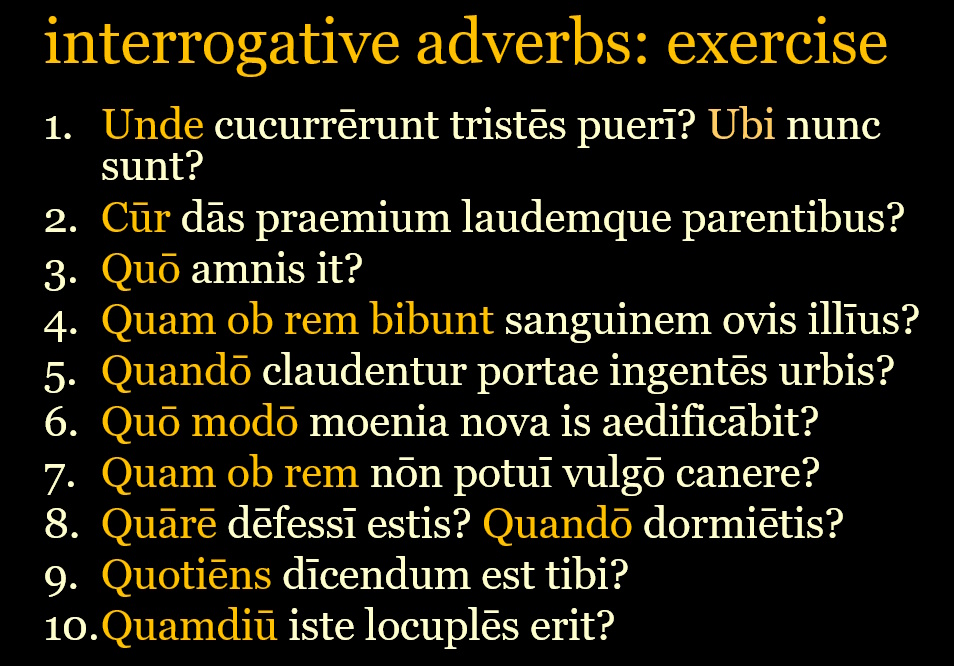
  1. Unde cucurrērunt tristēs puerī? Ubi nunc sunt?
  2. Cūr dās praemium laudemque parentibus?
  3. Quō amnis it?
  4. Quam ob rem bibunt sanguinem ovis illīus?
  5. Quandō claudentur portae ingentēs urbis?
  6. Quō modō moenia nova is aedificābit?
  7. Quam ob rem nōn potuī vulgō canere?
  8. Quārē dēfessī estis? Quandō dormiētis?
  9. Quotiēns dīcendum est tibi?
  10. Quamdiū iste locuplēs erit?

12.08.25: Level 3; review; direct questions [3]; types of interrogative words

Interrogatives are words which ask content questions i.e. which require a specific piece of information. They can be subdivided into three categories:

[1] Interrogative adjectives modify a noun. They ask a question about people or things, but seek specification as to which of two or more are being referred to.

Which book are you reading? [i.e. books have already been mentioned and the speaker wants a book to be specified]

Whose bag is that?

What kind of music do you like?

Which players were chosen for the team?

[2] Interrogative pronouns are used to form questions about people or things which are generally unknown i.e. there is no antecedent.

Who are you going with?

Whose is that?

What are you doing?

[3] Interrogative adverbs ask a question about an action, not a person or thing.

Why did you do that?

Where did you go?

How can we get there?


Friday, August 9, 2024

18.09.24: adverbs [7](2); interrogative adverbs (2)

Complete the translations with the appropriate adverbs.

  1. Ō rūs, quandō ego tē aspiciam? │ Oh, countryside, __________ shall I look at you?
  2. Quōmodo id cognōscis? │ __________ can you tell?
  3. Unde contrāxistī morbum? │ __________ did you contract the disease?
  4. Ubi terrārum est? │ __________ on earth is he?
  5. Quid gladiō pugnās incurvō? │ __________ do you fight with a bent sword?
  6. Ubi inveniam Pamphilium? Ubi quaeram? │ __________ can I find Pamphilus? __________ should I look?
  7. Cūr in terrā iacēs? │ __________ are you lying on the ground?
  8. Num dubium est? │ There’s no doubt, __________?
  9. Unde vēnistī? │ __________ have you come __________?
  10. Quārē facis sīc servīs tuīs? │ __________ do you deal with your servants in this way?
  11. Quō abiērunt frātrēs tuī? │ __________ have your brothers gone __________?
  12. Quotiēns haec verba dīcam? │ __________ shall I say these words?

18.09.24: adverbs [7](1); interrogative adverbs (1)

Interrogative adverbs seek information about where, why, when or how an action was performed. Some examples are listed below but there are others.

[1] cūr: why?

[2] quārē: by what means?; how?; why?

[3] quid as an interrogative pronoun means ‘what?’:

Quid dīxistī? │ What did you say?

Quid, as an interrogative adverb, means ‘why; what for?’

[4] num; nōnne

num was already discussed in an earlier unit. It is used in a direct question, expecting the answer ‘no’:

Num Sparta īnsula est? Sparta’s not an island, is it?│Surely Sparta’s not an island?

nōnne is also used in a direct question, but expects a 'yes' answer:

Nōnne intellegis? │ You understand, don't you? / Surely you understand?

[5] quandō: when?

[6] quō: to where? [arch. whither?]

[7] quōmodo: how?; in what way?

[8] ubi: where?

[9] unde: from where? [arch. whence?]