https://www.nle.org/Exams/Previous-Exams-Answer-Keys
I can't recommend these highly enough. The National Latin Exam, which is US based, produces multi-choice question papers for all levels and they post the answer keys. I just uploaded the introductory one for 2012 and I'll post more. I used these to test my own knowledge. In the end I only used these. I had a look through it. All the language in it has been covered so far. These papers include some historical / mythological questions but the emphasis is on the knowledge of the language. All the papers are free to download and I've given the link. But if you're new to Latin, then I would just focus on the intro papers. Have a go and see how you do!


Almost every 3rd declension noun in this text has been
covered in earlier posts. They are listed for reference. Read the text for
understanding – the translation is in the comments – and focus on the nouns in
bold, work out what cases they are in, and why they are in those cases.
DĒ PRĪNCIPIBUS RŌMĀNĪS
[Chesnutt: the Road to Latin (1933)]
In prīncipiō Rōma ā rēgibus regēbātur. Prīmus rēx erat
Rōmulus. Frāter Rōmulī erat Remus. Rōmulus et Remus erant geminī. Pater
Rōmulī et frātris Remī deus Mārs, māter Rhēa Silvia erat. Rōmae
erant statuae patris Mārtis et mātris Rhēae Silviae et frātrum.
Rōmulus erat rēx bonus et ā Rōmānīs laudābātur. Erant septem rēgēs
Rōmānī. Posteā erant cōnsulēs. Cōnsul Rōmānus ā populō Rōmānō
dēligēbātur. Imperium cōnsulis erat maximum. Duō cōnsulēs quotannīs
dēligēbantur et cīvitātem regēbant. Posteā imperātōrēs Rōmam
regēbant. Imperātor clārus erat Augustus Caesar. Rōmae erat magna
statua imperātōris Augustī Caesaris.
Vocabulary
[i] 3rd declension nouns
Caesar, -is [3/m]: Caesar
cīvitās, cīvitātis [3/f]: state; this is a word that can
cause a bit of head-scratching since it has a variety of meanings dependent
upon context e.g. a city and its surrounding territory, a city state, a
kingdom, tribe.
cōnsul, -is [3/m]: consul
frāter, frātris [3/m]: brother
imperātor, imperātōris [3/m]: (here) emperor, but it has
other meanings e.g. commander; commander-in-chief; ruler; the title could be
given to conferred on a military leader who had won his first great victory.
That could be as a result of his own soldiers greeting him that way, or it was
decreed by the Senate. You could not use the term “emperor” as we understand it
in Republican Rome, because they didn’t have emperors.
Mārs, Mārtis [3/m]: Mars (god)
māter, mātris [3/f]: mother
pater, patris [3/m]: father
prīnceps, prīncipis [3/m]: chief; leader
rēx, rēgis [3/m]: king
[ii] other words
clārus, -a, -um:
dēligō, dēligere [3]: choose
geminus, -ī [2/m]: twin
maximus, -a, um: greatest; very great
prīncipium, -ī [2/n]: beginning
quotannīs: yearly; every year
regō, regere [3]: rule
Notes
[1] Rōmae [locative] erant statuae … In Rome
there were statues …
[2] Passive voice: introduction
What you see here is called in grammar the passive
voice (or you can just say passive).
A sentence – both in English and Latin – can be [i] active or
[ii] passive.
[i] Active: the subject of the sentence is performing the
action.
The teacher punishes the pupil.
[ii] Passive: the subject of the sentence is not performing
the action but the action is being done to the subject.
The pupil is punished ¦ by the teacher.
The passive in Latin involves some work – but in stages. The
first point to consider is that, when you’re reading the authors, very often
they are talking about other people i.e. the 3rd person e.g. he is praised by
the king, they were elected by the people. To create those particular forms,
all you do is add -ur to the the 3rd person singular or plural of the verb.
laudat: he praises
> laudātur: he is praised; /long ā/: a
small point because written Latin did not use the macron sign, but, if you’re
aiming for spot-on pronunciation, then it’s quite strongly said: lau-DA-tur
laudant: they praise
> laudantur: they are praised
castīgābat: he was punishing
> castīgābātur: he was being punished /long
ā/
regēbant: they used to rule; they were ruling
> regēbantur: they used to be ruled
Magister [nominative: subject of the sentence] discipulum [accusative:
direct object] castīgat. The teacher punishes the student.
> Discipulus [now the subject of the
sentence: nominative] ¦ ā magistrō [ablative] ¦
castīgātur. The student is (being) punished ¦ by the
teacher.
“by the teacher” is known in grammar as the passive
agent i.e. the person by whom something is done; in
Latin, when you say something is being done by a person, you
use ā + ablative.
Rōmānī Rōmulum laudābant. The Romans used to praise Romulus.
> Rōmulus ¦ ā Rōmānīs ¦
laudābātur. Romulus was praised ¦ by the Romans.
That -ur ending stands out from the crowd and
marks a passive. Of course, other parts of the verb have a passive too which
form in a slightly different way, but, for now, this opens the door to the
passive.
A small quiz question: in the text Romulus is described as
being a good king and praised by the people. But no further mention is made of
Remus. Why is that?
____________________
In the beginning Rome was governed by kings. The first king
was Romulus. The brother of Romulus was Remus. Romulus and Remus were twins.
The father of Romulus and (his) brother Remus was the god Mars, the mother Rhea
Silvia. In Rome were the statues of the father Mars and the mother Rhea Silvia
and the brothers. Romulus was a good king and was praised by the Romans. There
were seven Roman kings. After that were the consuls. The Roman consul was
elected by the Roman people. The consul’s political authority was the greatest.
Two consuls were elected every year and governed the city. Afterwards emperors
ruled Rome. Augustus Caesar was a famous emperor. In Rome there was a great
statue of the emperor Augustus Caesar.
____________________


I wanted to show a couple of 3rd declension nouns
“operating” in a particular construction which you will come across often.
IS DIĒS ERAT [I] A. D. V. ¦ [II] KAL. APR. ¦ [III] L.
PĪSŌNE, A. GABĪNIŌ CŌNSULIBUS. (Caesar)
This day was [i] the fifth day before ¦ [ii] the first of
April ¦ [iii] when L. Piso and A. Gabinius were consuls.
This matters if you’re planning to read the authors because
it shows you part of the Roman system of dates: only part of it!
cōnsul, -is: 3rd declension. The consul was the
highest political authority in the Roman republic. Two consuls were elected
each year and it is common to find in the literature not a year, but reference
to when two particular consuls were in charge. Presumably everyone who was
anyone in Rome knew what year was being referred to.
In this case the consuls were L(ucius) Piso and A(ulus)
Gabinius.
Pīsō, Pīsōnis: Piso, a third declension proper noun
Gabīnius, -ī: Gabinius, a second declension proper noun
Latin has a special use of the ablative which we’ll cover
later but, for the purposes of understanding this construction, take a look at
what’s happening in this statement.
L. Pīsōne, A. Gabīniō cōnsulibus:
I’ll translate it as “When Piso and Gabinius were the consuls”; it doesn’t mean
precisely that but it is fine for the moment. The entire phrase is in the
ablative and you can see the ablative plural in cōnsulibus.
For the sake of completeness:
Kal. is an abbreviation of kalendae: the
first day of any month
Kal. Apr. = kalendae Aprilis: the first of April
Caesar writes: a. d. V. = ante (before)
diem (the day) V = five days before the first of April
So you need to count five days backwards and include
the first of April:
[5] April 1st
[4] March 31st
[3] March 30th
[2] March 29th
> [1] March 28th
Caesar doesn’t actually state the year. He assumes you know: but I looked it up! It was 58BCE.
[1] Ominous words from Pliny:
nubēs, nubis [3/f]: cloud
mōns, montis [3/m]: mountain
Nūbēs [nominative] - incertum procul
intuentibus ex quō monte [ablative]; Vesuvium
fuisse posteā cognitum est - oriēbātur, (Pliny 6.16)
The cloud was rising - at such a distance we
couldn't tell from which mountain - but
afterwards learned that it was Vesuvius.
[The images show an original Roman fresco of Vesuvius and an
illustration of the eruption in 1631]
[2] From the Venerable Bede: it’s a very good example of
seeing these 3rd declension nouns in one sentence.
hostis, -is [3/m]: enemy; this noun occurs all
the time in the literature since there are so many descriptions of battles and
is usually in the plural hostēs.
rēx, rēgis [3/m]: king
Sed tantā vī hostis [nominative] ferrum
īnfīxit, ut ¦ per corpus [accusative] ¦ mīlitis occīsī
[genitive] ¦ etiam ¦ rēgem [accusative] ¦ vulnerāret.
But the enemy thrust the sword with such
force, that ¦ through the body ¦ of the
slain soldier ¦ he also wounded the king.
[3] And if you’ve read all the sentences about those 1949
schoolboys kicking and punching each other…
… they stop fighting, and to make up:


[5] Ablative: this case has many different uses; some
uses have already been covered in earlier posts but I’ll recap these briefly
here.
[i] Almost all nouns in the ablative singular end in -e,
there are some that end in -ī and some where you may see either -e
or -ī.
[ii] the ablative plural is -ibus for all
genders i.e. the same ending as the dative plural
(a) One of the uses of the ablative is to specify a
particular point or period in time, and that one gives you a easy way of
remembering the ablative singular.
3 out of the 4 seasons are third declension nouns:
vēr, vēris [3/n]: spring
aestās, aestātis [3/f]: summer
hiems, hiemis [3/f]: winter
And we can take that a bit further:
vesper, vesperis [3/]: evening > vespere: in
the evening
nox, noctis [3/f]: night > nocte: at night;
you will also come across noctū but that’s an adverb not a
noun
(b) The ablative is used to express by what
means something is done:
pēs, pedis [3/m]: foot
Sextus caput [accusatīve] Mārcī ¦ pede [ablatīve] calcat. │ Marcus
tramples on Marcus’ head ¦ with (his) foot.
venter, ventris [3/m]: stomach
Mārcus ventrem [accusative] Sextī ¦ pedibus [ablative
plural] ¦ calcat. │ Marcus treads on ¦ Sextus’ stomach ¦ with his feet.
mare, maris [3/n]: sea; this is one where the
ablative might end in -e or -ī
marī terrāque │ by sea and by land
(c) The ablative is used with certain prepositions e.g.
in (in / on); ē/ex (out of); dē (down) from, about (concerning); cum
([together] with)
Ubi est rēx tuus? maximē nunc salvet tē in omnibus urbibus
tuīs (Vulgate) │ Where is your king that he may save you in all your cities?
Sextus ex ventre labōrat. │ Sextus has a pain in his stomach
[literally: he is suffering by reason of his stomach].
Mārcus ex capite labōrat. │ Sextus has a headache
[literally: he is suffering as a cause of his stomach].
And one of Cicero’s friends has been ill:
Caeparius… dīxit tē in lectō esse, quod ex pedibus labōrārēs
(Cicero) │ Caeparius … said you were in bed because you were suffering with
your feet. [Translated also as: told me you were in bed with the gout]
A charming one from Plautus:
At tū ut oculōs ēmungāre ex capite per nāsum tuōs. (Plautus)
│ Aye, that you may blow your eyes out of your head through your nose.
lēx, lēgis [3/f]: law
Title of one of Cicero’s works: Dē Lēgibus │ on / about laws
gladiātor, gladiātoris [3/m]
Lēx scrīpta dē gladiātōribus (Cicero) │ The law (was)
written about gladiators.
eques, equitis [3/m]: cavalryman
Here’s a previous quotation but now in full:
Antōnius ¦ [i] cum equitibus [ablative] ¦ [ii] hōrā noctis [genitive] quārtā ¦ sē in castra sua ad Mutinam recēpit. (Cicero) │ At the fourth hour of the night, ¦ Antony withdrew ¦ with the cavalry ¦ to his camp at Mutina.

Now that we've covered the 3rd declension, from now on I
will post vocabulary in this format, which is the same as most dictionaries and
grammar books would do it:
It's normal, when there is no stem change, simply to show the genitive case ending and not repeat the word i.e.
When there is a stem change, however, I will show that stem change in full; not all dictionaries do that but, at this stage, it's useful to see it like that:
Noting vocabulary in this kind of "shorthand" way is standard practice: it gives you all the information you need about the noun's gender, the declension to which it belongs and what, if any stem change there is.
You can see in the image how I’ve noted the vocabulary:
PS: there are two other declensions to look at but – honestly – compared to the Everest of the 3rd declension, the other two are a walk in the park!

The world (orbis) according to Pomponius Mela, the earliest known Roman geographer c.43 CE. Below is a late 19th century reconstruction of his map.

[3] Genitive: indicates the possessor;
very often conveys the English preposition ‘of’
[i] All genders in the singular end in -is
[ii] All genders in the plural end in -um or -ium;
again, don’t be distracted at the moment as to why that happens. There is
enough to learn in the 3rd declension without going down side roads.
frāter, frātris [3/m]: brother
cūstōs, cūstōdis [3/m]: guard
It may have changed, but my own matriculation card for
university was written in Latin:
cīvis, cīvis [3/m or f]: citizen
ūniversitās, ūniversitātis [3/f]: university
nox, noctis [3/f]: night
odor, odōris [3/m]: smell; scent
flōs, flōris [3/m]: flower
infāns, infantis [3/ m or f]: infant
[4] Dative: the dative indicates the indirect
object i.e. the person or thing to whom / which something
is, for example, given or said
[i] all genders in the singular end in -ī
[ii] all genders in the plural end in -ibus
sacerdōs, sacerdōtīs [3/m or f]: priest;
priestess
urbs, urbis [3/f]: city
orbis, orbis [3/m]: world
ovis, ovis [3/f] sheep
Here are some sample sentences showing different case usage in the 3rd declension. Each section has some “schoolbook” sentences and then a couple of examples from the literature.
As always, don’t get dragged down by other aspects of the
grammar. Just look at the noun in bold and the translation. Refer back
to the tables that showed you the endings for 3rd declension nouns so
you can see where the endings come from. Case uses have been covered in earlier
posts but, if you’re not sure about cases, then ask here in the group, and I’ve
also given a brief note for those new to the group and new to Latin about what
each case does.
[1] Nominative: the subject of the
sentence; the person or thing that is performing the action
[i] Masculine, feminine and neuter singular nouns can be any
ending.
[ii] Masculine, feminine plural is -ēs
[iii] Neuter plural is -a (sometimes -ia,
but don’t be concerned by that now)
canis, canis [3/m or f] dog
Canis in viā latrat. │ The dog is barking in the street
Canēs in viā latrant. │ The dogs are barking in the street.
Canēs interdiū clausōs esse oportet... (Cato) │ Dogs should be chained up during the day, …
homō, hominis [3/m]: man
Ecce homō (Vulgate). │ Behold the man.
caput, capitis [3/n]: head
Caput mihi dolet. │ My head hurts
tempus, temporis [3/n]: time
Tempora annī sunt vēr, aestās, autumnus, hiems. │ The times [ = the seasons] of the year are spring, summer, autumn, winter.
And two very famous 3rd declensions from Cicero that leads
you into the exact same endings for the accusative plural:
mōs, mōris: manner / way of behaving; custom
Ō tempora! Ō mōrēs! │ Oh the times! Oh the customs!
One loose translation of this is: "Shame on this age
and on its lost principles!" And Cicero was saying that 2000 years ago.
[2] Accusative: the direct object of
the sentence i.e. the person or thing that is experiencing the action
[i] masculine and feminine singular ends in -em
[ii] the neuter will be exactly the same as whatever it was
in the nominative; it does not change
[iii] masculine and feminine plural is -ēs i.e.
the same as the nominative plural
[iv] neuter plural is –(i)a i.e. the same as the
nominative plural
frōns, frontis [3/f]: forehead
Mārcus frontem Sextī pulsat. │ Marcus strikes Sextus’ forehead.
Sextus frontem Marci pulsat. │ Sextus strikes Marcus’ forehead.
auris, auris [3/f]: ear
Mārcus aurēs Sextī vellit. │ Marcus tugs Sextus’ ears.
dēns, dentis [3/m]: tooth
Sextus dēntēs Mārcī excutit. │ Sextus knocks out Marcus’ teeth.
crūs, crūris [3/n]: leg
Mārcus crūs Sextī torquet. │ Marcus twists Sextus’ leg.
Sextus crūra Mārcī torquet. │ Sextus twists Marcus’ legs.
fēlēs, felis [3/f]: cat
mūs, mūris [3/m or f]: mouse
Canis fēlem terret. │ The dog frightens the cat.
Fēlēs mūrem terret. │ The cat frightens the mouse.
quī canem et fēlem ut deōs colunt (Cicero) │those who worship the dog and the cat as gods
ōdī hominem; īrātus pugnō (Lucilius) │ I hate the man; enraged I fight
From the “Boar’s Head Carol” (15th cent.):
laus, laudis [3/f]: praise
Caput aprī dēferō / Reddēns laudēs Dominō │ I bear the head of the boar rendering praises to the Lord.
mīles, militis [3/m]: soldier
Ego īre vīdī mīlitēs plēnīs viīs. (Plautus) │ I've seen the soldiers marching through the crowded streets.
ōs, ōris [3/n]: mouth
Opprime ōs! (Plautus) │ Shut your mouth!


The MGM lion told you a crucial point about the 3rd
declension, and now the dog that's been guarding the house in Pompeii for 2000
years tells you the accusative ending:
cavē canem [beware (of) the dog].
And a star sign tells you one of the plural endings for
these nouns:
piscēs


Keep it simple. Pick up a few quotations to help you remember. Practice some easy constructions.
Tacitus was quite fond of putting words into other people’s mouths. The quotation in the previous post is (supposedly) from a speech made by Calcagus, a Caledonian chief who fought against Gnaeus Agricola in northern Scotland. It’s the last line that we’ll focus on because it shows you exactly how to approach the case endings of this 3rd declension.
Where they make a desert, they call it peace.
What do they make? They make a desert = direct object =
accusative.
What do they call it? They call it peace = direct object =
accusative.
Ubi sōlitūdin¦em [accusative] faciunt pāc¦em [accusative]
appellant.
[1]
Nominative: sōlitūdō (loneliness; desert)
Genitive: sōlitūdin¦is
Now you have the stem:
sōlitūdin¦-
> Accusative: sōlitūdin¦em
[2]
Nominative: pāx (peace)
Genitive: pāc¦is
Now you have the stem:
pāc¦-
> Accusative: pāc¦em
So, to do a bit practice with this, we’ll look at some
animals.
[i] If the noun has no stem change then it’s
straightforward:
avis [nominative], av¦is
[genitive]: bird
stem av¦- no change
> av¦em habeō. I have a bird.
[ii] If, on the other hand, you have a snake…
serpēns [nominative], serpent¦is [genitive]: snake
stem serpent¦-
> serpent¦em habeō. I have a snake.
Here are some animals. Even if having a pet scorpion isn’t
your idea of fun, it’s only for practice! Just follow the rule of [i] and [ii]
above. If there’s a stem change that must be included.
1. fēles, fēlis: cat [no stem
change]
2. mūs, mūris [stem change]
3. anas, anatis: duck
4. ānser, ānseris: goose
5. apis, apis: bee
6. avis, avis: bird
7. ariēs, arietis: ram
8. bōs, bovis: ox
9. canis, canis: dog
10. leō, leōnis: līōn
11. lepus, leporis: hare
12. ovis, ovis: sheep
13. piscis, piscis: fish
14. scorpiō, scorpiōnis: scorpion
15. serpēns, serpentis: snake
16. testūdō, testūdinis: tortoise
17. tigris, tigris [also: tigridis]: tiger
18. vulpēs, vulpis: fox


Before we do a bit of practice with the case endings, the
last line of this quotation gets you started.
These plunderers of the world [the Romans], after exhausting
the land by their devastations, are rifling the ocean: stimulated by avarice,
if their enemy be rich; by ambition, if poor; unsatiated by the East and by the
West: the only people who behold wealth and indigence with equal avidity. To
ravage, to slaughter, to usurp under false titles, they call empire; and ¦
where they make a desert, they call it peace. (Tacitus: Agricola)
Ubi sōlitūdin¦em faciunt pāc¦em appellant.

Getting your head around these stem changes isn’t entirely unsystematic. So far, you’ve seen that a lot of these changes exist in English derivatives e.g. dēns, dentis: tooth; English derivative: dentist.
However, there are large groups of 3rd declension nouns
which, as soon as you see them, you can confidently know the stem ending
because they all do the same thing. Within these nouns there are many abstract
concepts, and since Roman authors often like to write in very elaborate ways,
they come up a lot.
[1] -tās > -tāt¦is
[2] -tūdō > -tūdin¦is
[3] -tiō > -tiōnis
[4] -tūs > -tūtis
virtūs: one of the toughest words to convey neatly in
English. For the Romans, virtūs was the most important human
characteristic. Wiktionary lists fourteen possible translations: good luck with
that.
[5] -tor; -sor > -tōris; -sōris
So, the only change here is to a long /ō/ but these are
useful suffixes to spot because they describe masculine agent nouns i.e.
nouns that are performing the action e.g.
[6] Latin had a female equivalents of some of these jobs and
the ending to look out for is -īx with a stem change to -īc¦is
also:

And we can go back to an earlier post to look again at the
first word we started with in the 3rd declension:
ANNŌ DECIMŌ ¦ EDWARDĪ SEPTIMĪ RĒGIS
In the tenth year ¦ of King Edward the 7th
Nominative: rēx
Genitive: rēgis

The first sight all the various stem changes seems an impossible task. That was my first reaction. However, let’s look at a lot of the ones that have appeared in the posts so far, and you will see something that certainly helped me learn these.
caput, capitis: head; English derivative: capital
punishment
corpus, corporis: body; Engl. deriv. corporal
punishment
cor, cordis: heart; Engl. deriv. cordial
crūs, crūris: leg; Engl. deriv. (anatomy) crural,
pertaining to the leg
custos, custodis: guard; Engl. deriv. custodial
sentence
dēns, dentis: tooth; Engl. deriv. dentist
dūx, dūcis: general; Engl. deriv. ducal
frāter, frātris: brother; Engl. deriv. fratricide
(also matricide and patricide)
frōns, frontis: forehead; Engl. deriv. front
lac, lactis: milk; if you’re lactose
intolerant, what can’t you take?
lēx, lēgis: law; Engl. deriv. legal
mīles, militis: soldier; Engl. deriv. military
mōns, montis: mountain
nōmen, nominis: name; Engl. deriv. nominate;
nominative
nox, noctis: night; Engl. deriv. nocturnal
animal
opus, operis: work; Engl. deriv. opera
pectus, pectoris: breast; Engl. deriv. pectoral
muscles
pēs, pedis: foot; Engl. deriv. pedestrian
ōs, ōris: mouth; Engl. deriv. oral examination
rēx, rēgis: king; Engl. deriv. regal clothing
venter, ventris: belly; Engl. deriv. ventricle
A great number of third declension nouns found their way into English, mainly through French. What you’ll notice is that these derivatives contain the original stem changes. In fact, if there was no stem change, that too is reflected in derivatives:
feles, felis: cat; “feline”
canis, canis: dog; “canine”
auris, auris: ear; “aural”
comprehension.
And to put that into practice, here are some other 3rd
declension nouns all of which undergo a stem change. Look at the English
derivatives – they have the answers – and supply the missing letter or letters.
And so, you’ve seen approximately forty words where the stem changes exist in English derivatives. Of course, you can’t work out all the stem changes by doing it that way. However, the vast majority of the words listed above are common in the literature.
Second important point: all nouns in a Latin dictionary and in other resources e.g. school textbooks are listed with the nominative and genitive singular. Look again at the tables in the previous post; the genitive is listed immediately below the nominative, that shows the stem changes and you can see the “domino effect” from there. There are two reasons for that:
[i] The genitive singular is the case ending conventionally
used to indicate what, if any, stem change there is in a 3rd declension noun.
It’s really important that you get a grip on that:
Here are a few more examples. The ending doesn’t change, but
the stem does.
And so on:
Some 3rd declension nouns don’t change the stem:
Similarly:
When you open up the door of 3rd declension nouns – and
there are thousands of common ones that are in the literature – learning the
noun along with its genitive is as integral as learning le or la in
French or der, die, das in German.
[ii] The second reason why this genitive case form is listed
in the vocabulary is to differentiate between different declensions.
[a] hortus (2nd declension) [b] corpus (3rd
declension)
[a] puer (2nd declension) [b] māter (3rd
declension)
How do you know to which declension these nouns belong?
The answer is that you don’t. They look identical to one
another. Therefore, the dictionaries will list all nouns with their
genitive singular to show the declension they belong to because the
genitive singular is different for all the declensions.
puella, -ae [1]
hortus, -ī [2]
templum, -ī [2]
corpus, corporis [3]
So, if the genitive singular is -ae, it’s first
declension, if it’s -ī, it’s 2nd declension, and if it’s -is it’s
third declension. That’s what you need to look out for because that will tell
you to which declension a noun belongs and, therefore, what endings need to be
added.
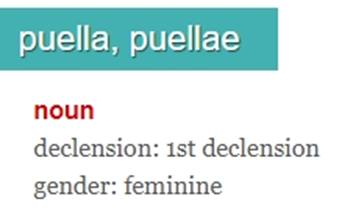
Look at the images posted from https://latin-dictionary.net/. You'll see
that it lists the nominative and genitive singular of the nouns; that indicates
to what declension the noun belongs. Similarly, any stem change in 3rd
declension nouns is indicated.
Here are some nouns listed as they would appear in a
dictionary. To what declension do each of them belong (1st / 2nd/ 3rd)?
All you have to do is look at the genitive ending and you
have the answer. Note the ones in bold; without the genitive case ending
listed, you would not be able to tell to which declension they belong, but with
the genitive case ending included, you can immediately:
via, -ae: road
taurus, -ī: bull
pectus, pectoris: breast
culīna, -ae: kitchen
magister, magistrī: teacher
mare, maris: sea
schola, -ae: school
fluvius, -iī: rīver
vēritās, vēritātis: truth
magistra, -ae
gladius, -iī: sword
dux, dūcis: general
poēta, -ae
puer, -ī: boy
frāter, frātris: brother
opus, operis: work
nōmen, nōminis: name
flūmen, flūminis: river
sīdus, sīderis: star
cūstōs, cūstōdis: guard