Friday, January 24, 2025

30.03.25: H & B; level 2; reading; M. Valerius Corvus (349BC)

Cōnsul Rōmānus cōpiās contrā Gallōs dūxerat et castra in locō idōneō posuerat. Tum Gallus, vir propter corporis magnitūdinem et pulchra arma īnsignis, ad nostrōrum statiōnēs vēnit: scūtum hastā ferit, ūnum ē Rōmānīs ad certāmen prōvocat. Erat tum in exercitū Rōmānō tribūnus mīlitum, iuvenis posteā propter multās victōriās nōtus, nōmine M. Valerius. ‘Nīsī cōnsulī,’ inquit, ‘ ingrātum fuerit, solus contrā hominem īnsolentem pugnābō.’ Datūr ā cōnsule venia: Valerius ad certāmen armātus prōcessit. Vix iam manum cōnseruerant, ubi corvus repente in galeā Valeriī cōnsēdit et identidem os oculōsque hostis rōstrō appetīvit. Itaque mox Rōmānus barbarum superat. Tum nec Gallī in statiōnibus manēbant et Rōmānī ad victōrem cucurrērunt. Nōn iam sōlum statiōnum mīlitēs sed legiōnēs utrimque pugnae interfuērunt. Diū et ācriter pugnābant: tandem Rōmānī barbarōs vīcērunt et ad maris ōram fugāvērunt.

1] Lines 1 – 3 (Cōnsul … provocat)

[i] Who were the Romans fighting? (1)

[ii] Where had the consul located the camp? (1)

[iii] How did one of the enemy intimidate the Romans? (2)

[iv] (line 3) venit … ferit … prōvocat: what tense is used here and why? (2)

[2] Lines 3 – 6; translate (12)*

[i] Erat tum [ii] in exercitū Rōmānō [iii] tribūnus mīlitum, ¦ [iv] iuvenis posteā ¦ [v] propter multās victōriās ¦ [iv] nōtus, ¦ [vi] nōmine M. Valerius. ¦ [vii] ‘Nīsī cōnsulī,’ inquit, ‘ingrātum fuerit, ¦ [viii] solus [ix] contrā hominem īnsolentem [viii] pugnābō.’ [x] Datūr ā cōnsule venia: ¦ [xi] Valerius [xii] ad certāmen [xi] armātus prōcessit.

Note: fuerit; what tense is this? How would it literally translate? How would it best translate into fluent English?

[3] Lines 7 – 8 (Vix … superat)

[i] Briefly explain how Valerius won the fight. (4)

[ii] Which single words in this extract indicate that …

[a] the fight had just started (1)

[b] the first action was sudden (1)

[c] it was a sustained attack (1)

[d] the barbarian was quickly beaten (1)

[4] Lines 8 – end (Tum … fugāvērunt)

[i] How did [a] the Gauls and [b] the Romans react after the attack? (2)

[ii] How did the battle intensify? (4)

[iii] What was the outcome of the battle? (2)

[5] Complete the translations of these extracts and note the difference in the Latin and English word order:

vir propter [i] corporis [ii] magnitūdinem … īnsignis │ a man remarkable on account of [ii] __________ [i] __________

ad [i] nostrōrum [ii] statiōnēs vēnit │ he came to [ii] __________ [i] __________

Nōn iam sōlum [i] statiōnum [ii] mīlitēs … pugnae interfuērunt. │ No longer were only the [ii] __________ [i] __________ involved in the battle …

Rōmānī barbarōs … ad [i] maris [ii] ōram fugāvērunt │ The Romans put the barbarians to flight towards [ii] __________ [i] __________


https://en.wikipedia.org/wiki/Marcus_Valerius_Corvus

____________________

*[2] [i] At that time there was ¦ [ii] in the Roman army ¦ [iii] a military tribune, [iv] a young man later / afterwards well-known [v] on account of (his) many victories ¦ [vi]  by the name of Valerius. ¦ [vii] “Unless it displeases the consul,” / “If it does not displease the consul,” he said ¦ [viii] “I shall fight alone ¦ [ix] against the arrogant / haughty / insolent man.” ¦ [x] Permission was given [historical present in the original Latin] by the consul: ¦ [xi] Valerius, armed, advanced [xii] towards the contest / fight.

29.03.25: Level 2; grammar revision; verbs [1a]: first conjugation

Match the English with the Latin verbs in the word cloud; an example of a first conjugation verb in full is given for reference

  1. you (sg.) praise / are praising
  2. you (sg.) were praising / used to praise
  3. you (sg.) will praise
  4. you (sg.) (have) praised
  5. you (sg.) had praised
  6. you (sg.) will have praised
  7. you (sg.) are (being) praised
  8. you (sg.) were (being) praised
  9. you (sg.) will be praised
  10. you (masc. sg.) were / have been praised
  11. you (fem. sg.) were / have been praised
  12. you (masc. sg.) had been praised
  13. you (fem. sg.) had been praised
  14. you (masc. sg.) will have been praised
  15. you (fem. sg.) will have been praised 

____________________

laudāvistī; laudās; laudātus es; laudāveris; laudāverās; laudābāris; laudātus eris; laudāta es; laudātus erās; laudāris; laudāta eris; laudāta erās; laudābis; laudāberis; laudābās


28.03.25: Level 1; readings [7]: [i] Good friends?; [ii] Invitation to the theatre

[i] Good friends?

(Cornelia waits in front of the Marcellus theatre for Marcus. Suddenly her friends Tullia and Aemilia appear…)

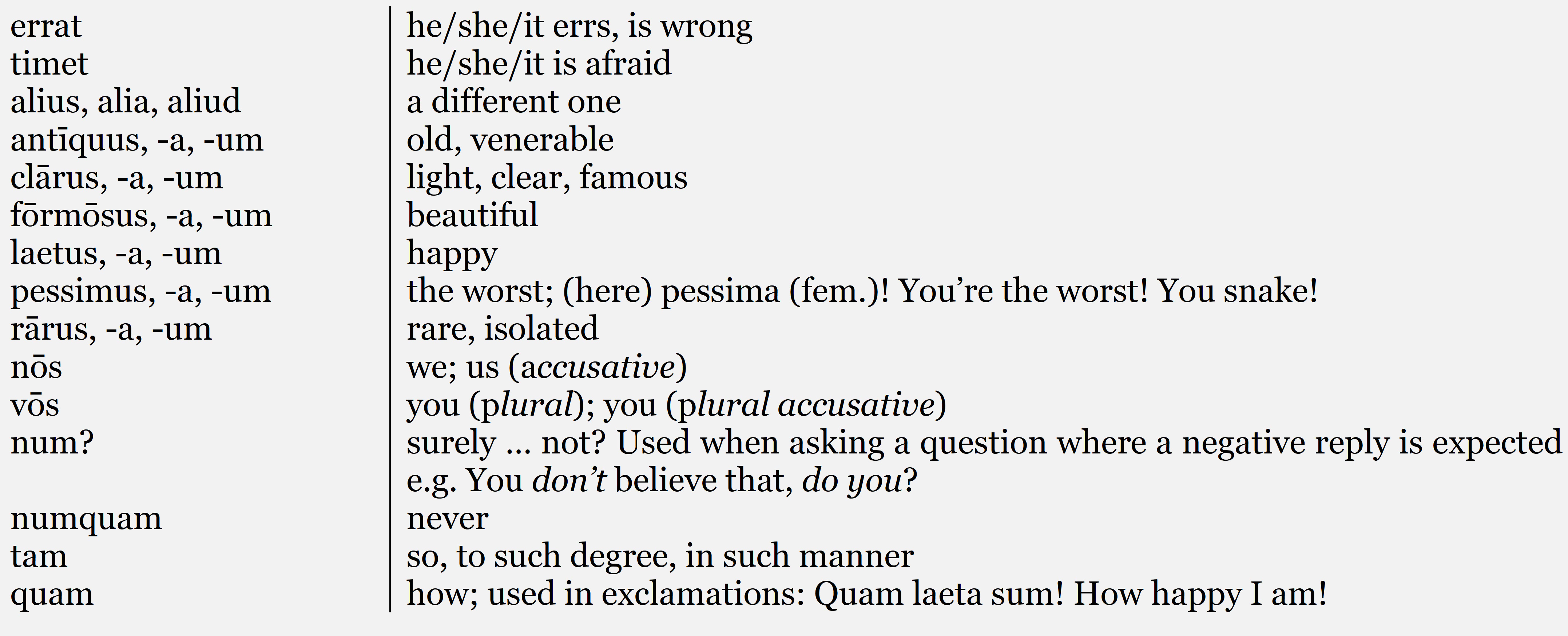
T: Cūr hīc sedēs, Cornēlia? Num Mārcum exspectās?

C: Nōn errās, amīca. Mārcum exspectō, sed iam timeō, quod cessat.

(Tullia et Aemilia rīdent)

C: Cūr rīdētis, amīcae? Cūr vōs tam laetae estis?

A: Rīdēmus, quod tam stulta es, quod hic sedēs et amīcum exspectās.

T: Nōs numquam amīcōs exspectāmus, nōs nōn tam stultae sumus. Amīcī nōs exspectant.

C: Libenter Mārcum exspectō, quod amīcus fīdus et bonus est.

A: Amīcī fīdī et bonī rārī sunt. Fortasse Mārcus iam aliam amīcam amat; nam nōn sōlum lūdī clārī et forum antīquum et theātra Mārcum invītant, sed etiam fōrmōsae puellae! (Cornēlia tacet)

T: Cūr tacēs, Cornēlia? Num errō?

C: Certē errās, pessima, nam ibi Mārcus stat, mē exspectat! Ōh, quam laeta sum! – Hīc sum, Mārce, hīc tē exspectō!

[ii] Invitation to the theatre

Aemilia: Hodiē tē invītō, Tite! Fābula bona est!

Titus: Ōh, quam grātus et laetus sum, Aemilia! Amīca bona es, et amīcae bonae rārae sunt.

[Iam Titus et Aemilia theātrum clārum intrant.]

Titus (subitō): Ecce, ibi est Quīntus.

Aemilia: Salvē, Quīnte! Certē Paulam exspectās?

Quīntus: Errās! Paulam nōn iam exspectō; iam adest; ibi stat. Hodiē nōn nōs amīcās invītāmus, sed amīcae nōs invītant.


Thursday, January 23, 2025

27.03.25: Level 3; deponent verbs (6)(ii); imperfect and future tenses; exercise [2]

moror, -ārī, -ātus sum [1/dep]: to delay

mereor, -ērī, meritus sum [2/dep]: to deserve, earn

aggredior, -ī, aggressus sum [3-iō/dep]: to approach; advance towards; attack

patior, patī, passus sum [3-iō/dep]: to suffer; endure

Choose the correct translaton; this time, the present, future and imperfect tenses are used:

  1. The sun is rising │Sōl [a] oriēbātur [b] oritur [c] oriētur
  2. The sun was rising │ Sōl [a] oriētur [b] oritur [c] oriēbātur
  3. The sun will rise │Sōl [a] oriētur [b] oriēbātur [c] oritur
  4. He could easily endure [= was easily enduring bodily pain] │ ille … facile dolōrem corporis [a] patitur [b] patiēbātur [c] patiētur (Cicero)
  5. I often use a sword │Gladiō saepe [a] ūtēbar [b] ūtar [c] ūtor
  6. The angry sailors advance towards us │ [a] aggrediēbantur [b] aggredientur [c] aggrediuntur nōs furentēs nautae (Petronius)
  7. The king is threatening him with death │ Rēx eī mortem [a] minātur [b] minābātur [c] minābitur
  8. The king will threaten him with death │ Rēx eī mortem [a] minābātur [b] minātur [c] minābitur
  9. The matter speaks for itself. Rēs ipsa [a] loquēbātur [b] loquitur [c] loquētur
  10. What will he promise us? │ Quid nōbīs [a] pollicēbitur? [b] pollicēbātur? [c] pollicētur?
  11. While he is staying a few days at Vesontio … │ Dum paucōs diēs ad Vesontiōnem … [a] morātur [b] morantur [c] morāmur … (Caesar)
  12. The enemy, the enemy, who(ever) kills them will earn a reward │ 'hostēs, hostēs, quī eōs occīderit, praemium [a] merēbiminī [b] merēbitur [c] merēbuntur

____________________

The sun is rising │Sōl [a] oriēbātur [b] oritur [c] oriētur

The sun was rising │ Sōl [a] oriētur [b] oritur [c] oriēbātur

The sun will rise │Sōl [a] oriētur [b] oriēbātur [c] oritur

He could easily endure [= was easily enduring bodily pain] │ ille … facile dolōrem corporis [a] patitur [b] patiēbātur [c] patiētur (Cicero)

I often use a sword │Gladiō saepe [a] ūtēbar [b] ūtar [c] ūtor

The angry sailors advance towards us │ [a] aggrediēbantur [b] aggredientur [c] aggrediuntur nōs furentēs nautae (Petronius)

The king is threatening him with death │ Rēx eī mortem [a] minātur [b] minābātur [c] minābitur

The king will threaten him with death │ Rēx eī mortem [a] minābātur [b] minātur [c] minābitur

The matter speaks for itself. │ Rēs ipsa [a] loquēbātur [b] loquitur [c] loquētur

What will he promise us? │ Quid nōbīs [a] pollicēbitur? [b] pollicēbātur? [c] pollicētur?

While he is staying a few days at Vesontio … │ Dum paucōs diēs ad Vesontiōnem … [a] morātur [b] morantur [c] morāmur … (Caesar)

The enemy, the enemy, who(ever) kills them will earn a reward │ 'hostēs, hostēs, quī eōs occīderit, praemium [a] merēbiminī [b] merēbitur [c] merēbuntur

26.03.25: Level 2; Grammar Review; 3rd declension nouns [8]

aurifex, aurif __ is [3/m]: __________

calix, cali __ is [3/m]: __________

mōns, mon __ is [3/m]: __________

pedes, ped __ is [3/m]: __________

prōditor, prōdit __ ris [3/m]: __________

bōs, b __ is [3 m/f]: __________

carō, car __ is [3/f]: __________

quiēs, quietis [3/f]: __________

tellūs, tellū __ is [3/f]: __________

agmen, agm __ is [3/n]: __________

-c-; -et-; -ic-; -in-; -it-; -n-; -ō-; -ov-; -r-; -t-

calm; column (of soldiers); cup; goldsmith; head of cattle; infantryman; meat; mountain; traitor; world

25.03.25: H & B; level 2; reading; a family curse [2]

Deī Oenomaum rēgem per ōrāculum sīc [1] monuerant: ‘Ā generō [2] necāberis.’ Itaque Oenomaus ‘ Nēmō,’ inquit, ‘fīliam in mātrimōnium [3] dūcet.’  Multī tamen pulchram fīliam, Hippodamīam, amābant, multī [4] petēbant. Fīliam in mātrimōnium nōn ducēs,’ respondit omnibus, ‘nisi patrem in currūs certāmine [5] vīceris: sī [6] victus eris, morte poenās audāciae [7] persolvēs.’ Multī ad certāmen veniēbant, multī ā rēge [8] superābantur. Tandem Pelops Myrtilum, rēgis aurīgam, prōmissīs [9] conciliāvit. ‘Dīmidium rēgnī [10]  dabō,’ inquit, ‘sī in certāmine [11] adiūveris.’ Tum Myrtilus rēgiī currūs axem discidit: itaque rēx ē currū cecidit, Pelops victor cum Hippodamīa ad patriam revertit. Sed quamquam ā Myrtilō via ad victōriam [12] inventa erat, prōmissum Pelops [13] nōn praestitit. Nam ubi currum prope mare agēbat, aurīgam in aquam dēmīsit. Myrtilus autem, ‘Ā dīs immortālibus,’ clāmāvit, ‘auxilium [14] petō: rem tam foedam dī [15]  nōn neglegent: per omnēs annōs Pelopis perfidiae poenās Pelopidae persolvent.’

Give the precise translation of the following verbs from the text even if, sometimes, the literal translation is not what English would finally use:

  1. Deī … rēgem … monuerant │ The gods [a] had warned [b] warned [c] were warning the king
  2. Ā generō necāberis │ You … [a] were killed [b] will kill [c] will be killed by (your) son-in-law
  3. Nēmō … fīliam … dūcet. │ Nobody … [a] is leading [b] has led [c] will lead my daughter
  4. Multī … fīliam … petēbant. │Many … [a] desired ( = were desiring) [b] had desired [c] will desire (his) daughter
  5. nisi patrem … vīceris │ Unless you … [a] will conquer [b] will have conquered [c] conquer the father
  6. victus eris, … │If you … [a] will conquer [b] were conquered [c] will have been conquered
  7. … poenās … persolvēs │ … you … [a] are paying [b] will pay [c] paid the price / penalty
  8. multī … superābantur │ Many … [a] were (being) conquered [b] had been conquered [c] will have been conquered
  9. Pelops Myrtilum … prōmissīs conciliāvit. │ Pelops … [a] has won over [b] won over [c] had won over Myrtilus
  10. Dīmidium rēgnī dabō,… │ I … [a] am giving [b] was giving [c] shall give you half of the kingdom
  11. … ‘sī in certāmine adiūveris. │ If you [a] will have helped [b] will help [c] are helping in the contest
  12. quamquam … via … inventa erat, … │ Although a way [a] had been found [b] was found [c] will be found
  13. … prōmissum Pelops nōn praestitit │ Pelops … [a] has not kept [b] is not keeping [c] did not keep (his) promise
  14. auxilium petō │ I … [a] sought [b] seek [c] will seek help
  15. … dī nōn neglegent │ The gods [a] do not ignore [b] will not ignore [c] did not ignore

____________________

Deī … rēgem … monuerant │ The gods [a] had warned [b] warned [c] were warning the king

Ā generō necāberis │ You … [a] were killed [b] will kill [c] will be killed by (your) son-in-law

Nēmō … fīliam … dūcet. │ Nobody … [a] is leading [b] has led [c] will lead my daughter

Multī … fīliam … petēbant. │Many … [a] desired ( = were desiring) [b] had desired [c] will desire (his) daughter

nisi patrem … vīceris │ Unless you … [a] will conquer [b] will have conquered [c] conquer the father

victus eris, … │If you … [a] will conquer [b] were conquered [c] will have been conquered

… poenās … persolvēs │ … you … [a] are paying [b] will pay [c] paid the price / penalty

multī … superābantur │ Many … [a] were (being) conquered [b] had been conquered [c] will have been conquered

Pelops Myrtilum … prōmissīs conciliāvit. │ Pelops … [a] has won over [b] won over [c] had won over Myrtilus

Dīmidium rēgnī dabō,… │ I … [a] am giving [b] was giving [c] shall give you half of the kingdom

… ‘sī in certāmine adiūveris. │ If you [a] will have helped [b] will help [c] are helping in the contest

quamquam … via … inventa erat, … │ Although a way [a] had been found [b] was found [c] will be found

… prōmissum Pelops nōn praestitit │ Pelops … [a] has not kept [b] is not keeping [c] did not keep (his) promise

auxilium petō │ I … [a] sought [b] seek [c] will seek help

… dī nōn neglegent │ The gods [a] do not ignore [b] will not ignore [c] did not ignore

25.03.25: H & B; level 2; reading; a family curse [1]

Deī Oenomaum rēgem per ōrāculum sīc monuerant: ‘Ā generō necāberis.’ Itaque Oenomaus ‘ Nēmō,’ inquit, ‘fīliam in mātrimōnium dūcet.’  Multī tamen pulchram fīliam, Hippodamīam, amābant, multī petēbant. Fīliam in mātrimōnium nōn ducēs,’ respondit omnibus, ‘nisi patrem in currūs certāmine vīceris: sī victus eris, morte poenās audāciae persolvēs.’ Multī ad certāmen veniēbant, multī ā rēge superābantur. Tandem Pelops Myrtilum, rēgis aurīgam, prōmissīs conciliāvit. ‘Dīmidium rēgnī dabō,’ inquit, ‘sī in certāmine adiūveris.’ Tum Myrtilus rēgiī currūs axem discidit: itaque rēx ē currū cecidit, Pelops victor cum Hippodamīa ad patriam revertit. Sed quamquam ā Myrtilō via ad victōriam inventa erat, prōmissum Pelops nōn praestitit. Nam ubi currum prope mare agēbat, aurīgam in aquam dēmīsit. Myrtilus autem, ‘Ā dīs immortālibus,’ clāmāvit, ‘auxilium petō: rem tam foedam dī nōn neglegent: per omnēs annōs Pelopis perfidiae poenās Pelopidae persolvent.’

[1] Lines 1 – 2 (Deī … dūcet)

Nēmō … fīliam in mātrimōnium dūcet. What did Oenomaus say and why did he say it? (3)

[2] Lines 2 – 5 (Multī … persolvēs)

What challenge did Oenomaus set to those wanting to marry Hippodamia, and what was the price of failure? (2)

[3] Lines 5 – 7; translate (10)*

[i] Multī ¦ [ii] ad certāmen ¦ [i] veniēbant, [iii] multī ¦ [iv] ā rēge ¦ [iii] superābantur. [v] Tandem Pelops Myrtilum, ¦ [vi] rēgis aurīgam, [vii] prōmissīs [v] conciliāvit. [viii] ‘Dīmidium rēgnī dabō,’ inquit, ¦ [ix] ‘sī ¦ [x] in certāmine ¦ [ix] adiūverīs.’

Note: ‘Dīmidium rēgnī dabō,’ inquit, ‘sī in certāmine adiūveris.’ What tense is adiūveris? How would it literally be translated? How would it be best translated?

[4] Lines 7 – 8 (Tum … revertit)

What did Myrtilus do to the chariot and with what results? (4)

[5] Lines 8 – 10 (Sed … dēmīsit)

[i] Give a translation of Sed quamquam ā Myrtilō via ad victōriam inventa erat, prōmissum Pelops nōn praestitit (4) and [ii] explain why that statement is made. (2)

[6] Lines 10 – end (Myrtilus autem … persolvent)

[i] Whose help did Myrtilus seek? (1)

[ii] Why did he think they would help? (2)

[iii] Who was to be punished? (1)

[7] In your own words give a brief description of Myrtilus referring to his character and motives. (4)**


dēmittō , -ere, -mīsī, -missus [3]: send down; throw / cast down

neglegō, -ere, neglēxī, neglēctus [3]: ignore / be indifferent; overlook

perfidia, -ae [1/f]: treachery

https://en.wikipedia.org/wiki/Oenomaus


King Oenomaus, Hippodamia, and Olympian gods. Illustration (colour lithograph) from a binding of 'Peintures de Vases Antiques Vulgairement Appeles Etrusques' by Aubian Louis Millin de Grandmaison, with 'Introduction a l'Etude des Vases Antiques d'Argile Peints Vulgairement Appeles Etrusques', by A. Dubois Maisonneuve; possibly refers to the establishment of the Olympic Games in honour of Oinomaos; died in a chariot race against Pelops, who wanted to marry his daughter Hippodamea.

by The Stapleton Collection (French), Public Domain

https://commons.wikimedia.org/w/index.php?curid=15518537

____________________

* [3] [i] Many came ¦ [ii] to the contest, ¦ [iii] (and) many were conquered / beaten ¦ [iv] by the king. [v] Pelops finally won over Myrtilus, ¦ [vi] the king’s charioteer ¦ [vii] with promises. [viii] “I shall give you half the kingdon, he said ¦ [ix] “If you help (me) ¦ [x] in the contest.”

** [7] acts out of self-interest; no loyalty to the king; motivated by promises of power / wealth; hypocritical: refers to the “foul deed” and “treachery” of Pelops yet he himself committed a treacherous act

Tuesday, January 21, 2025

22.01.25: Latin for canines; Rocco [1]

https://www.facebook.com/reel/1354338782613518

Canis meus amat nivem … │ My dog loves the snow …

… et hodiē laetissimus est …│ … and he is very happy today …

… quia ningit. │ … because it’s snowing.

Rocco, surge! │ Rocco, stand / get up!

Domum redeāmus. │ Let’s go home.

Venī! │ Come.

____________________

In the footnotes, he states:

Foris manēre vult. │ He wants to stay outdoors.

Mihi (dative) autem displicet frīgus. │Literally: the cold, however, is displeasing to me = but I don't like the cold; frīgus, frīgoris [3/n]: (the) cold

There are two points to note:

[i] laetissimus est: this is the superlative form of the adjective and is about to be discussed in detail here in the group.

The superlative is the equivalent of English biggest or most beautiful; to form it the ending -issimus (masc.), - issima (fem.), -issimum (neut.) is added to the stem of the adjective:

laet¦us: happy > laet¦issim¦us, -a, -um: happiest

However, Latin’s use of the superlative goes beyond English in that, as here in the reel, it can express “very” i.e. he’s very happy

[ii] redeamus; as mentioned many times before, even a short and simple piece of Latin can have a point “lurking” in the shadows 

redeāmus is an example of the subjunctive, a feature of the language which most often will appear last in a textbook because it involves considerable study, has many different uses and is built upon previous knowledge.

For now, simply note that one of the uses of the Latin subjunctive is to express “Let’s do something …” and leave it at that.

  • Domum redeāmus │ Let’s go home
  • Gaudeāmus igitur iuvenēs dum sumus │ Let us rejoice, therefore, while we are young
  • Vīvāmus mea Lesbia atque amēmus (Catullus) │ Let us live, my Lesbia, and let us love


24.03.25: Level 1; readings [6]: a foolish prejudice

Mārcus magnās dīvitiās nōn possidet, itaque neque multa neque magna dōna dare potest. Mārcus nōn est Croesus*; sed Cornēlia puella est, et “cūnctae puellae diū et libenter tabernās spectant, aurum et argentum valdē amant saepeque multa dōna exspectant”. Sīc Mārcus cōgitat, sed stultus est; nam Cornēlia neque magna neque multa dōna exspectat. Grāta et contenta est, quod Mārcus amīcus bonus et fīdus est, quod nōn sōlum lūdōs, sed etiam theātra amat. Nam theātra Cornēliam imprīmīs dēlectant: gaudet et rīdet, cum fābulās spectat, et cum populus clāmat, clāmat et Cornēlia.

*Croesus: legendary king; known for his great wealth

https://en.wikipedia.org/wiki/Croesus


Monday, January 6, 2025

23.03.25: Level 3; deponent verbs (6)(i); imperfect and future tenses; exercise [1]

Focus on what matters i.e. recognise [i] meaning [ii] tense and [iii] who / what is performing the action. You need to go slowly before you can go quickly! You’ve seen in the two previous posts that there are consistent personal endings and clear markers for tenses. Match the English verbs with the Latin deponent verbs in the word cloud all of which are either imperfect or future tense:

1st conjugation

hortor, -ārī, -ātus sum: to encourage, urge

minor, -ārī, -ātus sum: to threaten

mīror, -ārī, -ātus sum: to wonder at, be surprised

2nd conjugation

vereor, -ērī, veritus sum: to fear

3rd conjugation

loquor, loquī, locūtus sum: to speak, talk

proficīscor, proficīscī, profectus sum: to set out, depart

sequor, sequī, secūtus sum: to follow

ūtor, -ī, usus sum: to use, make use of

3rd-iō conjugation

prōgredior, -ī, prōgressus sum: to advance, go forward

morior, -ī, mortuus sum: to die

4th conjugation

orior, -īrī, ortus sum: to rise, arise

potior, -īrī, potītus sum: to get possession of

  1. The sun was rising. │ Sōl __________
  2. The sun will rise.│ Sōl __________
  3. The king was threatening him with death. │ Rēx eī mortem __________
  4. I often used a sword. │ Gladiō saepe __________
  5. We shall not fear the enemy. │ Hostēs nōn __________
  6. Whom were you encouraging? │ Quem __________?
  7. Whom will you encourage? │ Quem __________?
  8. When will they set out? │ Quandō __________?
  9. The boy will set out at dawn. │ Puer prīmā lūce __________ 
  10. The senator was speaking loudly. │ Senātor magnā vōce __________
  11. We will always follow you. │ Tē semper __________
  12. They used to admire the girl’s beauty. │ Pulchritūdinem puellae __________
  13. You are gods … but you will die just like men. │ Dīī estis …, vōs autem sīcut hominēs __________
  14. Moreover, when we (will) become masters / take possession of a very beautiful and wealthy city … │ __________ praetereā cum pulcherrimā opulentissimāque urbe … (Livy) 
  15. Labienus … was proceeding quietly. │ Labiēnus … placidē __________. (Caesar)


22.03.25: level 3; review; ACL/NJCL NATIONAL LATIN EXAM (Latin 2); 2012; Part 1 [2]: answers and notes

[1] Nēmō sine aquā diū vīvere potest. │ A) without watersine + ablative case: without

Nobody can live a long time without water.

[2] Magnum flūmen per campōs Italiae celerrimē fluit. │ D) very swiftlysuperlative adverb

celerrimus, -a, -um: superlative adjective > celerrimē: superlative adverb; either ‘most quickly’ or, commonly, very quickly

A large river flows very quickly through the fields / plains of Italy.

[3] Difficile est nāvigāre autumnō. B) in the Fallablative of time when

It is difficult to sail in the Fall / Autumn.

[4] Mox hic senātor erit _____. A) cōnsulpredicate nominative i.e. a noun or adjective which follows the verb ‘to be’ and gives further information about the subject of the sentence i.e. X = Y e.g. this man is a doctor; this man is brave; the noun or adjective is in the nominative case agreeing in gender and number

This senator will soon be a consul.

[5] Vir humilis numquam laudat. │C) himselfreflexive pronoun referring back to the subject

A humble man never praises himself.

[6] Vīsne omnēs populōs esse līberōs? │ D) Do you wish │ irregular verb: velle

Do you wish all people to be free?

[7] Mīlitēs Rōmānī fortiōrēs omnibus hostibus erant. │ A) than all their enemiesablative of comparison = Engl. ‘than’

The Roman soldiers were braver than all the enemies.

[8] Ancillae ā dominā laudātae sunt.B) were praisedperfect passive

The maidservants were praised by the mistress.

[9] Dā mihi vīnum, _____! │B) Rūfe vocative case of 2nd declension nouns in -us > -e

Give me wine, Rufus!

[10] Liberīs [dative] ¦ arma habēre ¦ nōn licet. │ D) Children are not permitted to have weapons. │ licet: impersonal verb = it is allowed / permitted and is followed by the dative case i.e. it is not permitted for children to have weapons

[11] Nōlī abīre; tē mēcum manēre volō! │ B) Don’t go away │negative imperative: nōlī(te) + infinitive

Don’t go away; I want you to stay with me!

[13] Medicus amīcum vulnerātum ē proeliō portāvit. │ A) wounded │ perfect passive participle used as an adjective

The doctor carried (his) wounded friend [= his friend who had been wounded] out of the battle.

[13] Multa et mala Troiānīs ā Iūnōne facta sunt. │ B) by Juno │ablative of agent i.e. the person by whom an action is performed

Many evil things were done to the Trojans by Juno.

[14] Equī huius hominis quattuor diēbus vēndentur. │ C) of this man │ declension of hic, haec, hoc

The horses of this man / this man’s horses will be sold within four days.

[15] Quibus dux auxilium dedit? │ C) To whom │ declension of quis? (who?); here: dative plural implying that more than one person was given help.

To whom did the commander give help? / Who did the commander give help to?

[16] Rēgēs, quōrum potestās maxima est, multōs annōs regent. │  C) whose  declension of quī, quae, quod

Kings, whose power [= the power of whom] is very great, will reign for many years.

Notes: at this level you should be familiar with the specific grammatical terms for different features:

Image #1: question [14] refers to the demonstrative pronoun / adjective hic, haec, hoc (those; these)

Equī huius hominis quattuor diēbus vēndentur. │ The horses of this man will be sold within four days.

Grammar books may refer to hic, haec and hoc either as demonstrative pronouns or demonstrative adjectives, or both terms together. The reason for this is that they serve more than one function:

[i] If they describe a named noun e.g. hic liber (this book) we can say that they are acting as a demonstrative adjective as in the example above.

[ii] If they stand alone i.e. they are in place of a noun then they can be defined as demonstrative pronouns e.g. this (man), this (one) or he; this (woman), she; this (thing), it

In the plural, the same range of translations in [i] and [ii] apply e.g. these (books), these (ones / men / women / things), they

Context will determine the best translation.

Images #2 and #3: questions [15] and [16]

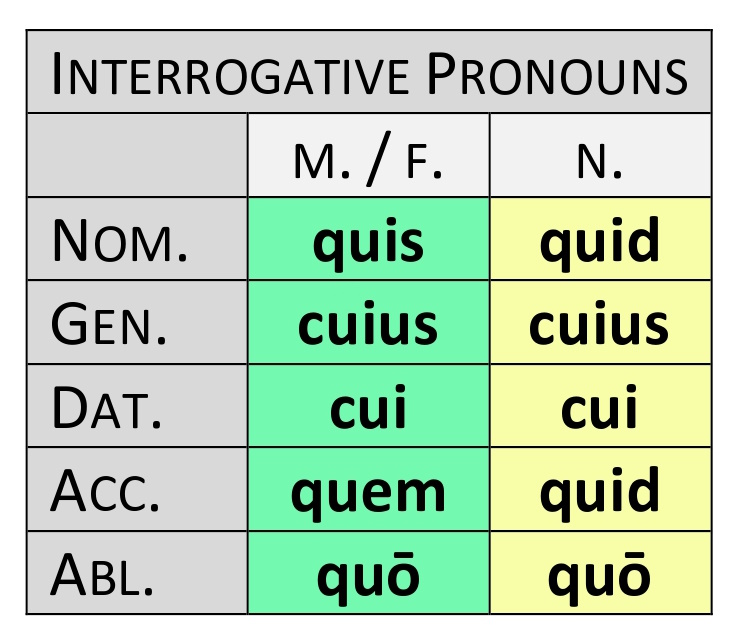
Image #2: question 15 refers to quis / quid? (who / what?) i.e. an interrogative pronoun asking a question

Quibus dux auxilium dedit? │ To whom did the commander give help?

Image #3: question 16 refers to quī / quae / quod (who / which) i.e. a relative pronoun that introduces a relative clause which gives more information about the preceding noun in the main clause

Rēgēs, ¦ quōrum potestās maxima est, ¦ multōs annōs regent. │ Kings, ¦ whose power is very great / the greatest, ¦ will reign for many years.

There is almost no difference in the declensions of both of these:

[i] the interrogative pronoun (quis?) can be masculine or feminine

[ii] the interrogative pronouns in the plural are identical to the relative pronouns

21.03.25: level 3; review; ACL/NJCL NATIONAL LATIN EXAM (Latin 2); 2012; Part 1 [1]: questions

https://www.nle.org/_files/ugd/aac38e_3e2b56d7415a48ccb21db95515467db6.pdf

The first part of the test has eighteen questions on different features of Latin grammar; of the 18 questions, 16 of them have already been covered in the group. Therefore, two questions have, at this stage, been omitted but will be discussed at level 3 in detail in later posts. The numbering of the questions in the original test paper has been altered in order to put some features of the language together.

[1] Nēmō sine aquā diū vīvere potest. A) without water B) by water C) in water D) out of water

[2] Magnum flūmen per campōs Italiae celerrimē fluit. A) swift B) swiftly C) more swiftly D) very swiftly

[3] Difficile est nāvigāre autumnō. A) for the Fall B) in the Fall C) the Fall D) from the Fall

[4] Mox hic senātor erit _____. A) cōnsul B) cōnsulis C) cōnsulī D) cōnsule

[5] Vir humilis numquam laudat. A) them B) this C) himself D) her

[6] Vīsne omnēs populōs esse līberōs? A) Did you wish B) Will you wish C) Were you wishing D) Do you wish

[7] Mīlitēs Rōmānī fortiōrēs omnibus hostibus erant. A) than all their enemies B) of all their enemies C) by all their enemies D) with all their enemies

[8] Ancillae ā dominā laudātae sunt. A) are praised B) were praised C) will be praised D) had been praised

[9] Dā mihi vīnum, _____! A) Rūfus B) Rūfe C) Rūfō D) Rūfum

[10] Liberīs arma habēre nōn licet. A) Children ought to have their own weapons. B) He agrees that the children will not have weapons. C) Children do not like to have weapons. D) Children are not permitted to have weapons.

[11] Nōlī abīre; tē mēcum manēre volō! A) I am not going away B) Don’t go away C) No one is leaving D) Never leave

[12] Medicus amīcum vulnerātum ē proeliō portāvit. A) wounded B) about to wound C) wound D) wounding

[13] Multa et mala Troiānīs ā Iūnōne facta sunt. A) for Juno B) by Juno C) to Juno D) with Juno

[14] Equī huius hominis quattuor diēbus vēndentur. A) this man B) to this man C) of this man D) by this man

[15] Quibus dux auxilium dedit? A) Who B) Whose C) To whom D) With whom

[16] Rēgēs, quōrum potestās maxima est, multōs annōs regent. A) who B) to whom C) whose D) by whom

20.03.25: Level 2; Grammar Review; 3rd declension nouns [7]

gurges, gurg __ is [3/m]: __________

pariēs, pari __ is [3/m]: __________

serpēns, serpen __ is [3 m/f]: __________

imperātrīx, imperātrī __ is [3/f]: __________

laus, lau __ is [3/f]: __________

phalanx, phalan __ is [3/f]: __________

pōtiō, pōtiō __ is [3/f]: __________

crūs, crū __ is [3/n]: __________

fūnus, fūn __ is [3/n]: __________

lūmen, lūm __ is [3/n]: __________

-c-; -d-; -er-; -et-; -g-; -in-; -it-; -n-; -r-; -t-

batallion; drink; empress; funeral; leg; light; praise; snake; wall; whirlpool

19.03.25: H & B; level 2; reading; the Licinian laws

Quamquam multa pauperibus cīvibus concessa erant, nōndum tamen fīnītum erat inter patriciōs plēbēiōsque certāmen. Legēs identidem ā tribūnīs plēbis Liciniō et Sextiō rogābantur (1), per patriciōrum auctōritātem antīquābantur (2). Per multōs annōs multīs dē rēbus cīvitās dissēnsiōne perturbābātur. Tandem Camillus dictātor rempūblicam iterum servāvit. ‘Frūstrā iam,’ inquit, “tribūnōrum postulātiōnibus resistimus: multa patriciī concēdēmus; cōnsulum alter ē plēbēiīs semper creābitur; agrī pūblicī nēmō amplius quīngenta iūgera (3) possidēbit: contrā rēs ūna concēdētur ā plēbēiīs; iūs ā praetōre administrābitur, praetor ē patriciīs creābitur. Tum dēnique fīnīta erit dissēnsiō et pāx reīpūblicae reddētur.’ Placuit omnibus Camillī cōnsilium: posteā nūllae erant inter patriciōs et plēbēiōs dissēnsiōnēs: dictātor templum Concordiae dēdicāvit.

(1) rogō, -āre, -āvī, -ātus [1]: ask, but, in the context of laws, propose

(2) antīquō, -āre, -āvī, -ātus [1]: (here: with regard to laws) reject

(3) iūgerum, -ī [2/n]: unit of land measurement

https://en.wiktionary.org/wiki/iugerum

[A]

[1] Lines 1 – 4 (Quamquam … perturbābātur)

[i] True or false:

[a] The poor had received nothing from the patricians. (1)

[b] The struggles between the plebeians and the patricians were over. (1)

[ii]

[a] Who were Licinius and Sextius? (1)

[b] What requests did they make? (1)

[c] How did the patricians react? (1)

[d] How was the State affected? (2)

[2] Lines 4 – 9 (Tandem … reddētur)

[i] Why did Camillus decide to give concessions? (2)

[ii] What concessions were made concerning:

[a] consulships (3)

[b] public land (3)

[iii] What concession were the plebeians required to make? (4)

[iv] What did Camillus think would be the result of these concessions? (2)

[3] Lines 9 – end; translate (7); [i] Placuit omnibus [ii] Camillī cōnsilium: [iii] posteā [iv] nūllae erant [v] inter patriciōs et plēbēiōs [iv] dissēnsiōnēs: [vi] dictātor [vii] templum Concordiae [case?] [vi] dēdicāvit.

[4] In your own words briefly explain why the temple referred to in the text was appropriately named. (4)*

https://en.wikipedia.org/wiki/Concordia_(mythology)

[B] Choose the correct translation [a], [b] or [c]

  1. administrābitur: [a] was being managed [b] will be managed [c] is managed
  2. antīquābantur: [a] were rejected [b] was rejected [c] will be rejected
  3. concēdētur: [a] is conceded [b] are conceded [c] will be conceded
  4. concessa erant: [a] were conceded [b] have been conceded [c] had been conceded
  5. creābitur: [a] will be elected [b] was elected [c] is elected
  6. fīnīta erit: [a] will have been finished [b] was finished [c] had finished
  7. nōndum … fīnītum erat: [a] has not yet finished [b] were not yet finished [c] had not yet been finished
  8. perturbābātur: [a] will be … [b] was being … [c] is being … thrown into confusion
  9. reddētur: [a] is being returned [b] will be returned [c] are being returned
  10. rogābantur: [a] were proposed [b] had been proposed [c] was being proposed


By Classical Numismatic Group, Inc. http://www.cngcoins.com, CC BY-SA 3.0, https://commons.wikimedia.org/w/index.php?curid=380111

____________________

*The temple was dedicated to [i] Concordia, the Roman goddess often associated with political stability. The temple symbolically represents [ii] the peaceful end of a long period of strife [iii] between the plebeians and the patricians through [iv] concessions on both sides

18.03.25: Level 1; readings [1] - [5]: review (4)

Match the nouns with the images

adversāriī; aedificium; amīcī; argentum; aurum; dōnum; gladius; lacrimae; monumenta; populus; rōstra; sīmia; taberna; templum; tuba


17.03.25: Level 3; deponent verbs (5)(ii); imperfect and future tenses; 3rd, 3-iō, 4th conjugations

[1] imperfect tense: again, the tense markers are the same for all three conjugations i.e. -ba- / -bā-, the only difference being in the stem vowels:

3rd conjugation: revertor, revert¦ī, reversus sum [3/dep]: return

  • revert¦ē¦ba¦r, revert¦ē¦¦ris etc. │ I was returning / used to return, you (sg.) were returning etc.

3rd-iō conjugation: egredior, egredī, egressus sum [3-iō/dep]: go out

  • egred¦¦ba¦r, egred¦¦¦ris etc. │I was going out, you (sg.) were going out etc.

4th conjugation: mentior, mentī¦rī, mentitus sum [4/dep]: lie; deceive

  • ment¦¦ba¦r, ment¦¦¦ris │I was lying; I used to deceive; you (sg.) were lying etc.

[2] future tense

[i] 3rd conjugation: -a- / -ē[e]-

revertar: I shall return

revertēris: you (sg.) will return

revertētur: he/she/it will return

revertēmur: we will return

revertēminī: you (pl.) will return

revertentur: they will return

[ii] 3rd-iō conugation: -ia- / -iē[e]-

ēgrediar: I shall go out

ēgredris: you (sg.) will go out

ēgrediētur: he/she/it will go out

ēgrediēmur: we will go out

ēgrediēminī: you (pl.) will go out

ēgredientur: they will go out

[iii] 4th conjugation: -ia- / -iē[e]-

mentiar: I shall lie / deceive

mentris: you (sg.) will lie

mentiētur: he/she/it will lie

mentiēmur: we will lie

mentiēminī: you (pl.) will lie

mentientur: they will lie