Tuesday, February 25, 2025

26.02.25: Comenius XLVIII (1658); the making of honey

The making of Honey │ Mellificium

The Bees send out a swarm, 1. and set over it a Leader, 2. │ Āpēs ēmittunt Exāmen, 1. adduntque illī Ducem (Rēgem), 2.

That swarm being ready to fly away is recalled by the Tinkling of a brazen Vessel, 3. and is put up into a new Hive, 4. │ Exāmen illud, āvolātūrum, revocātur tinnītū Vāsis æneī, 3. & inclūditur novō Alveārī, 4.

They make little Cells with six corners, 5. and fill them with Honey-dew, and make Combs, 6. out of which  the Honey runneth, 7. │ Struunt Cellulās sexangulārēs, 5. et complent eās Mellīgine, & faciunt Favōs, 6. ē quibus Mel effluit, 7.

The Partitions being melted by fire, turn into Wax, 8. │ Cratēs liquātī igne abeunt in Cēram, 8.

Vocabulary

alvear, alveāris [3/n]: (Mediaeval) beehive

Also:

alveārium, -ī [2/n] or mellārium, -ī [2/n]; alvus, -ī [2/f]

The term apiārium, -ī [2/n] from which the English word apiary is derived refers to an area where bees are kept

[a]

āpis, -is [3/f]: bee

cēra, -ae [1/f]: wax; beeswax; a seal made of wax

exāmen, exāminis [3/n]: swarm; especially of bees, but can refer to other creatures

favus, -ī [2/m]: honeycomb

mel, mellis [3/n]: honey-dew

mellificium, -ī [2/n]: honey-making

mellīgō, mellīginis [3/f]: honey-dew

[b]

aeneus, -a, -um: [i] copper, bronze [ii] (here) ‘brazen’ referring to something that is loud and strident e.g. made by the striking of something metal (see notes)

crātis, -is [3/f]: [i] wickerwork [ii] a ‘hurdle’ in the sense of an artificial barrier; Caesar uses this term when describing the defending of a bridge

sexangulāris, -e: (Late Latin) hexagonal; (CL) sexangulus, -a, -um

tinnitus, -ūs [4/m]: ringing, tinkling, jingling; the condition known as tinnitus i.e. a ringing in the ears is obviously derived from the word

vās, -is [3/m]: vessel

Notes

[i] Something to spot which will be discussed in detail in a later post since there is much more to it. Look out for the ending: -ūrus, -a, -um which indicates something that is about to or going to happen; it conveys a sense of near future

exāmen illud, āvolātūrum │ that swarm (which is) about to fly away

[ii] Careful! -ur at the end of the verb indicates a passive:

Exāmen … revocātur │ the swarm is called back

(Exāmen) … inclūditur │ (the swarm) is kept in / enclosed

[iii] liquātus, -e, -um: (having been) melted

Cratēs liquātī ¦ igne │the partitions (having been) melted ¦ by fire

[iv] Exāmen illud … revocātur tinnītū Vāsis æneī │ that swarm is called back by the sound of a brazen vessel

What is tanging? Basically, beekeepers use some sort of device, an old cooking pot for instance, to make a loud noise by beating it with a spoon or stick, while chasing an escaping swarm. It is thought this may convince the bees that a storm with thunder is approaching and they need to find a place to land, now, and then the beekeeper can capture them and return them to their home.

https://www.honeybeeobscura.com/tanging-whats-all-that-banging-023/

“the winged attendants of the Muses”; Marcus Terentius Varro on bees …

Quae cum causa Musarum esse dicuntur volucres,  …│ They are with good reason called​ 'the winged attendants of the Muses’

… quod et, si quando displicatae sunt, cymbalis et plausibus numero redducunt in locum unum │ … because if at any time they are scattered they are quickly brought into one place by the beating of cymbals or the clapping of hands

Apes non sunt solitaria natura, ut aquilae, sed ut homines. │ Bees are not of a solitary nature, as eagles are, but are like human beings.

Tria enim harum: cibus, domus, opus, neque idem quod cera cibus, nec quod mel, nec quod domus. │ They have three tasks: food, dwelling, toil; and the food is not the same as the wax, nor the honey, nor the dwelling. 

Neque ipsae sunt inficientes │ They are themselves not idle

Non in favo sex angulis cella, totidem quot habet ipsa pedes? │ Does not the chamber in the comb have six angles, the same number as the bee has feet?

intus opus faciunt, quod dulcissimum quod est, et deis et hominibus est acceptum │ and within (the hive) they produce a substance which, because it is the sweetest of all, is acceptable to gods and men alike

Media alvo, qua introeant apes, faciunt foramina parva dextra ac sinistra. │ At the middle of the hive small openings are made on the right and left, by which the bees may enter


21.05.25: Level 3; summary of the uses of the ablative case [6]: [i] the ablative of accompaniment; [ii] the ablative of manner

[i] accompaniment; Latin tutorial:

https://www.youtube.com/watch?v=W319yZbfMuM&t=136s

[ii] manner; Latin tutorial:

https://www.youtube.com/watch?v=edMFJdnWSl4&t=26s

Both of these ablatives use the preposition cum (with):

[i] the ablative of accompaniment

This is used when referring to the person (together) with whom the action is being performed.

Both Latin and English use a preposition:

Caesar, qui cum suīs legiōnibus …nāvigāverat, │ Caesar, who had sailed (together) with his legions …

cum omnibus copiīs ad locum vēnērunt │ They came to the place with all the troops

[ii] the ablative of manner

John spoke with great enthusiasm at the meeting.

“with great enthusiasm” refers to the way / manner in which he spoke

[1] When there is only a single noun involved, the preposition cum is normally used i.e. as in English

Cum celeritāte vēnit. │ He came with speed.

[2] When there is a noun + adjective, cum may be omitted:

Summā celeritāte vēnit. │ He came with the utmost speed.

But also:

Magnā cum cūrā │ with great care


21.05.25: Level 3; summary of the uses of the ablative case [5]: the ablative of source / material

Latin tutorial: https://www.youtube.com/watch?v=9HJtA7RsPYI

The prepositions ē / ex and are both used to express the ablative of source / material i.e. the source from which something / someone comes or the material out of which something is made. Given the literal meaning of ē / ex as ‘out of’ e.g. physically going out of a house, the same idea is being expressed here in that something / someone emerges out of something else:

Ex Aegyptō oriundus sum. │ I come from Egypt i.e. I originally come from Egypt; Egypt is the source from where I come.

Ex Italiā oriunda est. │ She’s from Italy.

nummī (coins) ¦ argentum (silver) > nummī ex argentō: coins made of silver

ōlla (pot) ¦ argilla (clay) > ōlla ex argillā: a pot made from clay

fistula (water pipe) ¦ plumbum (lead) > fistula ē / ex plumbō: a water pipe made of lead

Erat tōtus ex fraude et mendāciō factus. │ He was entirely made up of lies and falsehood.

Examples with the preposition :

factum cautibus antrum │ a cave formed from (out of) rocks

Templum marmore pōnam. │ I’ll build a temple (made) of marble.


Monday, February 24, 2025

21.05.25: Level 3; summary of the uses of the ablative case [4]: prepositions (3)

Life can sometimes become trickier when these prepositions do not refer to something literal at which point, depending upon context, they can have a wide range of transferred meanings and you may need to do some digging in a dictionary to identify the precise one.

All this post will do is show some examples of they way in which they can differ in meaning depending on context. In subsequent posts we will look at some other common ones. I am only giving one or two alternative meanings.

[1] (down / away) from:

cecidisse ¦ equō ¦ dīcitur (Cicero) │ he is said to have fallen (down) from his horse

digitō ānulum dētrahō. │ I pull the ring (away) from (my) finger.

That idea is still used in English every time you deice the car!

[2] about in the sense of concerning e.g. I read a book about history.

Q. Mūcius … multa nārrāre ¦ C. Laeliō socerō suō ¦ … solēbat (Cicero) │ Quintus Mucius Scaevola … used to relate many incidents about his father-in-law, Gaius Laelius

We see this use in the word describe.

prae

[1] before / in front of

prope Tiberim fluvium, quā ¦ prae sē ¦ armentum agēns nandō trāiēcerat (Livy) │ close to the river Tiber, where he had swum across it with the herd before him

prae- occurs in English derivatives as pre- referring to something which is ‘before’ something else e.g. prehistoric, preconditions, pre-nuptial agreement.

[2] [i] in comparison with; [ii] on account of

[i] prae eā urbe (Livy) │in comparison with that city

[ii] ut ¦ prae laetitiā ¦ lacrimae prōsiliunt mihi (Plautus) │  how my tears are starting forth for very joy. 

prō

[1] before / in front of

subsidia Camillus firmat validamque statiōnem ¦ prō castrīs ¦ oppōnit (Livy)│ Camillus forms the reserve, and posts a strong guard before the camp

[2] for; on behalf of: an easy one to remember since you’re either in the pro-Trump / Macron / Starmer / Kim Jong Un camp – or, if not, you’re in the anti-one!

Hoc nōn modo nōn ¦ prō mē, ¦ sed contrā mē est potius (Cicero) │ This is not only not for me, but even against me

21.05.25: Level 3; the equipment of Persian soldiers

Translate into English:

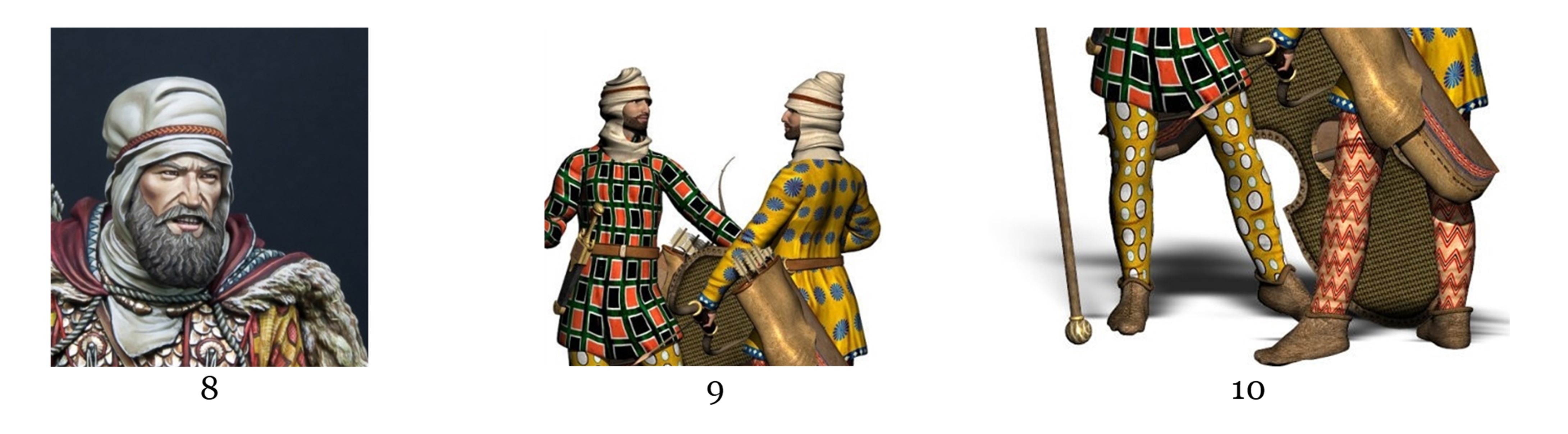
Persae hōc modō īnstrūctī sunt. In capite pilēōs gestant; hōs tiārās vocant: circā corpus, tunicās manicātās variī colōris, et lōrīcās ferreīs squāmīs in piscium similitūdinem: circā crūra, braccās: prō clipeīs vērō, crātēs vīmineās. Ā tergō suspēnsās habent pharetrās: hastae brevēs sunt, arcūs vērō grandēs, tēla ex arundine: praetereā ad dextrum femur ē zōnā suspēnsus est pūgiō.

arundō, arundinis [3/f]: [i] reed; [ii] shaft of an arrow

clipeus, -ī [2/m]: round shield

crātis, -is [3/f]: a “hurdle”, a moveable frame made of wickerwork

femur, femoris [3/n]: thigh (-bone)

īnstruō, -ere, īnstrūxī, instrūctus [3]: (here) equip

lōrīca, -ae [1/f]: coat of mail

manicātus, -a, -um: long-sleeved

pharetra, -ae [1/f]: quiver

pugiō, pugiōnis [3/m]: dagger

tiāra, -ae [1/f]: turban

vīmineus, -a, -um: wickerwork

zōna, -ae [1/f]: belt

[B] Match the phrases from the text with the images

ā tergō suspēnsās habent pharetrās

ad dextrum femur ē zōnā suspēnsus est pūgiō

arcūs vērō grandēs

circā crūra, braccās

et lōrīcās ferreīs squāmīs in piscium similitūdinem

hastae brevēs sunt

in capite pilēōs gestant; hōs tiārās vocant

prō clipeīs vērō, crātēs vīmineās

tēla ex arundine

tunicās manicātās variī colōris

____________________

The Persians are equipped in this manner: on the head they wear caps; these they call tiaras: about the body, tunics of various colours, with sleeves, and cuirasses with iron scales in the likeness of fish(es): breeches on their legs: but for shields (they carry) hurdles of wickerwork. They have quivers hung from the back; their spears are short, but their bows long; their arrows are (made) of reed; moreover, by the right thigh a dagger is suspended from the belt.

Sunday, February 23, 2025

20.05.25: Level 2; review; prīmus annus [5]; cāsus ablātīvus; [i] opus; [ii] filled with; [iii] adjectives + the ablative

Vīlla Cornēliāna

Contentī sumus fundō nostrō. Vaccae enim lāc et cāseum, gallīnae anatēsque ōva, pecora carnem praebent. Flūmen etiam, quod praeter vīllam fluit, piscibus plēnum est. Haec omnia nūllō labōre habēmus, sed sī frūmentum et vīnum cupimus, multō labōre opus est. Nostrī autem servī fundum dīligenter cūrant; nam dominum amant, quia et iūstus et benignus est; sī enim servus laude dīgnus est, et laudem et praemium accipit, sed is quī indīgnus est sine morā poenās dat.

Apud Claudium contrā miserī sunt servī; dominus enim ipse Rōmae habitat, vīlicus autem est omnium hominum iniūstissimus. Servōs enim cottīdiē ferit, neque umquam satis cibī eīs dat. Eī quī ēsuriunt nōn bene labōrāre possunt. Nōlunt igitur servī Claudiam dīligenter labōrāre, et quam plūrimī ē fundō aufugiunt. Eīs enim quī labōrant opus est cibō; eīs etiam qui nōn labōrant cibō opus est vīvendī causā.

[1] Respondē:

  1. Quālī pēnsō contentus est magister?
  2. Quālibus servīs contentus est dominus?
  3. Quibus rēbus mēnsa magistrī plena est?
  4. Quibus rēbus nostra camera plēna est?
  5. Quālibus hominibus nostra camera plēna est?
  6. Quibus rēbus malum pēnsum est plēnum?
  7. Quibus animālibus ager est plēnus? Quibus avibus fundus? Quibus animālibus mare?
  8. Quā rē dīgnus es, sī pēnsum bene fēcistī?
  9. Quā rē dīgnus es, sī pēnsum male fēcistī?
  10. Quā rē tibi opus est scrībendī causā?
  11. Quibus membrīs tibi opus est videndī causā? Et natandī causā (1)? Et ambulandī causā (1)?
  12. Cūr servī apud Cornēlium libenter manēbant?
  13. Cūr apud Claudium nōn manēbant?
  14. Quis nostrōrum rēgum iūstus erat et benīgnus?
  15. Quis nostrōrum rēgum poenās dedit, quia iniūstus erat?

(1) causā [+ genitive]: for the sake of; on account of; placed after the noun (or, here, gerund)

videndī causā │ literally: for the sake of seeking > in order to see

natandī causā│ literally: for the sake of swimming > in order to see

ambulandī causā │ literally: for the sake of walking > in order to see

vīvendī causā │ literally: for the sake of living > in order to live

https://adckl.blogspot.com/2024/10/121224-level-1-topic-school-4-arts.html

https://www.facebook.com/groups/latinforstarters/posts/611381141473158/

[2] uses of the ablative; find the Latin:

  1. A slave is worthy of praise.
  2. We are happy with our farm.
  3. The river is full of (filled with) fish.
  4. We have all these things with no work.
  5. They need food. [ = to them there is need of food]
  6. Much work is needed. [ = there is need of a lot of work]
  7. They flee from the farm.
  8. without delay

Notes

[1] opus, operis [3/n]: (here) need; necessity

opus esse: to have need (of something); the person who needs it is in the dative case, and what there is a need of is expressed either by the nominative case or, as here, the ablative case.

multō labōre [ablative] opus est │ a lot of work is needed [ = there is need for much work]

Eīs [dative] enim quī labōrant opus est cibō [ablative] │For those who are working need food. [ = To them who are working there is a need for food.

novō cōnsiliō [ablative] nunc mihi [dative] opus est (Plautus) │ Now I need [literally: to me there is need of] a new plan.

auxiliō [ablative] mihi [dative] opus fuerat (Cicero) │ I had needed assistance.

[2] Latin uses the ablative case (categorised under the ablative of means) with adjectives and verbs that refer to filling something with something or being filled with (full of) something:

Flūmen … piscibus plēnum est. │ The river is full of (filled with) fish.

Tōtum montem hominibus complēvit. │ He filled the whole mountain with men.

Vīlla abundat gallīnā, lacte, cāseō, melle (Cicero) │ The farm abounds in poultry, milk, cheese and honey.

[3] Some adjectives are followed by the ablative case; these adjectives may be classified under different uses of the ablative, but it is enough simply to recognise them:

contentus, -a, um: content, satisfied

Contentī sumus fundō nostrō. │ We are content with our farm.

(in)dignus, -a, -um: (un)worthy

sī enim servus laude dīgnus est │ for if the slave is worthy of praise

līber, -a, -um: free (from)

nūdus, -a, -um: naked; bare; deprived (of)

orbus, -a, -um: bereaved; bereft (of) e.g. parents; childless, fatherless etc.

vacuus, -a, -um: empty; devoid (of)

perge hinc ¦ omnī līber metū ¦ tēque et exercitum servā (Livy) │ march on from here ¦ free from all fear ¦  and save yourself and the army

Huic trādita urbs est nūda praesidiō, referta cōpiīs (Cicero) │ Rome is delivered to him stripped of protection, stocked with supplies

arce et urbe orba sum (Ennius) │ I am bereft of citadel and city

vacua dēfēnsōribus moenia (Livy) │ unmanned walls [ = walls devoid of defenders]

20.05.25: Level 2; topic; Mankind; the human body; accident and illness [11]; review; perfect passive participles

Images #1 - #3: Poisoned, murdered, snatched away, and thrown off rocks: many people in Classical Latin literature – both real and fictional – came to unfortunate ends: match the perfect passive participles with the images.

cruciātus

dēiectus          

fractum

mersus

necātus; occīsus

percussus; ictus         

raptus

strangulātus  

venēnātus

verberātus


Images #4 - #5: Translate and, this time, note the ablative without ā/ab expressing the means / instrument with / by which the action was performed rather than by a person.

Some more sticky ends ….

  1. Mīles sagittā trānsfīxus est.   
  2. Puer morsū serpentis venēnātus est.
  3. Rēx gladiō occīsus est.
  4. Domus incēnsa est.    
  5. Nāvis tempestāte dēlēta est.  
  6. Vir fulmine ictus est.

Image #6: The city of Rome and the Roman Empire are often presented in terms of violence; this is a skewed vision since the overwhelming majority of citizens lived in peace, but Classical Latin literature does include many descriptions of battles, political intrigue, rough justice, and the wrath of the Gods. Consequently, it is useful to build up a ‘bank’ of vocabulary connected with these sorts of themes.

cruciō, cruciāre, cruciāvī, cruciātūs [1]: torture; crucify

lacerō, lacerāre, lacerāvī, lacerātus [1]: tear to pieces

necō, necāre, necāvī, necātus [1]: kill; murder (especially without physical wounding e.g. by poison or hunger)

strangulō, strangulāre, strangulāvi, strangulātus [1]: strangle

superō, superāre, superāvī, superātus, [1]: conquer; overcome

vastō, vastāre, vastāvī, vastātus [1]: lay waste

venēnō, venēnāre, venēnāvī, venēnātus [1]: poison

verberō, verberāre, verberāvī, verberātus [1]: whip; beat

____________________

dēleō, dēlēre, dēlēvī, dēlētus [2]: destroy

obsideō, obsidēre, obsēdī, obsessus [2]: besiege

____________________

[īcō], icere, īcī, ictus [3]: hit; strike (In Classical Latin literature only the perfect forms are found.)

caedō, caedere, caesī  caesūs [3]: cut; strike; kill

frangō, frangere, frēgī, frāctus [3]: break

incendō, incendere, incendī, incēnsus [3]: set fire to

mergō, mergere, mersī, mersus [3]: plunge; drown

occīdō, occīdere, occīdī, occīsus [3]: kill

submergō (also summergō), submergere, submersī, submersus [3]: sink

trānsfīgō, trānsfīgere, trānsfīxī, trānsfīxus [3]: thrust through

____________________

dēiciō, dēicere, dēiēcī, dēiectūs [3-iō]: throw down

interficiō, interficere, interfēcī, interfectus [3-iō]: kill; assassinate; slay

percutiō, percutere, percussī, percussūs [3-iō]: strike; beat

rapiō,   rapere, rapuī, raptus [3-iō]: snatch; abduct

19.05.25: Level 1; readings [15]: silence is golden

Iam Epicharmus Mārcum rogat: “Cūr istī virī tantopere clāmant? Cūr nōs Graecōs contumēliīs violant?”

Sed Mārcus: “Tacē, Epicharme! Tacē et tū, Dēmarāte! Ecce, istī virī iam quiētī sunt. Vītāte igitur rixam, amīcī!”

Sed ūnus ē virīs Rōmānīs Graecōs rogat: “Num patria vestra Graeciā est, puerī?”

Graecī nihil respondent, sed Mārcus: “Graecī sunt, nōn negō, sed amīcī meī! Es igitur quiētus et abstinē contumēliīs et iniūriīs!”

Cēterī autem virī clāmant: “Cūr vōs iuvat in Ītaliā nostrā esse? Cūr nōn in parvīs oppidīs vestrīs manētis? Cūr Rōmam nostram intrāre audētis? Properāte abīre, nisi…”

“Este quiētī” Mārcus clāmat, “este hūmānī!”

Virī autem “Movē tē cum amīcīs tuīs! Nōs neque Graecōs neque amīcōs Graecōrum amāmus!”


18.05.25: Level 3; the locative case (2); other nouns with the locative case

Image: A small number of nouns which do not fall under the category of towns, cities and small islands also have a locative case. Apart from rūs [3/n] the locative case is the same as the genitive singular.

humus, -ī [2/f]: ground; earth; soil  > Locative: humī  (on the ground)     

mīlitia, -ae [1/f]: military service > Locative: mīlitiae (on military service)

domus (irregular): house; *domus is an irregular noun in that its declension can comprise 2nd declension endings, but also 4th declension endings. However, the locative case is the same as the genitive case when 2nd declension endings are used i.e. domī (at home)

bellum, -ī [2/n]: war > Locative: bellī (at war) 

rūs, rūris [3/n]: countryside > Locative: rūrī (in the countryside) 

bellī domīque │ in war and (in) peace (at home)

Aurīga humī iacet. │ The charioteer is lying on the ground.

Flāviae pater magnam vīllam rūrī habet. │ Flavia’s father has a large house in the countryside.

tum porrō puer, ut saevīs prōiectus ab undīs nāvita, nūdus humī iacet īnfāns (Lucretius) │ Then further the child, just like a sailor cast forth by savage waves, lies naked and speechless on the ground

Scelestissimē, audēs mihi praedicāre id, domī tē esse nunc, quī hīc ades? (Plautus) │ You consummate villain, do you dare tell me this, that you are now at home, who are here present?

Quīn rūrī es in praefectūrā tuā? (Plautus) │But why aren't you in the country, at your post of command?

Mam. Aemilium, prīncipem aetātis suae bellī domīque, aerārium fēcērunt (Livy) │ They reduced Mamercus Aemilius, the foremost man of his time in war and peace (at home), to the lowest class of citizens

Latin tutorial: https://www.youtube.com/watch?v=VwLS-fh3pVg


Saturday, February 22, 2025

18.05.25: Level 3; the locative case; place names (3)

[iv] Greek city-states

[10] Syrācūsae: Syracuse is an historic city on the island of Sicily noted both for its rich Greek and Roman history, culture and architecture, and as the birthplace of the mathematician and engineer Archimedes. Founded by Ancient Greek settlers, it became a powerful city-state, allied with Sparta and Corinth, and during Roman Rule it was capital of the province of Sicily. The term Magna Graecia was used to refer to the Greek-speaking coastal areas of Southern Italy. Later writers also included Sicily.

https://en.wikipedia.org/wiki/Syracuse,_Sicily

https://en.wikipedia.org/wiki/Magna_Graecia

[11] Athēnae: One of the world’s oldest cities, Athens was a powerful city-state and a centre for the arts and learning. It is considered the birthplace of democracy and had considerable cultural and political impact on Ancient Rome.

https://en.wikipedia.org/wiki/Athens

[12] Corinthus: Corinth was an ancient city-state and developed as a commercial centre. In 146 BC, the city was destroyed by the Roman army. In 44 BC, as a newly rebuilt Roman colony it became the administrative capital of the Roman province of Achaea.

https://en.wikipedia.org/wiki/Corinth


[v] Byzantium

[13] Bȳzantium (present-day Istanbul) [Anc. Gk. Βυζάντιον (Būzắntĭon)] was an Ancient Greek city which adopted the name of Kōnstantinoupolis [Anc. Gk. Κωνσταντινούπολις; Latin: Cōnstantīnopolis; Eng. Constantinople ‘the city of Constantine’] after its foundation under Roman emperor Constantine I, who transferred the capital of the Roman Empire to Byzantium in 330AD.

The Byzantine Empire, also known as the Eastern Roman Empire, was the continuation of the Roman Empire in its eastern provinces in late antiquity and the Middle Ages surviving the fragmentation and collapse of the Western Roman Empire in the 5th century AD. It continued to exist for a further 1,000 years until the fall of Constantinople to the Ottoman Empire in 1453. During most of its existence, the empire remained the most powerful economic, cultural, and military force in Europe.

https://en.wikipedia.org/wiki/Byzantium

[vi] Egypt

Egypt (Aegyptus) was a province of the Roman Empire from 30BC until 641AD. After the assassination of Julius Caesar in 44 BC, the Ptolemaic Kingdom which had ruled Egypt since the Wars of Alexander the Great took the side of Mark Antony against the eventual victor Octavian, who as Augustus became the first Roman emperor in 27 BC, having defeated Mark Antony and the pharaoh, Cleopatra VII, at the naval Battle of Actium. After the deaths of Antony and Cleopatra, the Roman Republic annexed the Ptolemaic Kingdom of Egypt.

[14] Alexandrēa (Alexandria): Mediterranean port city in Egypt founded by Alexander the Great; it was home to the Lighthouse of Alexandria, one of the seven wonders of the ancient world, and to the Library of Alexandria.

https://en.wikipedia.org/wiki/Alexandria

[15] Thēbae (Thebes): Ancient Egyptian city about 800km south of the Mediterranean, the ruins within the modern city of Luxor

https://en.wikipedia.org/wiki/Thebes,_Egypt


18.05.25; Level 3; the locative case; place names (2)

[iii] wars and battles

[6] Cannae (now Canne della Battaglia) was a village in south east Italy and famous for being the site of the disastrous defeat of the Romans by Hannibal during the Second Punic War in 216BC. An estimated 60,000–70,000 Romans were killed or captured at Cannae.

https://en.wikipedia.org/wiki/Battle_of_Cannae

[7] Carthāgō (Carthage) was the capital of the Carthaginian civilisation in what is modern-day Tunisia. A major trading hub and one of the wealthiest cities in the classical world, it was destroyed by the Roman Republic in the Third Punic War in 146BC. Subsequently re-developed as Roman Carthage it became the major city in the Roman province of Africa.

https://en.wikipedia.org/wiki/Carthage

[8] Philippī [Gk: Φίλιπποι, Philippoi] was a major Greek city; it was here during the Civil War that Octavian and Mark Anthony, heirs of Julius Caesar,  faced the forces of Brutus and Cassius, Caesar’s assassins. The battle was fought on a plain near the city in 42BC, resulting in the defeat of Brutus and Cassius

https://en.wikipedia.org/wiki/Philippi

[9] Troia (Troy): ancient city in present-day Turkey in habited since the 4th millennium BC and the location of the Trojan War

https://en.wikipedia.org/wiki/Troy

https://en.wikipedia.org/wiki/Trojan_War


site of the battle of Cannae


the ruins at Carthage


the Forum at Philippi


Troy

18.05.25: Level 3; the Ethiopians

Translate into English:

Aethiopēs, pardōrum leōnumque pellibus amictī, arcūs habent praelongōs: sagittās vērō brevēs; hīs prō ferrō lapidēs acūtī praefīxī sunt. Hastās praetereā habent, hīs praefīxa sunt cornua cervōrum: habent etiam clāvās nōdōsās. Corporis dīmidium, in pugnam prōdeuntēs, crētā dealbātum habent, dīmidium miniō pictum. Aliī caput tēctum habent pelle equīnā, dē capite equī dētractā, cum auribus et iubā. Prō scūtīs gruum pellibus corpora tegunt.

Vocabulary

amiciō, -īre, amicuī / amixī, amictus [4]: clothe; dress; cover

cervus, -ī [2/m]: stag

clāva, -ae [1/f]: club

dētrahō, -ere, dētrāxī, dētractus [3]: pull / drag off (down, away)

minium, -ī [2/n]: cinnabar, a deep red mineral used in the making of the vermilion pigment

https://en.wikipedia.org/wiki/Cinnabar

nōdōsus, -a, -um: knotty (of wood); entangled

pardus, -ī [2/m]: leopard

pingō, -ere, pīnxī, pictus [3]: paint; tint; colour

praefīgō, -ere, praefīxī, praefīxus [3]: (here) fix on the end

praelongus, -a, -um: very long

Similarly:

praeclārus, -a, -um: very clear / bright; famous; splendid

praepotēns, praepotentis: very powerful

praedīlēctus, -a, -um: favourite

dealbō, -āre, -āvī, -ātus [1]: whiten; whitwash; cover in plaster

vae vōbīs scrībae et Pharisaeī hypocritae quia similēs estis sepulchrīs dealbātīs (Vulgate) │ Woe to you, scribes and Pharisees, hypocrites! For you are like [similar to] whitened tombs …

Notes

[1] in pugnam prōdeuntēs; present active participle prōdiēns, prōdeuntis from prōdeō, prōdīre: go forth; advance

[2] ablative agreement:

Aliī caput tēctum habent ¦ [i] pelle equīnā ¦, dē capite equī ¦ [ii] dētractā

Others have the head covered ¦ with horse hide ¦ pulled ¦ from the head of the horse

____________________

The Aethiopians, dressed / clad / covered in the skins of leopards and lions, have very long bows, but short arrows; instead of iron, these are tipped with sharp stones [literally: sharp stones are fastened to these on the end] Moreover / in addition, they have spears; these are tipped with stag’s horns [see previous literal translation].  When advancing into battle they have half of the body whitened with chalk, half painted with vermilion [see vocabulary]. Others have the head covered with horsehide / the skin of a horse, pulled off from the head of the horse together with the ears and mane. Instead of shields they cover their bodies with the skins of cranes.

17.05.25: Level 2; review; prīmus annus [4]; cāsus ablātīvus; cāsus accūsātīvus; expressions of time

Diēs Puerī Britannī

Puer Britannus prīmā hōrā (1) ē lēctō surgit. Ex cubiculō ad prandium dēscendit. Tum domō ad lūdum it. Ibi trēs vel quattuor hōrās labōrat. Prīmum linguam Gallicam discit, deinde Anglicam, postrēmō scientiam mathēmaticam. Tandem ē lūdō exit et domum ad secundum prandium redit. Ūnam hōram domī manet. Post prandium iterum ad lūdum venit. Decimā hōrā in campum exit.

Vesperī domum ad cēnam redit. Post cēnam pēnsum facit. Mox dormīre vult. Prīmā igitur vigiliā sē in lēctum iacit. Brevī sē somnō dat, et trēs vigiliās dormit. Prīmā hōrā gallus cantat; cum gallus cantat, puer nōn iam dormit; sed ē lēctō statim surgit; saepe etiam ante hanc hōram surgit, nam in lēctō manēre nōn vult. Cottīdiē māne surgit, merīdiē prandet, vesperī (2) cēnat, noctū (3) dormit.

(1) Ancient Roman timekeeping refers to the first hour of the day i.e. the first hour after dawn i.e. between 0600 – 0700 am; precise timings could vary depending on the time of the year

(2) vesperī or vespere

(3) noctū is an old ablative form; nocte is also used

[1] Respondē:

  1. Quandō ē lēctō surgis?
  2. Quandō tē in lēctum iacis?
  3. Quandō tē somnō dās?
  4. Quandō prandēs?
  5. Quandō cēnās?
  6. Quandō linguam Latīnam discis?
  7. Quid māne discis? (prīmō, deinde, postrēmō)
  8. Quis prīmā hōrā cantat?
  9. Quandō tū cantās?
  10. Quid māne facis? Quid merīdiē? Quid noctū?

[2] Expressions of time with the ablative; find the Latin:

[a]

  1. at the first hour
  2. at the tenth hour
  3. at the first “watch”; in Ancient Rome the night was divided into four vigiliae

[b]

  1. at midday
  2. in the evening
  3. at night

[c]

within a short time

[3] expressions of time with the accusative; find the Latin:

  1. He stays at home for one hour.
  2. He works for three or four hours.
  3. He sleeps for three “watches”.
  4. after lunch
  5. after dinner
  6. before this time / hour

[4] three different cases:

  1. He goes from home (ablative).
  2. He goes back (to) home (accusative).
  3. He stays at home (locative)