Monday, January 6, 2025

23.03.25: Level 3; deponent verbs (6)(i); imperfect and future tenses; exercise [1]

Focus on what matters i.e. recognise [i] meaning [ii] tense and [iii] who / what is performing the action. You need to go slowly before you can go quickly! You’ve seen in the two previous posts that there are consistent personal endings and clear markers for tenses. Match the English verbs with the Latin deponent verbs in the word cloud all of which are either imperfect or future tense:

1st conjugation

hortor, -ārī, -ātus sum: to encourage, urge

minor, -ārī, -ātus sum: to threaten

mīror, -ārī, -ātus sum: to wonder at, be surprised

2nd conjugation

vereor, -ērī, veritus sum: to fear

3rd conjugation

loquor, loquī, locūtus sum: to speak, talk

proficīscor, proficīscī, profectus sum: to set out, depart

sequor, sequī, secūtus sum: to follow

ūtor, -ī, usus sum: to use, make use of

3rd-iō conjugation

prōgredior, -ī, prōgressus sum: to advance, go forward

morior, -ī, mortuus sum: to die

4th conjugation

orior, -īrī, ortus sum: to rise, arise

potior, -īrī, potītus sum: to get possession of

  1. The sun was rising. │ Sōl __________
  2. The sun will rise.│ Sōl __________
  3. The king was threatening him with death. │ Rēx eī mortem __________
  4. I often used a sword. │ Gladiō saepe __________
  5. We shall not fear the enemy. │ Hostēs nōn __________
  6. Whom were you encouraging? │ Quem __________?
  7. Whom will you encourage? │ Quem __________?
  8. When will they set out? │ Quandō __________?
  9. The boy will set out at dawn. │ Puer prīmā lūce __________ 
  10. The senator was speaking loudly. │ Senātor magnā vōce __________
  11. We will always follow you. │ Tē semper __________
  12. They used to admire the girl’s beauty. │ Pulchritūdinem puellae __________
  13. You are gods … but you will die just like men. │ Dīī estis …, vōs autem sīcut hominēs __________
  14. Moreover, when we (will) become masters / take possession of a very beautiful and wealthy city … │ __________ praetereā cum pulcherrimā opulentissimāque urbe … (Livy) 
  15. Labienus … was proceeding quietly. │ Labiēnus … placidē __________. (Caesar)


22.03.25: level 3; review; ACL/NJCL NATIONAL LATIN EXAM (Latin 2); 2012; Part 1 [2]: answers and notes

[1] Nēmō sine aquā diū vīvere potest. │ A) without watersine + ablative case: without

Nobody can live a long time without water.

[2] Magnum flūmen per campōs Italiae celerrimē fluit. │ D) very swiftlysuperlative adverb

celerrimus, -a, -um: superlative adjective > celerrimē: superlative adverb; either ‘most quickly’ or, commonly, very quickly

A large river flows very quickly through the fields / plains of Italy.

[3] Difficile est nāvigāre autumnō. B) in the Fallablative of time when

It is difficult to sail in the Fall / Autumn.

[4] Mox hic senātor erit _____. A) cōnsulpredicate nominative i.e. a noun or adjective which follows the verb ‘to be’ and gives further information about the subject of the sentence i.e. X = Y e.g. this man is a doctor; this man is brave; the noun or adjective is in the nominative case agreeing in gender and number

This senator will soon be a consul.

[5] Vir humilis numquam laudat. │C) himselfreflexive pronoun referring back to the subject

A humble man never praises himself.

[6] Vīsne omnēs populōs esse līberōs? │ D) Do you wish │ irregular verb: velle

Do you wish all people to be free?

[7] Mīlitēs Rōmānī fortiōrēs omnibus hostibus erant. │ A) than all their enemiesablative of comparison = Engl. ‘than’

The Roman soldiers were braver than all the enemies.

[8] Ancillae ā dominā laudātae sunt.B) were praisedperfect passive

The maidservants were praised by the mistress.

[9] Dā mihi vīnum, _____! │B) Rūfe vocative case of 2nd declension nouns in -us > -e

Give me wine, Rufus!

[10] Liberīs [dative] ¦ arma habēre ¦ nōn licet. │ D) Children are not permitted to have weapons. │ licet: impersonal verb = it is allowed / permitted and is followed by the dative case i.e. it is not permitted for children to have weapons

[11] Nōlī abīre; tē mēcum manēre volō! │ B) Don’t go away │negative imperative: nōlī(te) + infinitive

Don’t go away; I want you to stay with me!

[13] Medicus amīcum vulnerātum ē proeliō portāvit. │ A) wounded │ perfect passive participle used as an adjective

The doctor carried (his) wounded friend [= his friend who had been wounded] out of the battle.

[13] Multa et mala Troiānīs ā Iūnōne facta sunt. │ B) by Juno │ablative of agent i.e. the person by whom an action is performed

Many evil things were done to the Trojans by Juno.

[14] Equī huius hominis quattuor diēbus vēndentur. │ C) of this man │ declension of hic, haec, hoc

The horses of this man / this man’s horses will be sold within four days.

[15] Quibus dux auxilium dedit? │ C) To whom │ declension of quis? (who?); here: dative plural implying that more than one person was given help.

To whom did the commander give help? / Who did the commander give help to?

[16] Rēgēs, quōrum potestās maxima est, multōs annōs regent. │  C) whose  declension of quī, quae, quod

Kings, whose power [= the power of whom] is very great, will reign for many years.

Notes: at this level you should be familiar with the specific grammatical terms for different features:

Image #1: question [14] refers to the demonstrative pronoun / adjective hic, haec, hoc (those; these)

Equī huius hominis quattuor diēbus vēndentur. │ The horses of this man will be sold within four days.

Grammar books may refer to hic, haec and hoc either as demonstrative pronouns or demonstrative adjectives, or both terms together. The reason for this is that they serve more than one function:

[i] If they describe a named noun e.g. hic liber (this book) we can say that they are acting as a demonstrative adjective as in the example above.

[ii] If they stand alone i.e. they are in place of a noun then they can be defined as demonstrative pronouns e.g. this (man), this (one) or he; this (woman), she; this (thing), it

In the plural, the same range of translations in [i] and [ii] apply e.g. these (books), these (ones / men / women / things), they

Context will determine the best translation.

Images #2 and #3: questions [15] and [16]

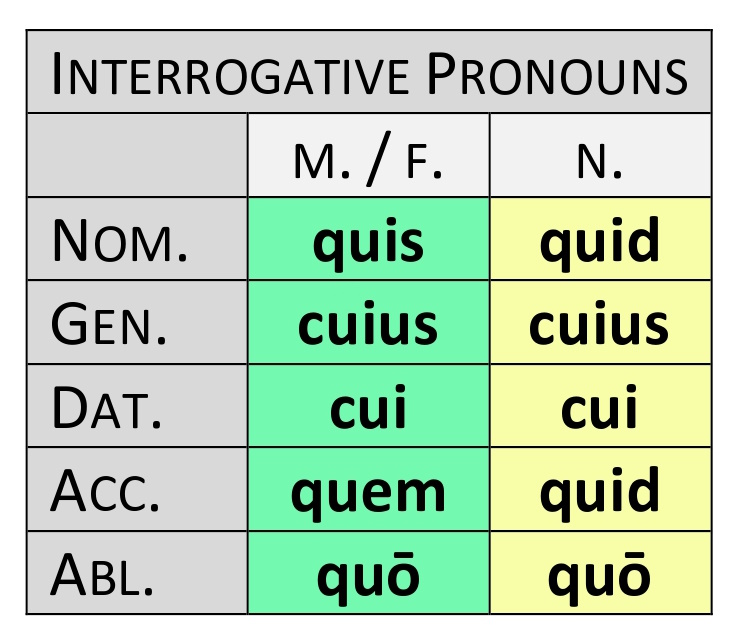
Image #2: question 15 refers to quis / quid? (who / what?) i.e. an interrogative pronoun asking a question

Quibus dux auxilium dedit? │ To whom did the commander give help?

Image #3: question 16 refers to quī / quae / quod (who / which) i.e. a relative pronoun that introduces a relative clause which gives more information about the preceding noun in the main clause

Rēgēs, ¦ quōrum potestās maxima est, ¦ multōs annōs regent. │ Kings, ¦ whose power is very great / the greatest, ¦ will reign for many years.

There is almost no difference in the declensions of both of these:

[i] the interrogative pronoun (quis?) can be masculine or feminine

[ii] the interrogative pronouns in the plural are identical to the relative pronouns

21.03.25: level 3; review; ACL/NJCL NATIONAL LATIN EXAM (Latin 2); 2012; Part 1 [1]: questions

https://www.nle.org/_files/ugd/aac38e_3e2b56d7415a48ccb21db95515467db6.pdf

The first part of the test has eighteen questions on different features of Latin grammar; of the 18 questions, 16 of them have already been covered in the group. Therefore, two questions have, at this stage, been omitted but will be discussed at level 3 in detail in later posts. The numbering of the questions in the original test paper has been altered in order to put some features of the language together.

[1] Nēmō sine aquā diū vīvere potest. A) without water B) by water C) in water D) out of water

[2] Magnum flūmen per campōs Italiae celerrimē fluit. A) swift B) swiftly C) more swiftly D) very swiftly

[3] Difficile est nāvigāre autumnō. A) for the Fall B) in the Fall C) the Fall D) from the Fall

[4] Mox hic senātor erit _____. A) cōnsul B) cōnsulis C) cōnsulī D) cōnsule

[5] Vir humilis numquam laudat. A) them B) this C) himself D) her

[6] Vīsne omnēs populōs esse līberōs? A) Did you wish B) Will you wish C) Were you wishing D) Do you wish

[7] Mīlitēs Rōmānī fortiōrēs omnibus hostibus erant. A) than all their enemies B) of all their enemies C) by all their enemies D) with all their enemies

[8] Ancillae ā dominā laudātae sunt. A) are praised B) were praised C) will be praised D) had been praised

[9] Dā mihi vīnum, _____! A) Rūfus B) Rūfe C) Rūfō D) Rūfum

[10] Liberīs arma habēre nōn licet. A) Children ought to have their own weapons. B) He agrees that the children will not have weapons. C) Children do not like to have weapons. D) Children are not permitted to have weapons.

[11] Nōlī abīre; tē mēcum manēre volō! A) I am not going away B) Don’t go away C) No one is leaving D) Never leave

[12] Medicus amīcum vulnerātum ē proeliō portāvit. A) wounded B) about to wound C) wound D) wounding

[13] Multa et mala Troiānīs ā Iūnōne facta sunt. A) for Juno B) by Juno C) to Juno D) with Juno

[14] Equī huius hominis quattuor diēbus vēndentur. A) this man B) to this man C) of this man D) by this man

[15] Quibus dux auxilium dedit? A) Who B) Whose C) To whom D) With whom

[16] Rēgēs, quōrum potestās maxima est, multōs annōs regent. A) who B) to whom C) whose D) by whom

20.03.25: Level 2; Grammar Review; 3rd declension nouns [7]

gurges, gurg __ is [3/m]: __________

pariēs, pari __ is [3/m]: __________

serpēns, serpen __ is [3 m/f]: __________

imperātrīx, imperātrī __ is [3/f]: __________

laus, lau __ is [3/f]: __________

phalanx, phalan __ is [3/f]: __________

pōtiō, pōtiō __ is [3/f]: __________

crūs, crū __ is [3/n]: __________

fūnus, fūn __ is [3/n]: __________

lūmen, lūm __ is [3/n]: __________

-c-; -d-; -er-; -et-; -g-; -in-; -it-; -n-; -r-; -t-

batallion; drink; empress; funeral; leg; light; praise; snake; wall; whirlpool

19.03.25: H & B; level 2; reading; the Licinian laws

Quamquam multa pauperibus cīvibus concessa erant, nōndum tamen fīnītum erat inter patriciōs plēbēiōsque certāmen. Legēs identidem ā tribūnīs plēbis Liciniō et Sextiō rogābantur (1), per patriciōrum auctōritātem antīquābantur (2). Per multōs annōs multīs dē rēbus cīvitās dissēnsiōne perturbābātur. Tandem Camillus dictātor rempūblicam iterum servāvit. ‘Frūstrā iam,’ inquit, “tribūnōrum postulātiōnibus resistimus: multa patriciī concēdēmus; cōnsulum alter ē plēbēiīs semper creābitur; agrī pūblicī nēmō amplius quīngenta iūgera (3) possidēbit: contrā rēs ūna concēdētur ā plēbēiīs; iūs ā praetōre administrābitur, praetor ē patriciīs creābitur. Tum dēnique fīnīta erit dissēnsiō et pāx reīpūblicae reddētur.’ Placuit omnibus Camillī cōnsilium: posteā nūllae erant inter patriciōs et plēbēiōs dissēnsiōnēs: dictātor templum Concordiae dēdicāvit.

(1) rogō, -āre, -āvī, -ātus [1]: ask, but, in the context of laws, propose

(2) antīquō, -āre, -āvī, -ātus [1]: (here: with regard to laws) reject

(3) iūgerum, -ī [2/n]: unit of land measurement

https://en.wiktionary.org/wiki/iugerum

[A]

[1] Lines 1 – 4 (Quamquam … perturbābātur)

[i] True or false:

[a] The poor had received nothing from the patricians. (1)

[b] The struggles between the plebeians and the patricians were over. (1)

[ii]

[a] Who were Licinius and Sextius? (1)

[b] What requests did they make? (1)

[c] How did the patricians react? (1)

[d] How was the State affected? (2)

[2] Lines 4 – 9 (Tandem … reddētur)

[i] Why did Camillus decide to give concessions? (2)

[ii] What concessions were made concerning:

[a] consulships (3)

[b] public land (3)

[iii] What concession were the plebeians required to make? (4)

[iv] What did Camillus think would be the result of these concessions? (2)

[3] Lines 9 – end; translate (7); [i] Placuit omnibus [ii] Camillī cōnsilium: [iii] posteā [iv] nūllae erant [v] inter patriciōs et plēbēiōs [iv] dissēnsiōnēs: [vi] dictātor [vii] templum Concordiae [case?] [vi] dēdicāvit.

[4] In your own words briefly explain why the temple referred to in the text was appropriately named. (4)*

https://en.wikipedia.org/wiki/Concordia_(mythology)

[B] Choose the correct translation [a], [b] or [c]

  1. administrābitur: [a] was being managed [b] will be managed [c] is managed
  2. antīquābantur: [a] were rejected [b] was rejected [c] will be rejected
  3. concēdētur: [a] is conceded [b] are conceded [c] will be conceded
  4. concessa erant: [a] were conceded [b] have been conceded [c] had been conceded
  5. creābitur: [a] will be elected [b] was elected [c] is elected
  6. fīnīta erit: [a] will have been finished [b] was finished [c] had finished
  7. nōndum … fīnītum erat: [a] has not yet finished [b] were not yet finished [c] had not yet been finished
  8. perturbābātur: [a] will be … [b] was being … [c] is being … thrown into confusion
  9. reddētur: [a] is being returned [b] will be returned [c] are being returned
  10. rogābantur: [a] were proposed [b] had been proposed [c] was being proposed


By Classical Numismatic Group, Inc. http://www.cngcoins.com, CC BY-SA 3.0, https://commons.wikimedia.org/w/index.php?curid=380111

____________________

*The temple was dedicated to [i] Concordia, the Roman goddess often associated with political stability. The temple symbolically represents [ii] the peaceful end of a long period of strife [iii] between the plebeians and the patricians through [iv] concessions on both sides

18.03.25: Level 1; readings [1] - [5]: review (4)

Match the nouns with the images

adversāriī; aedificium; amīcī; argentum; aurum; dōnum; gladius; lacrimae; monumenta; populus; rōstra; sīmia; taberna; templum; tuba


17.03.25: Level 3; deponent verbs (5)(ii); imperfect and future tenses; 3rd, 3-iō, 4th conjugations

[1] imperfect tense: again, the tense markers are the same for all three conjugations i.e. -ba- / -bā-, the only difference being in the stem vowels:

3rd conjugation: revertor, revert¦ī, reversus sum [3/dep]: return

  • revert¦ē¦ba¦r, revert¦ē¦¦ris etc. │ I was returning / used to return, you (sg.) were returning etc.

3rd-iō conjugation: egredior, egredī, egressus sum [3-iō/dep]: go out

  • egred¦¦ba¦r, egred¦¦¦ris etc. │I was going out, you (sg.) were going out etc.

4th conjugation: mentior, mentī¦rī, mentitus sum [4/dep]: lie; deceive

  • ment¦¦ba¦r, ment¦¦¦ris │I was lying; I used to deceive; you (sg.) were lying etc.

[2] future tense

[i] 3rd conjugation: -a- / -ē[e]-

revertar: I shall return

revertēris: you (sg.) will return

revertētur: he/she/it will return

revertēmur: we will return

revertēminī: you (pl.) will return

revertentur: they will return

[ii] 3rd-iō conugation: -ia- / -iē[e]-

ēgrediar: I shall go out

ēgredris: you (sg.) will go out

ēgrediētur: he/she/it will go out

ēgrediēmur: we will go out

ēgrediēminī: you (pl.) will go out

ēgredientur: they will go out

[iii] 4th conjugation: -ia- / -iē[e]-

mentiar: I shall lie / deceive

mentris: you (sg.) will lie

mentiētur: he/she/it will lie

mentiēmur: we will lie

mentiēminī: you (pl.) will lie

mentientur: they will lie


Sunday, December 29, 2024

16.03.25: Level 3; Dē diē ac nocte [2]

Dē diē ac nocte

Lūx diēs vocātur. Obscūritās nox appellātur. Manē aurōra rubēscit. Stēllae ēvānēscunt. Lūcēscit. Diēs fit. Sōl oritur. Illam partem caelī Orientem appellāmus. Diēs ad labōrem datur. Sōl tōtō diē in caelō lūcet. Mediō diē sōl altus in caelō vidētur. Illam partem caelī Merīdiem vocāmus. Medius diēs et merīdiēs dīcitur. Multō diē advesperāscit. Sōl occidit. Illam partem caelī Occidentem dīcimus. Post occāsum sōlis caelum obscūrum fit. Stēllae iterum lūcēscunt. Nox fit. Nox ad quiētem datur. Vesperī lūna plēna ab oriente oritur. Haec tōtā nocte in caelō lūcet. Mediā nocte alta in caelō vidētur. Māne ab occidente occidit. Stēllae quoque ab oriente orīrī videntur. Hae aut ab occidente cadunt, aut ortū sōlis ēvānēscunt.

Four types of verb:

[i] active verbs 

[ii] passive verbs

[iii] deponent verbs

[iv] inchoative verbs; those are the verbs with the tell-tale -sc- in the stem that show change / the beginning of a change i.e. x is becoming y.

And …

[v] the verb: fiō (to become); more on this verb in a later post

[A] Complete the translations with the words listed below.

  1. Lūx diēs vocātur. │ The light __________ day.
  2. Obscūritās nox appellātur.  │ The darkness __________  night.
  3. Manē aurōra rubēscit. │ In the morning the dawn __________ red.
  4. Stēllae ēvānēscunt. │ The stars __________ [= are fading away i.e. a process of change].
  5. Lūcēscit. │It is __________ light.
  6. Diēs fit. │It is __________ day.
  7. Sōl oritur. │ The sun is __________.
  8. Illam partem caelī Orientem appellāmus. │ __________ that part of the sky the East.
  9. Diēs ad labōrem datur. │ The day __________ (over) to work.
  10. Sōl tōtō diē in caelō lūcet. │ The sun __________ all day in the sky.

becoming; disappear; getting; is called; is called; is given; rising; shines; turns; we call

[B] Complete the translations with the words listed below.

  1. In the middle of the day the sun is seen high in the sky. │ Mediō diē sōl altus in caelō __________.
  2. We call that part of the sky the South. │ Illam partem caelī Merīdiem __________ [2 possibilities].
  3. The middle of the day is also called noon. │ Medius diēs et merīdiēs __________.
  4. Late in the day it starts to become evening. │ Multō diē __________.
  5. The sun is going down / setting. │ Sōl __________.
  6. We call that part of the sky the West. │ Illam partem caelī Occidentem __________ [2 possibilities].
  7. After sunset the sky becomes dark. │ Post occāsum sōlis caelum obscūrum __________.
  8. The stars begin to shine again. │ Stēllae iterum __________.
  9. It becomes night. │ Nox __________.
  10. The night is given (over) to rest. │ Nox ad quiētem __________.

advesperāscit; datur; dīcimus; dīcitur; fit; fit; lūcēscunt; occidit; vidētur; vocāmus

[C] Complete the translation of the rest of the text; some words are used more than once.

Vesperī lūna plēna ab oriente oritur. │ In the [1] __________ a full [2] __________ [3] __________ from the [4] __________.

Haec tōtā nocte in caelō lūcet. │ It [5] __________ in the [6] __________ the whole [7] __________.

Mediā nocte alta in caelō vidētur. │ At [8] __________ it [9] __________ high in the [10] __________.

Māne ab occidente occidit. │ In the [11] __________ it [12] __________ from the [13] __________.

Stēllae quoque ab oriente orīrī videntur. │ [14] __________ are also [15] __________ [16] __________ from the [17] __________.

Hae aut ab occidente cadunt, aut ortū sōlis ēvānēscunt. │ These either [18] __________ from the [19] __________ or [20] __________ at [21] __________.

east; evening; fade away; fall; goes down; is seen; midnight; moon; morning; night; rises; rising; seen; shines; sky; stars; sunrise; west

15.03.25: Level 2; Grammar Review; 3rd declension nouns [6]

ariēs, ari __ is [3/m]: __________

carnifex, carnif __ is [3/m]: __________

homō, hom __ is [3/m]: __________

lepus, lep __ is [3/m]: __________

sermō, sermō __ is [3/m]: __________

sacerdōs, sacerdō __ is [3 m/f]: __________

fax, fa __ is [3/f]: __________

fraus, frau __ is [3/f]: __________

genus, gen __ is [3/n]: __________

ōs, ō __ is [3/n]: __________

-c-; -d-; -er-; -et-; -ic-; -in-; -n-; -or-; -r-; -t-

butcher; conversation; deceit; hare; man; mouth; priest(ess); ram; torch; type

14.03.25: H & B; level 2; reading; the first aeronauts

Daedalus artifex erat per omnem Graeciam nōtus. Templa aedificāvit, deum imāginēs mīrās et pulchrās fingēbat. Tum, quod sorōris fīlium necāverat, ā iūdicibus damnātus est et ad Crētam īnsulam discessit. Diū cum Īcarō fīliō captīvus in īnsulā tenēbātur. Tandem ālās fīnxit. ‘Marī undique,’ inquit, ‘velut carcere impedīmur: nāvēs nōn habēmus: arte tamen via aperiētur. Sī patris cōnsiliō pārēbis, per āera salūtem petēs.’ Tum ālās ad humerōs cērā dēligāvit. Statim Īcarus in āera ascendit: mox, quoniam prope sōlem volābat, cēra liquēscēbat, puer īnfēlīx in mare cecidit et poenās audāciae morte persolvit. Daedalus autem incolumis in Ītaliam volāvit ubi templum aedificāvit ālāsque Apollinī dēdicāvit.

[1] Lines 1 – 2 (Daedalus … fingēbat)

What information is given about Daedalus? (6)

[2] Lines 2 – 4; translate (10)

[i] Tum, quod ¦ [ii] sorōris fīlium ¦ [i] necāverat, ¦ [iii] ā iūdicibus ¦ [iv] damnātus est ¦ et [v] ad Crētam īnsulam ¦ [vi] discessit. [vii] Diū ¦ [viii] cum Īcarō fīliō ¦ [vii] captīvus ¦ [ix] in īnsulā ¦ [vii] tenēbātur. [x] Tandem ālās fīnxit.*

[3] Lines 4 – 5 (Marī … petēs)

[i] With what is the sea compared and why? (3)

[ii] How does Daedalus think they can escape? (1)

[iii] Why must the son follow the father’s advice? (2)

[4] Lines 6 – 8 (Tum … persolvit)

[i] How were the wings attached? (2)

[ii] What did Icarus immediately do? (1)

[iii] What happened to Icarus and why? Discuss not only the physical reasons for this but also the human failing which was the underlying factor. (4)

[5] Lines 8 – end (Daedalus … dēdicāvit)

How did the story end for Daedalus? Give details. (3); Daedalus autem incolumis in Ītaliam volāvit ¦ ubi templum aedificāvit ¦ ālāsque Apollinī dēdicāvit.


https://en.wikipedia.org/wiki/Icarus

____________________

*Then, because he had killed (his) son’s sister, he was condemned by (the) judges and departed to the island of Crete. For a long time he was held captive on the island with (his) son Icarus. Finally he made wings.

Saturday, December 28, 2024

13.03.25: Level 1; readings [1] - [5]: review (3)

Those first five short texts focus on the following aspects of Latin grammar:

[1] the first and second conjugations of Latin verbs

[2] the nominative and accusative case of the first and second declension of Latin nouns

The posts here will not deal with these in any detail since they have been discussed many times in earlier posts.

Below are ‘index cards’ that summarise the key points covered.


12.03.25: Level 3; deponent verbs (5)(i); imperfect and future tenses; 1st and 2nd conjugation

[i] The imperfect and future tense of the deponent verbs are formed in exactly the same way as the passive verbs.

[ii] The deponent verbs are passive in form but active in meaning. Therefore, sequebar means ‘I was following’ and sequar ‘I shall follow’; below are examples of deponent verbs in the imperfect and future tenses.

[iii] Look for the signs!

Although it’s been mentioned many times before, it is worth remembering that, when staring directly in the face of Latin declension and, here, conjugations, they can look intimidating. Take them apart to see what they are telling you:

image #1: three pieces of information are given

[1] from the infinitive comes the stem to which other endings are added

[2] a tense marker; here you have the imperfect and the future tenses for the 1st and 2nd conjugations

[3] finally, the personal endings

image #2: the personal endings for all deponent / passive verbs in the imperfect and future tenses are the same:

-r

-ris

-tur

-mur

-minī

-ntur

image #3 (i): imperfect: all conjugations; -ba- / -bā- are the tense markers which are added to the stem of the verb in this example:

cōnor, cōnā¦rī, cōnātus sum [1/dep]: try

cōnā- = stem

cōnā¦ba¦r: I was trying

cōnāris: you (sg.) were trying

cōnābātur: he/she/it was trying

cōnābāmur: we were trying

cōnābāminī: you (pl.) were trying

cōnābantur: they were trying

image# 3 (ii): future; 1st / 2nd conjugations; -bo- / -bi- / -bu-; note the difference in the 2nd person singular*

cōnā¦bo¦r: I shall try

*cōnāberis: you (sg.) will try

cōnābitur: he/she/it will try

cōnābimur: we will try

cōnābiminī: you (pl.) will try

cōnābuntur: they will try

Images #4 and #5 show the exact same forms for the 2nd conjugation deponent verb: pollicēor, pollicē¦rī, pollicitus sum [2/dep]: promise, the only difference being the stem vowel -ē-:


11.03.25: Level 3; dē diē ac nocte [1]

A text might be labelled as ‘level 3’ not because it is particularly difficult but rather shows specific features of the language working together in this case different verb types. For the moment, just become familiar with the text and review vocabulary. 

Dē diē ac nocte

Lūx diēs vocātur. Obscūritās nox appellātur. Manē aurōra rubēscit. Stēllae ēvānēscunt. Lūcēscit. Diēs fit. Sōl oritur. Illam partem caelī Orientem appellāmus. Diēs ad labōrem datur. Sōl tōtō diē in caelō lūcet. Mediō diē sōl altus in caelō vidētur. Illam partem caelī Merīdiem vocāmus. Medius diēs et merīdiēs dīcitur. Multō diē advesperāscit. Sōl occidit. Illam partem caelī Occidentem dīcimus. Post occāsum sōlis caelum obscūrum fit. Stēllae iterum lūcēscunt. Nox fit. Nox ad quiētem datur. Vesperī lūna plēna ab oriente oritur. Haec tōtā nocte in caelō lūcet. Mediā nocte alta in caelō vidētur. Māne ab occidente occidit. Stēllae quoque ab oriente orīrī videntur. Hae aut ab occidente cadunt, aut ortū sōlis ēvānēscunt.

[1] vocabulary [i]; match the Latin and English expressions:
  1. māne
  2. mediā nocte
  3. mediō diē
  4. merīdiēs
  5. multō diē
  6. ortū sōlis
  7. post occāsum sōlis
  8. tōtā nocte
  9. tōtō diē
  10. vesperī
after the sun sets; at mid-day; at midnight; for the whole day; for the whole night; in the evening; in the morning; late in the day; mid-day; when the sun rises

[2] vocabulary [ii]; find from the passage the antonyms (opposites) of the following words*:
  1. advesperascit
  2. diēs
  3. labor
  4. lūna
  5. lux
  6. occāsus 
  7. ab occidente
  8. oritur
  9. vesperī
[3] The questions here are not chronological i.e. the answers in the text are not in the same order as the questions; you have to “look around” the entire text!**
  1. What are seen rising from the east? 
  2. What colour is the dawn?
  3. What happens late in the day?
  4. When is the moon seen high in the sky?
  5. When do the stars disappear?
  6. When does the sky become dark?
  7. Where does the moon rise from?
  8. Where is the sun seen at midday?

__________

advesperascit │ lūcēscit; diēs │ nox; labor │ quiēs; lūna │ sōl; lux│ obscūritās; occāsus │ ortus; ab occidente  │ ab oriente; oritur │ occidit; vesperī │ māne

**

Stēllae quoque ab oriente orīrī videntur.

Māne aurōra rubēscit. [< ruber, -ra, rum]

Multō diē advesperāscit.

LūnaMediā nocte alta in caelō vidētur.

Stēllae … ortū sōlis ēvānēscunt. [or: Māne … Stēllae ēvānēscunt.]

Post occāsum sōlis caelum obscūrum fit.

Vesperī lūna plēna ab oriente oritur.

Mediō diē sōl altus in caelō vidētur.

Tuesday, December 17, 2024

10.03.25: Level 2; Grammar Review; 3rd declension nouns [5]

pulvis, pulv __ is [3/m]: __________

pectus, pect __ is [3/n]: __________

crux, cru __ is [3/f]: __________

aestās, aestā __ is [3/f]: __________

comes, com __ is [3 m/f]: __________

lapis, lapi __ is [3/m]: __________

iūdex, iūd __ is [3/m]: __________

virgō, virg __ is [3/]: __________

mūs, mū __ is [3 m/f]: __________

speculātor, speculāt __ ris [3/m]: __________

-c-; -d-; -er-; -ic-; -in-; -it-; -ō-; -or-; -r-; -t-

breast; companion; cross; dust; judge; mouse; spy; stone; summer; young woman

09.03.25: H & B; level 2; reading; the fate of M. Manlius

M. Mānlius, quod Capitōlium ē perīculō servāverat, Capitōlīnus ā cīvibus vocātus est. Posteā pauperum causam contrā patriciōs dēfendit. Statim patriciī Mānlium, sīcut anteā Sp. Cassium et Sp. Maelium, accūsāvērunt. “Rēgnum,’ clāmābant, ‘appetit.’ Itaque Cornēliī Cossī iussū vīnctus est et in carcerem ductus. Tum plēbēiī sordidātī in viās pūblicās veniēbant, prope arma prō vindice sūmēbant: patriciī propter timōrem līberāvērunt. Statim Mānliī audācia augēbātur: apertē iam plēbēiōs ad vim et arma vocāvit. Tum etiam ā tribūnīs plēbis accūsātus est. Frūstrā Mānlius pectus nūdāvit, vulnera ostendit, ā dīs immortālibus auxilium petīvit : hominis īnfēlīcis verba sine misericordiā audiēbantur. Ā iūdicibus damnātus est et mortī inhonestae trāditus. Nam dē saxō Tarpēiō, ubi Capitōlium servāverat, ā tribūnīs plēbis dēmissus est. Nēmō posteā ē Mānliā gente Mārcus vocātus est. 

[A]

[1] Lines 1  - 3 (M. Mānlius … appetit); explain why the following three statements are false:

[i] Manlius’ real name was Capitolinus. (3)

[ii] He supported the Patricians. (2)

[iii] He was the first to be accused of wanting to be a king. (2)

[2] Lines 4 – 6; translate (10)

Itaque Cornēliī Cossī iussū vīnctus est et in carcerem ductus. Tum plēbēiī sordidātī in viās pūblicās veniēbant, prope arma prō vindice sūmēbant: patriciī propter timōrem līberāvērunt.

[i] Itaque ¦ [ii] Cornēliī Cossī iussū ¦ vīnctus est ¦ [iii] et in carcerem ductus. ¦ [iv] Tum plēbēiī sordidātī ¦ [v] in viās pūblicās ¦ [vi] veniēbant, ¦  [vii] prope arma ¦ [viii] prō vindice ¦ sūmēbant: ¦ [ix] patriciī ¦ [x] propter timōrem ¦ līberāvērunt.

[3] Lines 6 - 9 (Statim …audiēbantur)

Statim Mānliī audācia augēbātur: apertē iam plēbēiōs ad vim et arma vocāvit. Tum etiam ā tribūnīs plēbis accūsātus est. Frūstrā Mānlius pectus nūdāvit, vulnera ostendit, ā dīs immortālibus auxilium petīvit : hominis īnfēlīcis verba sine misericordiā audiēbantur.

How does this extract illustrate that Manlius “went too far” in his actions against the patricians? Give your own views with reference to the Latin text (10)

[4] Lines 9 to end (Ā iūdicibus … vocātus est)

In what way was Manlius’ demise ironic and humiliating?

https://en.wikipedia.org/wiki/Tarpeian_Rock

https://en.wikipedia.org/wiki/Marcus_Manlius_Capitolinus

[B] Match the English with the Latin in the wordcloud

  • afterwards
  • against
  • almost
  • also; even
  • because
  • for; because
  • for; on behalf of
  • immediately
  • in vain
  • just like
  • nobody
  • now; already
  • on account of
  • on the command (of)
  • openly
  • previously
  • then
  • therefore


Marcus Manlius executed by being tossed from the Tarpiean Rock;  Beccafumi, Siena (1532-35)

Friday, December 6, 2024

08.03.25: Level 1; readings [1] - [5]: review (2)

Latin is crammed with “little words”, very often adverbs that state, for example, where, when or how often an action takes places, or words that connect sentences or ask questions. These words appear so frequently that it’s important to recognise them. One way is to try to group them based on related ideas e.g. time. Match the English with the Latin words and phrases in the wordclouds.

Wordcloud #1

  • what
  • when (not used as a question)
  • where
  • who
  • why
  • because
  • for i.e. because

__________ 

  • for a long time
  • no longer
  • not yet
  • now
  • suddenly
  • today
  • then

Wordcloud #2

  • of course
  • perhaps
  • however
  • but
  • therefore

__________

  • and
  • also; even
  • not
  • and not
  • not only … │ … but also …
  • neither … │… nor…

__________

  • very much
  • especially
  • so many

07.03.25: Level 2; Grammar Review; 3rd declension nouns [4]

artifex, artif __ is [3/m]: __________

custōs, custō __ is [3/m]: __________

eques, equ __ is [3/m]: __________

imber, imb __ is [3/m]: __________

lūx, lū __ is [3/f]: __________

nix, ni __ is [3/f]: __________

vēritās, vēritā __ is [3/f]: __________

carmen, carm __ is [3/n]: __________

lītus, līt __ is [3/n]: __________

mūnus, mun __ is [3/n]: __________

-c-; -d-; -er-; -ic-; -in-; -it-; -or-; -r-; -t-; -v-

craftsman; gift; guard; horseman; light; rain; shore; snow; song; truth

Thursday, December 5, 2024

06.03.25: Level 3; deponent verbs (4)

Find the Latin in the word cloud:

(the sun) rises

he / she sets out

he / she threatens

I am angry

I linger

I wander

they promise

they return

they use

we follow

we lie

we return

you (pl.) encourage

you (pl.) fear

you (pl.) try

you (sg.) admire

you (sg.) go out

you (sg.) speak

cōnāminī; ēgrederis; hortāminī; īrāscor; loqueris; mentīmur; minātur; mīrāris; moror; oritur; pollicentur; proficīscitur; regredimur; revertuntur; sequimur; ūtuntur; vagor; verēminī

06.03.25: Level 3; reading; the four seasons [4]; winter

Dē hieme

Hieme sōl humilis ab austrō vidētur. Merīdiē vix calēscit. Brevissimī diēs, noctēs longissimae sunt. Nam ad occāsum properat sōl hībernus; nox hīberna morātur ac tardātur. In diēs frīgēscit. Terra frīgore et pruīnā rigēscit. Tempestās perfrīgida fit.

Prīmā hieme nix in altīs montibus esse incipit. Cōpia nivis in diēs crēscit. Omnia loca superiōra paulātim nive albēscunt. Flūmina et lacūs rigent gelū. Post paulō īnferiōra quoque loca nive alba sunt. Caelum iam serēnum iam nūbibus obscūrum est.

Tum dēmum summa* hiems in terram ruit. Ventī per terrās turbine flant. Omnia furōre tempestātis miscentur. Nox ātra terrae impendet. Hiems omnia nive cingit. Multōs diēs tempestās furit. Posteā fragor ventōrum cadit. Boreās nūbēs fugat atque caelum serēnat. Omnia silent. Tum sōl, lūna et lūcida sīdera omnēs agrōs silvāsque nive candidās dēspiciunt.

Vocabulary                                                                     

humilis, -e: low

vidētur: (it) is seen

occāsus, -ūs [4/m]: (here) West

morātur: lingers

tardātur: is delayed

incipiō, -ere; incēpī [3-iō]: begin

superior [m/f], -ius [n]: higher

rigeō, -ere; - [2]: become solid; stiffen

īnferior [m/f], -ius [n]: lower

summa* hiems: the depth of winter

ruō, -ere; ruī [2]: rush; tumble; fall

turbō, -īnis [3/m]: whirlwind; tornado

furor, -ōris [3/m]: rage; madness; fury

miscentur: (they) are mixed

āter, ātra, -um: black; dark

impendeō, -ere; - [2] + dat: hang over

cingō, -ere; cīnxī [3]: surround

furō, -ere; furuī [3]: rage; rave

fragor, -ōris [3/m]: noise; din

boreās, -ae [1/m]: North wind

dēspiciō, -ere; dēspexī [3]: look down on

*summus, -a, -um: [i] highest; greatest [ii] top - although summus is an adjective, it is often translated into English as a noun ‘the top of’ i.e. conveying the highest point either physically or with abstract concepts:

Cōnsul ipse vir summae dignitātis fuit. │ The consul himself was a man of the greatest worth.

summī et infimī │ the highest and the lowest (people)

Summā celeritāte ad silvam contendit. │He made for the forest with the utmost speed.

Avēs in summīs arboribus erant. │ The birds were in the treetops.

Poēta versōs summā vōce recitābat. │The poet was reciting the verses at the top of voice.

Novum templum in summō monte aedificaverunt. │ They’ve built a new temple on the top of the mountain.

Summā aestāte sōl maximē ārdet. │The sun burns the most at the height of summer.

Erat hiems summa, tempestās perfrīgida, imber maximus. (Cicero) │ It was the depth of winter, the weather was very cold, and the rain was very heavy.

[A]

  1. How is the sun described in the first sentence?
  2. What is the weather like at noon?
  3. In what direction is the sun hurrying?
  4. What happens to the ground?
  5. “Tempestās perfrīgida fit.” [i] Does tempestās refer to a storm? [ii] What is the function of the prefix per- in “perfrīgida”?
  6. When and where does the snow first begin to appear?
  7. How do the higher places change?
  8. What happens to the rivers and lakes?         
  9. Describe the sky.
  10. How does the writer convey the force of the winds?
  11. Why does the night seem threatening?
  12. “Multōs diēs tempestās furit. Posteā fragor ventōrum cadit. Boreās nūbēs fugat atque caelum serēnat. Omnia silent.” Explain in your own words how the weather changes.
  13. How are the fields and forests described?

[B] Find the Latin for:

  • a little while after
  • afterwards
  • at one time … at another …
  • day by day
  • finally
  • for; because
  • scarcely; hardly
  • then