At the time I mentioned that
Vincent used a number of verbs which, at that stage, should simply be noted
until the appropriate time came to look at those verbs in more depth because
they are all deponent. Now that we have looked in detail at the deponent verbs
we can look again at the text:
fruor, fruī, frūctus sum [3/dep]: enjoy
loquor, loquī, locūtus sum [3/dep]: speak
queror, querī, questus sum [3/dep]: complain
versor, versārī, versātus sum [1/dep]: live; stay;
be somewhere
Vincentius loquor. │ I, Vincent, am talking
= This is Vincentius speaking / talking.
Est diēs calidus. │ It’s a hot day.
Temperātūra est ferē trīgintā quattuor
gradūs celsiī. │ The temperature is about 34⁰C.
Multī nōn crēdunt │ Many (people)
don’t believe (it)
sed hoc mihi placet. │ but [literally] this pleases
me = I like this.
Vērum est. │It’s true.
Ferē numquam queror │ I almost
never complain
dē calōre aestātis │ about the heat
of the summer.
quia mihi placet.
│ because [literally] it is pleasing to me = I like it
In hōc hortō pūblicō │In this park [lit: public
garden]
nōmine ‘Brazos Bend State Park’
│[literally] by the name of = called ‘Brazos Bend State Park’
versantur multī alligātōrēs. │ there
are many alligators.
Venīte mēcum │ Come with me
ad eōs spectandōs. │ to look at them.
Sī eōs vidēbō │ If I see them,
vōbīs ostendam. │ I’ll show you.
Bene, iam nōn multum loquar.
│Well, I’ll not talk much any more [lit: I will no longer talk a lot]
Volō enim multum ambulāre
│ For I want to walk a lot
et fruī deambulātiōne.* │ and enjoy the
walk.
Vīdī nōnnūllōs alligātōrēs │I saw / I
have seen some alligators
fortasse quīnque, sex aut septem
│ perhaps 5, 6 or 7
sed omnēs vidēlicet in aquā natant
… nunc. │ but they’re all evidently swimming in the water … now.
Nūllī versantur in terrā.
│ None are on the land.
*Deponent verbs followed by the ablative case
Volō enim multum ambulāre
│ For I want to walk a lot
et fruī deambulātiōne.* │ and enjoy
the walk.
fruor, fruī,
frūctus sum [3/dep]: enjoy
cibō
fruitur. │ He enjoys food.
Other deponent verbs that are followed by the
ablative case:
ūtor, ūtī, ūsus sum [3/dep]: use
Vincere scīs, Hannibal, victōriāūtī nescīs.
(Livy) │You know how to conquer, Hannibal, but you do not know how to use the
victory.
Miles gladiōūtitur. │ The soldier
uses a sword.
Omnibus
cōpiīsūtuntur. │ They make use of all their forces.
fungor, fungī,
fūnctus sum [3/dep]: perform (a duty / function)
consulatūfungitur. │He performs the office of consul.
vescor, vescī,
-no perfect- [3/dep]: feed upon
Numidae
plērumque carne vēscuntur. │ The Numidians generally eat / feed on meat.
potior, potīrī,
potītus sum [4/dep]: obtain; take possession of
pīrātae nāvīpotiuntur. │The pirates take control of the ship.
Rēx Aegyptī
bellum īnfert quī terrāpotītur atque thēsaurōs templī et rēgiae
aufert. │ The king of Egypt wages war and he takes possession of the land
and steals the treasures of the temple and the palace.
Knowing what the genitive singular of
third declension nouns is not entirely a shot in the dark; there are patterns. Patterns
do not apply to every noun in the declension but there are certain endings to
look out for which will always have the same genitive case. Some examples came
up in the military vocabulary in the previous post:
[i]
imperātor, imperātōris
[3/m]: commander
-(t)or > -ōris
[ii]
legiō, legiōnis
[3/f]: legion
statiō, statiōnis
[3/f]: outpost
-(t)iō > -(t)iōnis
This ending occurs in hundreds of
English derivatives, and the creation of the derivative follows a
pattern:
Latin nominative: statiō
Latin accusative: statiōn¦em
> Anglo-Norman: estation i.e.
the /n/ of the accusative stem is retained but the accusative ending /em/
itself is lost
> Middle English: stacioun
> Modern English: station
[iii]
certāmen, certāminis [3/n]:
contest
-en > -inis
[2] The nouns above are created with
the use of suffixes:
[i] imperator; also nouns ending
in -sor
[ii] legiō; statiō
[iii] certāmen
Apart from those suffixes always
declining in the same way, they will always have the same gender:
[i]
imperātor, imperātōris
[3/masculine]: commander
Similarly:
senātor, senātōris
[3/masculine]: member of the Roman Senate; senator
lūsor, lūsōris [3/masculine]:
player
[ii]
statiō, statiōnis
[3/feminine]: outpost
Similarly:
nātiō, nātiōnis
[3/feminine]: birth; nation
[iii]
certāmen, certāminis [3/neuter]:
contest
Similarly:
carmen, carminis [3/neuter]:
song
Exercise
What is [i] the genitive singular and
[ii] the gender of the following nouns?
agmen, __________ [3/__]: column of
soldiers
ambitiō, __________ [3/__]: excessive
desire to please; desire for honour
Review [i] meaning and [ii] genitive
case endings of these third declension nouns; while all third declension nouns
have a genitive singular in -is, the stem to which that ending is attached
often differs from the nominative
Decius Mus reporting his dream on the battlefield, in a
painting by Jacob Matthias Schmutzer (1733–1811)
The Death of Decius Mus in Battle (1618) by Rubens
The impact of these figures in Roman
history is less, in my view, concerning whether or not they existed or if their
actions have been exaggerated / manipulated / fabricated (delete as applicable),
but rather their symbolic significance. I give a link to an article:
I make no political comment but
cite it merely to show that an individual who has featured in Roman history
since the 4th century BC still has influence today:
The enigmatic writer's real name is
Michael Anton, and he's a fast-talking 47-year-old intellectual who, unlike
most of his colleagues, can readily quote Roman histories and Renaissance
thinkers. But readers knew him throughout 2016 as Publius Decius Mus.
____________________
*[1] [iv]: [i] The gods had advised /
warned ¦ [ii] the consuls ¦ [iii] through a dream ¦ [iv] in this way: ¦ [v] “If
the army wins (La. future perfect: vīcerit; literally: will have won), ¦ [vi]
the commander will be killed: ¦ [vii] if the commander survives (La. future
perfect: superfuerit; literally: will
have survived) ¦ [viii] the army will be conquered.”
**[3]
devotion to
Rome in its entirety and its allies │ Prō rēpūblicā Rōmānā … prō populī Rōmānī
exercitū, legiōnibus, sociīs
selflessness:
prepared to sacrifice his own life, and belief in the gods: dedicates
his life to the Gods of the Underworld │ Deciī vītam … dīs Mānibus
dēvoveō
bravery:
rides alone into the battle-line │ sōlus in Latīnōrum aciem invāsit
energy:
kills a huge number of the enemy before dying in battle │ ingentem numerum
hostium occīdit
Epicharmus et Dēmarātus amīcī Cornēliae et Mārcī sunt.
Patria Epicharmī et Dēmarātī Graecia est, sed cūnctōs Graecōs iuvat terrās
aliēnās vidēre, diū ibi esse, templa
deōrum et deārum spectāre spectāre, monumenta clāra oppidōrum antīquōrum
vīsitāre. Itaque libenter antīqua aedificia populī Rōmānī spectāre solent – et
Mārcus cūncta templa deōrum, cūncta monumenta Rōmānōrum mōnstrāre properat.
Mārcum iuvat fābulās antīquās nārrāre; neque amīcī dubitant mīram Mārcī
scientiam laudāre.
There are four grammatical terms that are used when dealing with
deponent verbs and it’s important not to misinterpret them.
“a verb that has a [i] passive form but an [ii] active
meaning”
[i] a passive verb: the subject of the sentence experiences the
action; the action is done to the subject e.g. This bookwas written by George
Orwell.
[ii] an active verb: the subject of the sentence performs the action
e.g. George Orwellwrote “1984”.
The distinction between [i] and [ii] is generally clear.
The next two terms also apply to verbs but look at those verbs from a
different point of view:
[iii] a transitive verb: a verb that must befollowed
by a direct object to make sense:
Could you please bring ¦ + some coffee? i.e. ‘bring’ alone is
meaningless; it requires a direct object
My son has caught ¦ + a cold.
[iv] an intransitive verb: a verb that cannot
be followed by a direct object.
That dog is always barking.
The boy yawns in class all day.
They’ll arrive on Tuesday.
[v] Some verbs can be either intransitive or transitive:
She sings in that club every Saturday. │ The lady
sings ¦ + the Blues in that club every Saturday.
He left at 7pm. │ He left ¦ + some money on the
table.
[vi] When we now apply these concepts to the Latin
deponent verbs the following can be stated:
loquor │ I am speaking
the verb is [i] passive in form (loquor) but
[ii] active in meaning (I am speaking) i.e. although the verb looks
passive, it is the subject that is performing the action
the verb is [iv] intransitive i.e. it is not
followed by a direct object
You will see that many deponent verbs are
intransitive:
Sol oritur │ the sun rises
Caesar ē castrīs proficīscitur │ Caesar sets out
from the camp
res ipsa loquitur │ the matter speaks for itself
mortuus est │ he died
Cūr īrāsceris? │ Why are you (getting) angry?
Nox hīberna morātur │ the winter night lingers
Here are some more examples of deponent verbs from
the authors. Again, they are active and, in these contexts, intransitive.
[1] opīnor, opīnārī, opīnātus sum [1/dep]: suppose;
imagine; think
A deponent and passive verb in the same extract:
Sed debebatur, utopinor,
fatis tantae origo urbis (Livy) │ But the beginning of such a great city, as
I think /believe / in my opinion, was
owed to the fates …
[2]
fateor, fatērī, fassus sum [2/dep]: confess
patior, patī, passus sum [3-iō/dep]: suffer;
endure; put up with
pauper sum; fateor, patior; quod di
dant fero. (Plautus) │ I am poor, I confess it -- I put up with
it. What the Gods send, I endure.
[3] queror, querī, questus sum [3/dep]: complain
hic qui verna natus est queritur (Plautus) │
this man who was born a slave is complaining
[4] luctor, -ārī, -ātus sum [1/dep]: struggle;
wrestle
pars in gramineis exercent membra palaestris,
contendunt ludo et fulva luctantur harena (Virgil) │ Some train their
limbs on the grassy wrestling grounds, compete in sport, and grapple /
wrestle on the yellow sand
But, as is often the case in Latin, just because a
large number of these deponent verbs are intransitive, you cannot say that all
deponent verbs are intransitive – that would be a non sequitur!
Some can act as transitive verbs:
Agricola equum sequitur. │ The farmer follows the horse.
Hostēs urbem aggrediuntur. │ The enemy are attacking the city.
Pulchritūdinem puellae mīrāmur. │ We admire the girl’s beauty.
recordor, -ārī, -ātus sum [1]: recollect
Sed ut iis bonis erigimur, quae expectamus, sic
laetamur iis, quae recordamur. (Cicero) │ But just as we are elated by the good
things which we are waiting for, so we are delighted by the things which we
recollect.
Cōnsul Rōmānus
cōpiās contrā Gallōs dūxerat et castra in locō idōneō posuerat. Tum Gallus, vir
propter corporis magnitūdinem et pulchra arma īnsignis, ad nostrōrum statiōnēs
vēnit: scūtum hastā ferit, ūnum ē Rōmānīs ad certāmen prōvocat. Erat tum in
exercitū Rōmānō tribūnus mīlitum, iuvenis posteā propter multās victōriās
nōtus, nōmine M. Valerius. ‘Nīsī cōnsulī,’ inquit, ‘ ingrātum fuerit, solus
contrā hominem īnsolentem pugnābō.’ Datūr ā cōnsule venia: Valerius ad certāmen
armātus prōcessit. Vix iam manum cōnseruerant, ubi corvus repente in galeā
Valeriī cōnsēdit et identidem os oculōsque hostis rōstrō appetīvit. Itaque mox
Rōmānus barbarum superat. Tum nec Gallī in statiōnibus manēbant et Rōmānī ad
victōrem cucurrērunt. Nōn iam sōlum statiōnum mīlitēs sed legiōnēs utrimque
pugnae interfuērunt. Diū et ācriter pugnābant: tandem Rōmānī barbarōs vīcērunt
et ad maris ōram fugāvērunt.
1]
Lines 1 – 3 (Cōnsul … provocat)
[i]
Who were the Romans fighting? (1)
[ii]
Where had the consul located the camp? (1)
[iii]
How did one of the enemy intimidate the Romans? (2)
[iv]
(line 3) venit … ferit … prōvocat: what tense is used here and why? (2)
[2]
Lines 3 – 6; translate (12)*
[i]
Erat tum [ii] in exercitū Rōmānō [iii] tribūnus mīlitum, ¦ [iv] iuvenis posteā ¦
[v] propter multās victōriās ¦ [iv] nōtus, ¦ [vi] nōmine M. Valerius. ¦ [vii] ‘Nīsī
cōnsulī,’ inquit, ‘ingrātum fuerit, ¦ [viii] solus [ix] contrā hominem
īnsolentem [viii] pugnābō.’ [x] Datūr ā cōnsule venia: ¦ [xi] Valerius [xii] ad
certāmen [xi] armātus prōcessit.
Note:
fuerit; what tense is this? How would it literally translate? How would
it best translate into fluent English?
[3]
Lines 7 – 8 (Vix … superat)
[i]
Briefly explain how Valerius won the fight. (4)
[ii]
Which single words in this extract indicate that …
[a]
the fight had just started (1)
[b]
the first action was sudden (1)
[c]
it was a sustained attack (1)
[d]
the barbarian was quickly beaten (1)
[4]
Lines 8 – end (Tum … fugāvērunt)
[i]
How did [a] the Gauls and [b] the Romans react after the attack? (2)
[ii]
How did the battle intensify? (4)
[iii]
What was the outcome of the battle? (2)
[5] Complete
the translations of these extracts and note the difference in the Latin and
English word order:
vir
propter [i] corporis [ii] magnitūdinem … īnsignis │ a man remarkable on account
of [ii] __________ [i] __________
ad
[i] nostrōrum [ii] statiōnēs vēnit │ he came to [ii] __________ [i] __________
Nōn
iam sōlum [i] statiōnum [ii] mīlitēs … pugnae interfuērunt. │ No longer were
only the [ii] __________ [i] __________ involved in the battle …
Rōmānī
barbarōs … ad [i] maris [ii] ōram fugāvērunt │ The Romans put the barbarians to
flight towards [ii] __________ [i] __________
*[2] [i] At that
time there was ¦ [ii] in the Roman army ¦ [iii] a military tribune, [iv] a
young man later / afterwards well-known [v] on account of (his) many victories
¦ [vi] by the name of Valerius. ¦ [vii]
“Unless it displeases the consul,” / “If it does not displease the consul,” he
said ¦ [viii] “I shall fight alone ¦ [ix] against the arrogant / haughty /
insolent man.” ¦ [x] Permission was given [historical present in the original
Latin] by the consul: ¦ [xi] Valerius, armed, advanced [xii] towards the contest
/ fight.
(Cornelia waits in front of
the Marcellus theatre for Marcus. Suddenly her friends Tullia and Aemilia
appear…)
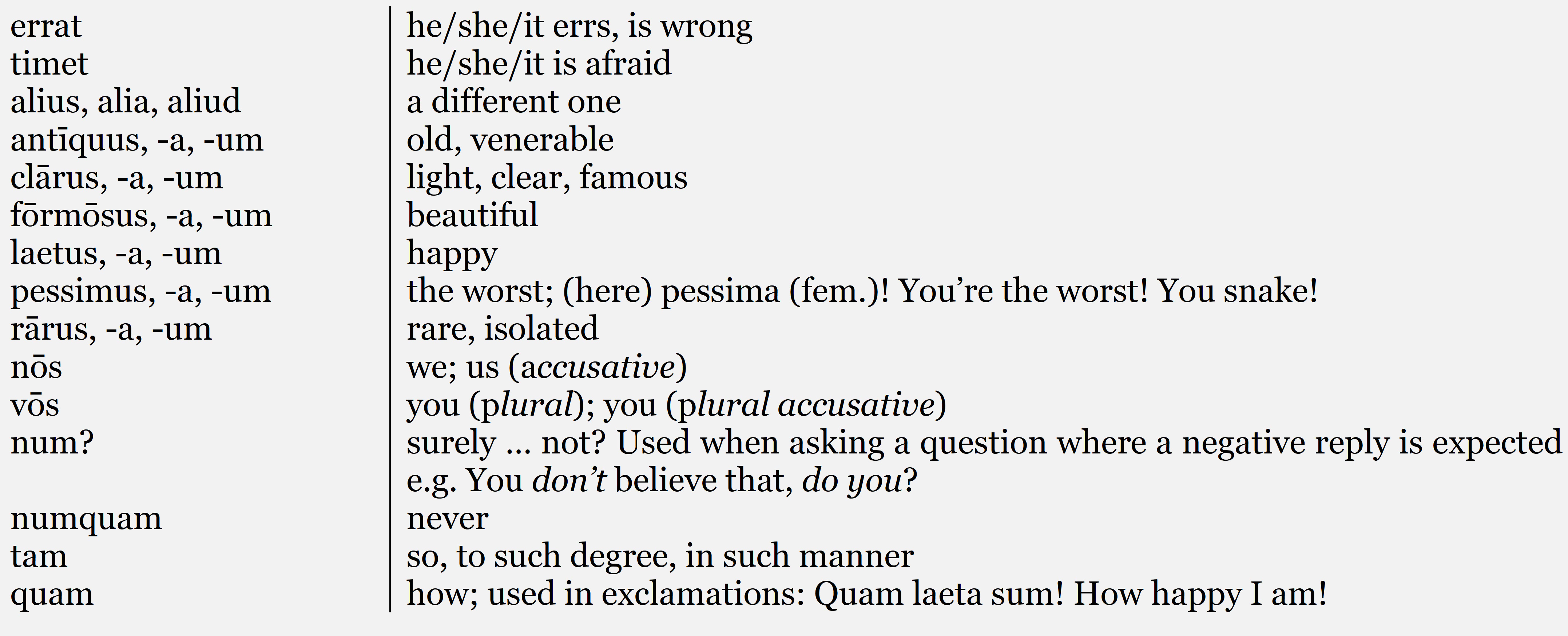
T: Cūr hīc sedēs, Cornēlia? Num
Mārcum exspectās?
C: Nōn errās, amīca. Mārcum
exspectō, sed iam timeō, quod cessat.
(Tullia et Aemilia rīdent)
C: Cūr rīdētis, amīcae? Cūr vōs
tam laetae estis?
A: Rīdēmus, quod tam stulta es,
quod hic sedēs et amīcum exspectās.
T: Nōs numquam amīcōs
exspectāmus, nōs nōn tam stultae sumus. Amīcī nōs exspectant.
C: Libenter Mārcum exspectō, quod
amīcus fīdus et bonus est.
A: Amīcī fīdī et bonī rārī sunt.
Fortasse Mārcus iam aliam amīcam amat; nam nōn sōlum lūdī clārī et forum
antīquum et theātra Mārcum invītant, sed etiam fōrmōsae puellae! (Cornēlia
tacet)
T: Cūr tacēs, Cornēlia? Num errō?
C: Certē errās, pessima, nam ibi
Mārcus stat, mē exspectat! Ōh, quam laeta sum! – Hīc sum, Mārce, hīc tē
exspectō!
[ii] Invitation to the theatre
Aemilia: Hodiē tē invītō,
Tite! Fābula bona est!
Titus: Ōh, quam grātus et laetus sum,
Aemilia! Amīca bona es, et amīcae bonae rārae sunt.
[Iam Titus et Aemilia theātrum
clārum intrant.]
Titus (subitō): Ecce, ibi est
Quīntus.
Aemilia: Salvē, Quīnte! Certē
Paulam exspectās?
Quīntus: Errās! Paulam nōn
iam exspectō; iam adest; ibi stat. Hodiē nōn nōs amīcās invītāmus,
sed amīcae nōs invītant.
mereor, -ērī, meritus sum [2/dep]: to deserve, earn
aggredior, -ī, aggressus sum [3-iō/dep]: to approach; advance towards; attack
patior, patī, passus sum [3-iō/dep]: to suffer; endure
Choose the correct translaton; this time, the present, future and
imperfect tenses are used:
The sun is rising │Sōl [a] oriēbātur [b] oritur [c] oriētur
The sun was rising │ Sōl [a] oriētur [b] oritur [c] oriēbātur
The sun will rise │Sōl [a] oriētur [b] oriēbātur [c] oritur
He could easily
endure [= was easily enduring bodily pain] │ ille … facile
dolōrem corporis [a] patitur [b] patiēbātur [c] patiētur (Cicero)
I often use a sword │Gladiō saepe [a] ūtēbar [b] ūtar [c] ūtor
The angry sailors
advance towards us │ [a] aggrediēbantur [b] aggredientur [c] aggrediuntur nōs
furentēs nautae (Petronius)
The king is
threatening him with death │ Rēx eī mortem [a] minātur [b] minābātur [c]
minābitur
The king will
threaten him with death │ Rēx eī mortem [a] minābātur [b] minātur [c] minābitur
The matter speaks for itself. Rēs ipsa [a] loquēbātur [b] loquitur
[c] loquētur
What will he promise us? │ Quid nōbīs [a] pollicēbitur? [b]
pollicēbātur? [c] pollicētur?
While he is staying
a few days at Vesontio … │ Dum paucōs diēs ad Vesontiōnem … [a] morātur [b]
morantur [c] morāmur … (Caesar)
The enemy, the
enemy, who(ever) kills them will earn a reward │ 'hostēs, hostēs, quī eōs
occīderit, praemium [a] merēbiminī [b] merēbitur [c] merēbuntur
____________________
The sun is rising │Sōl [a] oriēbātur [b] oritur[c]
oriētur
The sun was rising │ Sōl [a] oriētur [b] oritur [c] oriēbātur
The sun will rise │Sōl [a] oriētur[b] oriēbātur [c]
oritur
He could easily
endure [= was easily enduring bodily pain] │ ille … facile
dolōrem corporis [a] patitur [b] patiēbātur [c] patiētur (Cicero)
I often use a sword │Gladiō saepe [a] ūtēbar [b] ūtar [c] ūtor
The angry sailors
advance towards us │ [a] aggrediēbantur [b] aggredientur [c] aggrediuntur
nōs furentēs nautae (Petronius)
The king is
threatening him with death │ Rēx eī mortem [a] minātur [b]
minābātur [c] minābitur
The king will
threaten him with death │ Rēx eī mortem [a] minābātur [b] minātur [c] minābitur
The matter speaks for itself. │ Rēs ipsa [a] loquēbātur [b] loquitur[c] loquētur
What will he promise us? │ Quid nōbīs [a] pollicēbitur?
[b] pollicēbātur? [c] pollicētur?
While he is staying
a few days at Vesontio … │ Dum paucōs diēs ad Vesontiōnem … [a] morātur[b]
morantur [c] morāmur … (Caesar)
The enemy, the
enemy, who(ever) kills them will earn a reward │ 'hostēs, hostēs, quī eōs
occīderit, praemium [a] merēbiminī [b] merēbitur [c] merēbuntur
Deī Oenomaum rēgem
per ōrāculum sīc [1] monuerant: ‘Ā generō [2] necāberis.’ Itaque
Oenomaus ‘ Nēmō,’ inquit, ‘fīliam in mātrimōnium [3] dūcet.’ Multī tamen pulchram fīliam, Hippodamīam,
amābant, multī [4] petēbant. Fīliam in mātrimōnium nōn ducēs,’ respondit
omnibus, ‘nisi patrem in currūs certāmine [5] vīceris: sī [6] victus
eris, morte poenās audāciae [7] persolvēs.’ Multī ad certāmen
veniēbant, multī ā rēge [8] superābantur. Tandem Pelops Myrtilum, rēgis
aurīgam, prōmissīs [9] conciliāvit. ‘Dīmidium rēgnī [10] dabō,’ inquit, ‘sī in certāmine [11] adiūveris.’
Tum Myrtilus rēgiī currūs axem discidit: itaque rēx ē currū cecidit, Pelops
victor cum Hippodamīa ad patriam revertit. Sed quamquam ā Myrtilō via ad
victōriam [12] inventa erat, prōmissum Pelops [13] nōn praestitit.
Nam ubi currum prope mare agēbat, aurīgam in aquam dēmīsit. Myrtilus autem, ‘Ā
dīs immortālibus,’ clāmāvit, ‘auxilium [14] petō: rem tam foedam dī [15]
nōn neglegent: per omnēs annōs
Pelopis perfidiae poenās Pelopidae persolvent.’
Give the precise
translation of the following verbs from the text even if, sometimes, the
literal translation is not what English would finally use:
Deī
… rēgem … monuerant │ The gods [a] had warned [b] warned [c] were
warning the king
Ā
generō necāberis │ You … [a] were killed [b] will kill [c] will be
killed by (your) son-in-law
Nēmō
… fīliam … dūcet. │ Nobody … [a] is leading [b] has led [c] will lead my
daughter
Multī
… fīliam … petēbant. │Many … [a] desired ( = were desiring) [b] had
desired [c] will desire (his) daughter
nisi
patrem … vīceris │ Unless you … [a] will conquer [b] will have conquered
[c] conquer the father
sī
victus eris, … │If you … [a] will conquer [b] were conquered [c] will
have been conquered
…
poenās … persolvēs │ … you … [a] are paying [b] will pay [c] paid the
price / penalty
multī
… superābantur │ Many … [a] were (being) conquered [b] had been
conquered [c] will have been conquered
Pelops
Myrtilum … prōmissīs conciliāvit. │ Pelops … [a] has won over [b] won
over [c] had won over Myrtilus
Dīmidium
rēgnī dabō,… │ I … [a] am giving [b] was giving [c] shall give you half
of the kingdom
…
‘sī in certāmine adiūveris. │ If you [a] will have helped [b] will help
[c] are helping in the contest
quamquam
… via … inventa erat, … │ Although a way [a] had been found [b] was
found [c] will be found
…
prōmissum Pelops nōnpraestitit │ Pelops … [a] has not kept [b]
is not keeping [c] did not keep (his) promise
auxilium
petō │ I … [a] sought [b] seek [c] will seek help
…
dī nōnneglegent │ The gods [a] do not ignore [b] will not ignore
[c] did not ignore
____________________
Deī
… rēgem … monuerant │ The gods [a] had warned[b]
warned [c] were warning the king
Ā
generō necāberis │ You … [a] were killed [b] will kill [c] will be killedby (your) son-in-law
Nēmō
… fīliam … dūcet. │ Nobody … [a] is leading [b] has led [c] will lead my daughter
Multī
… fīliam … petēbant. │Many … [a] desired ( =
were desiring)[b] had desired [c] will desire (his) daughter
nisi
patrem … vīceris │ Unless you … [a] will conquer [b] will have conquered[c] conquer the father
sī
victus eris, … │If you … [a] will conquer [b] were conquered [c] will have been conquered
…
poenās … persolvēs │ … you … [a] are paying [b]
will pay[c] paid the price / penalty
multī
… superābantur │ Many … [a] were (being)
conquered[b] had been conquered [c] will have been conquered
Pelops
Myrtilum … prōmissīs conciliāvit. │ Pelops … [a] has won over [b] won over[c] had won over Myrtilus
Dīmidium
rēgnī dabō,… │ I … [a] am giving [b] was giving [c]
shall giveyou half of the kingdom
…
‘sī in certāmine adiūveris. │ If you [a] will
have helped[b] will help [c] are helping in the contest
quamquam
… via … inventa erat, … │ Although a way [a] had
been found[b] was found [c] will be found
…
prōmissum Pelops nōnpraestitit │ Pelops … [a] has not kept [b]
is not keeping [c] did not keep(his) promise
auxilium
petō │ I … [a] sought [b] seek[c] will
seek help
…
dī nōnneglegent │ The gods [a] do not ignore[b] will not ignore[c] did not ignore
Deī Oenomaum rēgem per ōrāculum sīc monuerant: ‘Ā generō necāberis.’ Itaque Oenomaus ‘ Nēmō,’ inquit, ‘fīliam in mātrimōnium dūcet.’ Multī tamen pulchram fīliam, Hippodamīam, amābant, multī petēbant. Fīliam in mātrimōnium nōn ducēs,’ respondit omnibus, ‘nisi patrem in currūs certāmine vīceris: sī victus eris, morte poenās audāciae persolvēs.’ Multī ad certāmen veniēbant, multī ā rēge superābantur. Tandem Pelops Myrtilum, rēgis aurīgam, prōmissīs conciliāvit. ‘Dīmidium rēgnī dabō,’ inquit, ‘sī in certāmine adiūveris.’ Tum Myrtilus rēgiī currūs axem discidit: itaque rēx ē currū cecidit, Pelops victor cum Hippodamīa ad patriam revertit. Sed quamquam ā Myrtilō via ad victōriam inventa erat, prōmissum Pelops nōn praestitit. Nam ubi currum prope mare agēbat, aurīgam in aquam dēmīsit. Myrtilus autem, ‘Ā dīs immortālibus,’ clāmāvit, ‘auxilium petō: rem tam foedam dī nōn neglegent: per omnēs annōs Pelopis perfidiae poenās Pelopidae persolvent.’
[1]
Lines 1 – 2 (Deī … dūcet)
Nēmō
… fīliam in mātrimōnium dūcet.
What did Oenomaus say and why did he say it? (3)
[2]
Lines 2 – 5 (Multī … persolvēs)
What
challenge did Oenomaus set to those wanting to marry Hippodamia, and what was
the price of failure? (2)
Note:
‘Dīmidium rēgnī dabō,’ inquit, ‘sī in certāmine adiūveris.’ What tense
is adiūveris? How would it literally be translated? How would it
be best translated?
[4]
Lines 7 – 8 (Tum … revertit)
What
did Myrtilus do to the chariot and with what results? (4)
[5]
Lines 8 – 10 (Sed … dēmīsit)
[i]
Give a translation of Sed quamquam ā Myrtilō via ad victōriam inventa erat,
prōmissum Pelops nōn praestitit (4) and [ii] explain why that statement is
made. (2)
[6]
Lines 10 – end (Myrtilus autem … persolvent)
[i]
Whose help did Myrtilus seek? (1)
[ii]
Why did he think they would help? (2)
[iii]
Who was to be punished? (1)
[7]
In your own words give a brief description of Myrtilus referring to his
character and motives. (4)**
King
Oenomaus, Hippodamia, and Olympian gods. Illustration (colour lithograph) from
a binding of 'Peintures de Vases Antiques Vulgairement Appeles Etrusques' by
Aubian Louis Millin de Grandmaison, with 'Introduction a l'Etude des Vases
Antiques d'Argile Peints Vulgairement Appeles Etrusques', by A. Dubois
Maisonneuve; possibly refers to the establishment of the Olympic Games in
honour of Oinomaos; died in a chariot race against Pelops, who wanted to marry
his daughter Hippodamea.
by
The Stapleton Collection (French), Public Domain
*
[3] [i] Many came ¦ [ii] to the contest, ¦ [iii] (and) many were conquered /
beaten ¦ [iv] by the king. [v] Pelops finally won over Myrtilus, ¦ [vi] the
king’s charioteer ¦ [vii] with promises. [viii] “I shall give you half the
kingdon, he said ¦ [ix] “If you help (me) ¦ [x] in the contest.”
**
[7] acts out of self-interest; no loyalty to the king; motivated by promises of
power / wealth; hypocritical: refers to the “foul deed” and “treachery” of
Pelops yet he himself committed a treacherous act