Saturday, March 22, 2025

23.06.25: topic; ships [9]; Comenius; XCI; a Ship-wreck (4); terra austrālis: the southern land

Sphera terrestris …dīvīsa est in trēs continentēs; nostram, quæ subdīviditur in Eurōpam, Asiam, & Āfricam, in Americam (cuius incolæ sunt antipodēs nōbīs) & in Terram Austrālem, adhūc incognitam. (Comenius CVII: 1658)

The terrestrial sphere … is divided into three continents, ours, which is subdivided into Europe, Asia, Africa, America, (whose inhabitants are antipodes to us;) and the South Land, yet unknown.

antipodēs from Greek: ἀντίποδες (antípodes), referring, in the world of Comenius, to the place on the opposite side of the Earth from a given point, the English derivative antipodean being an informal reference to the inhabitants of Australia and New Zealand, but Comenius uses it to describe America.

Images #1 and #2

[i] terra austrālis nōndum cognita (1570 (the southern land not yet known)

[ii] terra austrālis incognita (1618) (the unknown southern land)

However, the maps do not refer to Australia but to an as yet undiscovered (or partially discovered), unknown (or not yet known), disputed and, at times, dismissed notion of a landmass in the southern hemisphere, which was first suggested by Aristotle in the 4th century BC. And it did take a little time to prove that he was right!


What we call the continent of Australia was originally named New Holland, the term Terra Austrālis reserved for the southern landmass referred to above.

The English explorer Matthew Flinders was the first to circumnavigate New Holland in 1803, and used the name ‘Australia’ to describe it on a map in 1804. It was Flinders who suggested the name now used, the New South Wales Governor Lachlan Macquarie endorsing the name to replace New Holland in communication with London in 1817, and the name came into common local usage.

Image #3: Map of Australia by Flinders (1814) ascribing the name Terra Austrālis or Australia

On the “reassignment” of the name Terra Austrālis Flinders wrote:

“There is no probability, that any other detached body of land, of nearly equal extent, will ever be found in a more southern latitude; the name Terra Australis will, therefore, remain descriptive of the geographical importance of this country, and of its situation on the globe: it has antiquity to recommend it; and, having no reference to either of the two claiming nations, appears to be less objectionable than any other which could have been selected.”

Flinders was, of course, wrong in making that bold assertion because the “unknown southern land” did become known, by which point, however, the name now belonged to Australia.

Maybe from the 4th century BC we hear Aristotle’s voice telling Flinders: “I told you so!” Moreover, Aristotle had already given it a name since, at the time, the north lay under the constellation Ἄρκτος [Árktos] i.e. “Ursa Major” (the Great Bear). Therefore, he called the other end of the world ἀνταρκτικός [antarktikós] i.e. opposite to the north > Latin: antarcticus, -a, -um (south) > New Latin …

“The five largest islands or peninsulas … are termed continents, and designated by the names Eurasia, Africa, North America, South America, and Australia. …. The elevated region round the South Pole is crowned by the unexplored and scarcely discovered continent of Antarctica.” [Hugh Robert Mill, “The Continental Area” (1891)]

23.06.25: topic; ships [8]; Comenius; XCI; a Ship-wreck (3)

boreālis, -e: northern

oriēns, orientis [3/m]: east

orientālis, -e: eastern

occidēns, occidentis [3/m]: west

occidentālis, -e: western

austrālis, -e: southern

images:

[i] aurora borealis: the northern lights

[ii] the Orient line to Australia (for £140 - return!)

[iii] oriental Jazz essentials

[iv] Occidental College, Los Angeles has the motto: Occidēns Proximus Orientī (the West is nearest the East)


22.06.25: Level 3; the ablative absolute [2]: formation

Forming the ablative absolute is not unlike an ‘equation’ i.e. there is a consistent step-by-step way of creating it. Examples:

  • With [1] the city ¦ [2] having been captured

[i] Begin with the nominative singular:

[1] city [2] captured

> [1] urbs [2] capta i.e. the perfect passive participle, the fourth principal part of the verb < capiō, capere, cēpī, captus

[ii] Transfer both words into the ablative case:

> [1] urbe [2] captā = ablative absolute = with the city having been captured

  • With the brother | having been killed.

[i] Begin with the nominative singular:

[1] brother [2] killed

> [1] frāter [2] necātus < necō, -āre, -āvī, necātus

[ii] Transfer both words into the ablative case:

> [1] frātre [2] necātō = ablative absolute = with the brother having been killed

The same approach would also apply to ablative absolutes with plural nouns or pronouns:

  • With the soldiers | having been killed.

[i] nominative plural:

[1] soldiers [2] killed

> [1] mīlitēs [2] necātī

[ii] Transfer both words into the ablative case:

> [1] mīlitibus [2] necātīs = ablative absolute = with the soldiers having been killed

22.06.25: Level 3; the ablative absolute [1]

One of the reasons why Latin can express itself far more concisely than many other languages is the construction known as the ablative absolute and it is because of its conciseness that it very frequently occurs in the literature.

The ablative absolute is a phrase that describes the circumstances under which an action is performed. The circumstances most often refer either to time or reason.

First take a look at this English sentence that comprises two clauses:

[1] When (after) / since the money had been found, ¦ [2] the master punished the slave.

[1] is an adverbial clause in that it describes the circumstances in which the action in the main clause [2] took place; in this example [1] could refer either to time (when or after) or reason (since)

3 points to note:

[i] the adverbial clause is passive i.e. after the money had been found

[ii] the action in [1] happened before the action in [2]

[iii] the adverbial clause does not say that it was the master who found the money; maybe he did, but the clause does not imply that

In Latin, this clause can be expressed by a phrase: the ablative absolute which comprises 2 parts:

[1] noun / pronoun + [2] perfect passive participle; both in the ablative case

> [1] pecūniā [2] inventā = the ablative absolute

In grammar books this type of ablative absolute is normally translated in a very literal way so that it is clear what exactly is being conveyed: with X having been Y-ed

[X] pecūniā ¦ [Y] inventā = literally: with the money ¦ having been found. This, of course, sounds very cumbersome in English but, at this early stage, it is better to keep to that translation; in later posts, more natural sounding translations will be discussed.

Pecūniā inventā, dominus servum punīvit. │ With the money having been found, the master punished the slave.

Leōne vīsō, fēminae discessērunt. │ With the lion having been seen, the women departed.

Acceptīs litterīs, Caesar discēdit. │ With the letter having been received, Caesar departs.

Hīs verbīs dictīs, Caesar discessit. │ With these words having been said, Caesar departed.

Remember:

[i] the construction is passive: with the lion having been seen

[ii] the ablative absolute refers to something which happened before the main action: [1] Leōne vīsō, ¦ [2] fēminae discessērunt.

[iii] the ablative absolute does not refer to the subject of the sentence; there is no implication that it was the women themselves who saw the lion (that may be construed from context, but it is not stated in the ablative absolute) 

22.06.25: Level 3; the Labours of Hercules; [I] The infant Hercules and the serpents

[I] THE INFANT HERCULES AND THE SERPENTS

Dī grave supplicium sūmunt dē malīs, sed iī quī lēgibus deōrum pārent, etiam post mortem cūrantur. Illa vita dīs erat grātissima quae hominibus miserīs ūtilissima fuerat. Omnium autem praemiōrum summum erat immortālitās. Illud praemium Herculī datum est.

Herculīs pater fuit Iuppiter, māter Alcmēna, et omnium hominum validissimus fuisse dīcitur. Sed Iūnō, rēgina deōrum, eum, adhūc infantem, interficere studēbat; nam eī et Herculēs et Alcmēna erant invisī. Itaque misit duās serpentēs, utramque saevissimam, quae mediā nocte domum Alcmēnae vēnērunt. Ibi Herculēs, cum fratre suō, nōn in lectulō sed in scūtō ingentī dormiēbat iam audācēs serpentēs adpropinquāverant, iam scūtum movēbant. Tum frāter, terrōre commōtus, magnā vōce mātrem vocāvit, sed Herculēs ipse, fortior quam frāter, statim ingentēs serpentēs manibus suīs rapuit et interfēcit.

Notes

[1] dī grave supplicium sūmunt │ the gods inflict heavy / serious punishment; illa vita dīs erat grātissima │ that life was very pleasing to the gods

Declension of deus: very few nouns in Latin have alternative endings; deus, -ī  [2/m] has the usual 2nd declension endings in the singular, but there are alternative endings in the plural

[2] iī quī lēgibus deōrum pārent │ those (people) who obey the laws of the gods

iī is an alternative spelling of the plural eī (they) in the nominative plural; similarly iīs = eīs in the dative and ablative plural

[3] iī quī lēgibus deōrum pārent

pāreō, pārēre, pāruī [2] obey (give obedience to); some verbs in Latin – known in grammar as “special verbs” are followed by the dative case:

https://adckl.blogspot.com/2025/02/180425-level-3-verbs-with-dative-case-2.html

[4] omnium hominum validissimus fuisse dīcitur │ he is said to have been the strongest of all men

You have already seen two infinitive forms:

[i] amāre: to love; the present active infinitive

[ii] amārī: to be loved; the present passive infinitive

The Latin infinitives are important since they are used in constructions which do not match English. That is a major topic which will be discussed in later posts. For the moment, note the following:

[iii] amāvisse: to have loved; the perfect active infinitive

These are regularly formed from the third principal part of the verb:

(1) amō, amāre, amāvī

(2) amāvī: I (have) loved

(3) remove -ī > amāv-

(4) add -isse

(5) > amāvisse: to have loved

Therefore:

sum, esse, fuī >

fuī: I was / have been

remove -ī > fu-

add -isse

> fuisse: to have been

[5] eī et Herculēs et Alcmēna erant invīsī │ both Hercules and Alcmena were hateful to her

invīsus, -um, -a: hateful i.e. they evoked a feeling of hatred in her

[6] Itaque misit duās serpentēs, utramque saevissimam │ Therefore, she sent two serpents, each (of them) very fierce

uter¦que [m], utra¦que [f], utrum¦que [n]: each (of two); both

[7] Herculēs ipse … ingentēs serpentēs … rapuit │ Hercules himself seized the huge serpents

Image: ipse, ipsa, ipsum is used to convey emphasis, the same idea as English ‘myself’, ‘yourself’, ‘himself’ etc. in combination with a noun or personal pronoun e.g. He himself said that. When used with a noun, the translation may be ‘the very’.

Caesarem ipsum servāvimus. │ We saved Caesar himself.

Vōs ipsī iūdicāte: decet mulierem nōn vēlātam ōrāre Deum? (Vulgate) │ You yourselves judge: is it proper for a woman without a veil to pray to God?

Fidēlissimī servī senem ad templum ipsum portāvērunt. │ The most faithful servants carried the old man to the temple itself /  the very temple.

Note: in English, -self and -selves, apart from having the same emphatic function as Latin ipse e.g. I myself will do it, also is used to express reflexive actions e.g. She hurt herself, he looked at himself in the mirror; Latin does not use ipse to convey this, but the reflexive pronoun sē.

Sē ex nāvī prōiēcit. (Caesar) │ He threw himself from the ship.


21.06.25: Level 2; Sonnenschein: Maria Britannica [2]: listening

[“Lateris prīmī longitūdinem circiter quingenta mīlia esse iūdicat, secundī septingenta, tertiī octingenta. Itaque dē magnitūdine insulae nōn multum errabat. Flūmen Tamesam ā marī circiter octōgintā mīlia distāre iūdicat."]

[1] Choose [A], [B] or [C]

[a] Length of:

[i] the first side: [A] 50 [B] 500 [C] 5000 miles

[ii] the second side: [A] 700 [B] 7000 [C] 70 miles

[iii] the third side: [A] 8000 [B] 80 [C] 800 miles

[b] Distance of the Thames to the sea: [A] approximately 18 [B] 80 [C] about 80 miles

[Hīc nōs puerī "Errābat igitur" inquimus; "nam inter Londinium et mare nōn sunt octōgintā mīlia." Sed patruus meus "Rectē iudicābat" inquit; "nam pars maris ubi Caesaris castra erant circiter octōgintā mīlia Rōmāna ā Londiniō distat."]

[2] Why do the boys think Caesar made a mistake? (2)

[3] Why does the uncle state that Caesar was correct? (4); [nam [i] pars maris ¦ ubi [ii] Caesaris castra erant ¦ [iii] circiter octōgintā mīlia Rōmāna ¦ [iv] ā Londiniō distat]

[Tria maria insulam nostram circumdant; inter Britanniam et Galliam est mare Britannicum vel fretum Gallicum; ab occidente mare Hibernicum; ab oriente mare Germānicum. Nōmina marium temporibus antīquīs nōn ūsitāta erant; sed iam Graecī Britanniam esse insulam iūdicābant."]

[4] Which body of water is:

[i] between Britain and France? (1)

[ii] to the west? (1)

[iii] to the east? (1)

[5] What were not used at that time? (1)

[6] What had the Greeks determined? (1)

21.06.25: Level 2; Sonnenschein: Maria Britannica [1]: text, exercise, notes

“Lateris prīmī longitūdinem circiter quingenta mīlia esse iūdicat, secundī septingenta, tertiī octingenta. Itaque dē magnitūdine insulae nōn multum errabat. Flūmen Tamesam ā marī circiter octōgintā mīlia distāre iūdicat." Hīc nōs puerī "Errābat igitur" inquimus; "nam inter Londinium et mare nōn sunt octōgintā mīlia." Sed patruus meus "Rectē iudicābat" inquit; "nam pars maris ubi Caesaris castra erant circiter octōgintā mīlia Rōmāna ā Londiniō distat. Tria maria insulam nostram circumdant; inter Britanniam et Galliam est mare Britannicum vel fretum Gallicum; ab occidente mare Hibernicum; ab oriente mare Germānicum. Nōmina marium temporibus antīquīs nōn ūsitāta erant; sed iam Graecī Britanniam esse insulam iūdicābant."

Vocabulary review: match the Latin and English

circiter

circumdō, -dare, -dedī, -dātus [1]

distō, -āre, distitī [1]

errō, -āre, -āvī, -ātus [1]

flūmen, flūminis [3/n]

fretum, -ī [2/n]

Hibernicus, -a, -um

itaque

iūdicō, -āre, -āvī, -ātus [1]

latus, lateris [3/n]

longitūdō, longitūdinis [3/f]

magnitūdō, magnitūdinis [3/f]

occidēns, occidentis [3/m]

oriēns, orientis [3/m]

rēctē

ūsitātus, -a, -um

judge / determine; Irish; east; correctly; channel / estuary; approximately; length; make a mistake; river; stand apart / be distant; size; side; surround; therefore; used / usual / common; west

Note: to review i-stem nouns like mare, -is [3/n]:

Level 3; Sonnenschein; Prō Patriā [3]; Cunobelīnus [4]; review: i-stem nouns (3)

https://adckl.blogspot.com/2025/03/140625-level-3-sonnenschein-cunobelinus.html

https://www.facebook.com/groups/latinforstarters/posts/817036527574284/


20.06.25: topic; ships [7]; Comenius; XCI; a Ship-wreck (2)

Incubuēre marī tōtumque ā sēdibus īmīs / ūna [1] Eurusque [2] Notusque ruunt crēberque procellīs / [3] Āfricus et vastōs volvunt ad lītora flūctūs. (Virgil)

[The winds] fall upon the sea and they overturn everything from the bottom-most depths – together, both [1] East Wind and [2] South Wind and, frequent with gusts, the [3] Southwest Wind – and they roll huge waves toward the shores.

[i] Images #1 and #2: Latin has a number of terms pertaining to wind direction which were first discussed here:

https://adckl.blogspot.com/2024/05/240424-nouns-and-adjectives-referring.html

Ancient Greek mythology referred to the ‘Anemoi’ / Ἄνεμοι (‘winds’) of which there were four, each personified as a god. In Roman mythology ‘anemoi’ is ventī (‘winds’) and the winds were also considered to be gods. The images of the four Gods are from the Tower of the Winds at Athens.

[1] Boreās, -ae [1/m]: the north wind

aquilō, aquilōnis [3/m]; septentriō, septentriōnis [3/m]: north, north wind

aquilōnāris, -e; boreālis, -e; septentriōnālis, -e: northern

[2] Notus, Notos, -ī [2/m]: the south wind

auster, austrī [2/m]; merīdiēs, merīdiēī [5/m]: south, south wind

austrālis, -e; merīdiōnālis, -e; merīdiānus, -a, -um: southern

[3] Eurus, -ī [2/m]; apēliōtēs, -ae [1/m]; subsōlānus, -ī [2/m]: east wind

oriēns, orientis [3/m]: east

orientālis, -e: eastern

[4] Zephyrus, -ī [2/m]; favōnius, -ī [2/m]: west wind

occidēns, occidentis [3/m]: west

occidentālis, -e: western


compass points

https://adckl.blogspot.com/2024/05/240424-east-and-west.html

Image #3: In antiquity, the earth was divided into parallel clime zones according to latitude; Renaissance geographers typically showed nine such climatic zones, this image also showing the compass points:

septentriō, septenriōnis [3/m]: north

merīdiēs, merīdiēī [5/m]: south

oriēns, orientis [3/m]: east

occidēns, occidentis [3/m]: west

Image #4: 1472: publication of Etymologiae of archbishop Isidore of Seville, a 7th century encylcopedia

The map has East (Oriens) at the top, South (Meridies) at the right, West (Occidens) at the bottom, and North (Septentrio) at the left, the central sea labelled as ‘The Great Sea, or Mediterrnean” (Mare magnum sive mediterraneum). The continents aree named together with the son of Noah accredited with its settlement: Europa (Japhet / Iaphet), Africa (Ham), Asia (Shem). Jerusalem (Hierusalem) is placed in Western Asia near the centre of the world, the Garden of Eden (Paradisus) in the Far East.

Image #5

Sōl in oriente oritur. │ The sun rises in the East.

Sōl in occidente occidit. │ The sun sets in the West.

Ventus ab oriente spīrat. │ The wind is blowing from the East.

Ventus ab occidente flat. │ The wind is blowing from the West.

20.06.25: topic; ships [6]; Comenius; XCI; a Ship-wreck (1)

There are different editions of the work of Comenius; this one – and I have reproduced the text exactly – show an interesting comparison between Latin, the spelling of which has remained virtually unchanged for centuries, and 17th century English, which still shows remarkable inconsistency in spelling, a feature also noticeable in the early editions of Shakespeare’s works.

suddain = sudden; sayl = sail; shipwrack = shipwreck; sheat = sheet; shoars = shores

When a storm ariseth on a suddain, they strike sayl lest the ship should be dashed against rocks or light upon shelves.

Cum procella oritur repente contrahunt vēla nē nāvīs ad scopulōs allīdātur, aut incīdat in brevia (syrtēs).

If they cannot hinder her they suffer shipwrack.

Sī nōn possunt prohibēre patiuntur naufragium.

And then the men, the wares, all things are miserably lost.

Tum hominēs, mercēs, omnia miserābiliter pereunt.

Nor doth the sheat-anchor, being cast with a cable, do any good.

Neque hīc sacra anchora, rūdentī iacta quidquam adiuvat.

Some escape, either on a plank, and by swimming, or in the boat.

Quīdam ēvādunt, vel tabulā, ac ēnatandō, vel scaphā.

Part of the wares, with the dead folks, is carried out of the sea, upon the shoars.

Pars mercium cum mortuīs ā marī in littora dēfertur.

[i] Passives:

Pars mercium … dēfertur │ Part of the wares … is carried away

anchora … iacta │ the anchor (which has been) thrown

[ii] Deponent verbs:

procella oritur │ a storm arises

patiuntur naufragium │ they suffer a shipwreck

[iii] Gerund:

Quīdam ēvādunt … ēnatandō │ some escape by swimming away

[iv] procella, -ae [1/f]: violent wind, storm, hurricane, tempest

tempestās, tempestātis [3/f]: context will determine the meaning: [i] storm or gale, [ii] weather (either good or bad), [iii]  period of time, season

[v] image #1: contrahō, -ere, contrāxī, contractus [3]: draw in; pull (several objects) together; contrahunt vēla │ they strike the sails i.e. the sails are furled

solvō, -ere, solvī, solūtus [3]: untie, loosen; used to refer to ‘setting sail’ i.e. untying the ship from its mooring: paulō post mediam noctem nāvēs solvit (Caesar) │ he sets sail a little after midnight

[vi] scopulus, -ī [2/m]: rock, cliff, crag

[vii] syrtis, -is [3/f]: sandbank

brevis, -e: [i] short; [i] (of depth) shallow i.e. Comenius is referring to the “shallow parts” of the water; Engl. shelf = reef, sandbar

[viii] naufragium,-ī [2/n]: shipwreck

Image #2: late 3rd century Roman shipwreck off the coast of Sicily

submergō (summergō), -ere, -mersī, -mersus [3]: sink

nāvēs submerguntur │ ships are sunk

nāvis submersa │ a sunken ship

[ix] merx, mercis [3/f]: merchandise; goods

Image #3: Some of the 135 amphorae from the wreck of a Roman ship off the coast of northern Catalonia

[x] sacra anc(h)ora: the term “sacred anchor”, derived from sailors, refers to the strongest anchor, only weighed when the ship is at its most critical point; sheet anchor: a large, spare anchor for use in emergencies

Image #4: Prīncipia Latīnē Loquendī Scrībendīque (1556) with depiction of the sacra anchora


[xi] rūdēns, rūdentis [3/m]: rope, cord, cable

[xii] tabula, -ae [1/f]: [i] (here) plank, [ii] wax covered tablet used for writing with a stylus

[xiii] scapha, -ae [1/f]: light boat, skiff

et cum scaphās concurrere undique ab nāvibus cernerent (Livy) │ When they saw boats from all the ships rowing to the place [i.e. small boats which belong to larger ones]

[xiv] littus, littoris [3/n]: alternative of litus, litoris [3/n]: shore

Grammar

For the moment, note the use of the Latin subjunctive in the sentence:

contrahunt vēla ¦ nē nāvīs ad scopulōs [i] allīdātur, aut [ii] incīdat in brevia │ they strike the sails ¦ lest the ship [ii] (might / should) be dashed against the rocks or [ii] light upon sandbanks

The subjunctive is used to express purpose. That purpose may be [1] positive i.e. X is done in order that Y happens, or [2] negative i.e. X is done in order that Y does not happen. Latin uses a subjunctive here because, at the point at which the main action [X] takes place, the purpose [Y] has not yet been achieved; in older English, it was common to read: “He went [X] to the shop in order that he might buy [Y] bread”, and it is this type of structure which Latin uses.

What we have here is a negative purpose:

contrahunt vēla [X] ¦ nē nāvis ad scopulōs allīdātur [Y]

They strike the sails [X] ¦ in order that the ship might not be dashed [Y] against the rocks

The archaic word ‘lest’ is often used to convey this: they strike the sails lest the ships (should / might) be dashed against the wrecks [i.e. this is what they do not want to happen], but it can be rendered in a less stilted manner: … (in order) to avoid the ship being dashed against the rocks

Nē mīlitēs oppidum inrumperent, portās obstruit (Caesar) │ He barricaded the gates, in order that the soldiers might not break into the town = …to avoid the soldiers breaking into the town

Tuesday, March 18, 2025

19.03.25: Follow-up on the previous post; grammatical “curve balls”

Referring to:

https://www.facebook.com/groups/latinforstarters/posts/646798164598122/

Sī versūs hōrum duōrum poētārum neglegētis, magnā parte litterārum carēbitis. │ If you neglect the verses of these two poets, you will miss a large part of literature.

A single sentence can be really useful, especially if you’re “on the way” with Latin. Of course, you can just be content with the translation that’s given, but you can look at it in a little more depth almost as a check-list.

When learning Latin, words and phrases such as “usually”, “most commonly” etc. give you the clue that, while most of the language conforms to very specific rules, there are “curve balls” and this sentence has quite a few of them!

[1]

versus: most nouns ending in -us are 2nd declension; this one isn’t, which is why dictionaries and vocabulary lists will give a second piece of information i.e. the genitive singular because the genitive singular is different for, in fact, the three declensions that this word could belong to:

hortus, hortī [genitive singular]: garden; 2nd declension because the genitive singular [-ī] is telling you that

pectus, pectoris [genitive singular]: chest; 3rd declension [-is]

versus, versūs [genitive singular]: 4th declension [-ūs]

[2]

poeta, -ae: poet; most 1st declension nouns are feminine; this one isn’t – it’s masculine and belongs to a little group of nouns which, although they have feminine endings, are considered to be masculine in gender owing to their association with “occupations” that were traditionally performed by males, for example:

poēta, -ae [1/masculine]: poet

agricola, -ae [1/m]: farmer

aurīga, -ae [1/m]: charioteer

pīrāta, -ae [1/m]: pirate

scrība, -ae [1/m]: scribe

However, although the nouns decline as feminines, whatever agrees with them e.g. adjectives, are masculine – and that is exactly the same as modern Russian: dedushka (grandfather) in Russian is grammatically feminine, but when you say “my grandfather”, Russian uses the masculine form for ‘my’ i.e. “moj dedushka” (incidentally, ‘man’ in Russian is also feminine: muzhchina!) Therefore, in this sentence:

versūs hōrum [masculine] duōrum [masculine] poētārum [feminine]: the verses of those two poets

[3] Sī versūs hōrum duōrum poētārum [i] neglegētis, magnā parte litterārum [ii] carēbitis.

[i] If you neglect [English: present tense] the verses of these two poets, ¦ [ii] you will miss [English: future tense] a great part of literature. That’s the right translation, of course, but it isn’t exactly what the Latin is saying.

It’s the first part where English and Latin are different. The “if” part of the sentence is known as the conditional clause; in this structure, English most often uses the present tense: if you [i] give [present tense] me the money, [ii] I’ll buy the cake.

In Latin, however, the future tense is used here:

Sī versūs hōrum duōrum poētārum [i] neglegētis [future tense], …

Literally: If you will neglect the works of these two poets,…

[4] … magnā parte litterārum carēbitis │ careō, -ēre [2]: lack, be without; this is one of a small group of verbs that are followed by the ablative case and convey the sense of being deprived of something

You will miss (miss out on, lack, be deprived of) a great part of literature.

A common verb of this type is: egeō, -ēre [2]: lack, want, be without, need

Cicero needs a lot of things in the ablative case…

tamen et ipse egeō argūmentō epistulārum (Cicero) │  still I am in want of subject matter

cōnsciīs egeō aliīs (Cicero) │ I need others as accomplices

egeō rēbus omnibus (Cicero) │ I am in want of everything

tuō cōnsiliō egeō (Cicero) │ I need your advice

But what he doesn’t need …

sed nōn egeō medicīnā (Cicero) │ I don’t need a remedy


Thursday, March 13, 2025

19.06.25: Level 2; Sonnenschein; Gentium Britannicārum Societās [4]: listening (2)

Listen to the recording without looking at the transcript.

[1] Choose the correct answer [A], [B] or [C].

[Caesar formam et incolās Britanniae in capite duodecimō et tertiō decimō librī quintī commemorat. Incolae partis interiōris Celtae et barbarī erant; incolae maritimae partis ex Belgiō praedae causā immigrāverant, sīcut priōre aetāte trans flūmen Rhenum in Belgium migrāverant.]

[i] Caesar describes Britannia in the [A] 2nd and 3rd  [B] 22nd and 23rd [C] 12th and 13th chapters of his [A] 15th [B] 5th [C] 25th book.

[ii] The Celts lived [A] by the sea [B] inland [C] on a small island.

[iii] The migrants lived [A] by the sea [B] inland [C] on a small island.

[iv] They had migrated [A] to start a war [B] because of better weather [C] to plunder.

[v] They crossed the Rhine [A] in winter [B] the previous summer [C] a year before.

[2] Fill in the blanks with a single word or short phrase.

[Et nōnnulla nōmina gentium maritimārum, unde nōmina urbium hodiernārum dērivāta sunt, Belgica vel Gallica sunt. Belgae autem ā Germānīs oriundī erant, ut Caesar in capite quartō librī secundī dēmonstrat. Itaque pars Britannōrum antīquōrum Germānicā orīgine erant.]

[i] Belgian and Gaulish influence is seen in today’s __________.

[ii] The Belgae were originally from __________.

[iii] Caesar refers to this in the __________ chapter of his __________ book.

[iv] Some of the __________ were of Germanic origin.

[3]

[Formam insulae esse triquetram dēclārat. Sed ūnum latus ad Galliam spectāre existimat, alterum ad Hispāniam atque occidentem, tertium ad septentriōnēs. Itaque dē lateribus et angulīs laterum errābat. Hiberniam ab occidente parte Britanniae esse rectē iūdicat, insulam Mōnam inter Britanniam et Hiberniam esse.]

Which of the three maps gives the closest representation of Caesar’s description of Britannia?

And take a second look: which of the three maps thinks that Brazil is an island off the west coast of Ireland?


Map A


Map B


Map C

____________________

[3] Map [C]

Formam insulae esse triquetram dēclārat:  shaped like a triangle

ūnum latus ad Galliam: one side facing Gaul

alterum ad Hispāniam: a second side facing Spain

insulam Mōnam inter Britanniam et Hiberniam: the island of Anglesey between Britain and Ireland

19.06.25: Level 2; Sonnenschein; Gentium Britannicārum Societās [3]: listening (1)

[A] Listen to the text and fill in the blanks with the missing words

Gentium Britannicārum __________

Tum patruus meus reliqua de __________ Caesaris narrāvit. "Dum __________ nautaeque Rōmānī __________ novīs armīs ornant, Caesar ad reliquās copiās properat. Intereā __________ summum imperium Cassivellaunō mandāverant. Cassivellaunus nōn erat __________ ūniversārum __________ Britannicārum, sed __________ vel __________ __________ Cassōrum.

classem; dux; expedītiōne; gentis; gentium; hostēs; mīlitēs; princēps; rēx; societās

[B] Listen to the text and choose the correct form of the noun

Annō tamen quartō et quinquāgēsimō ante Christum nātum …

  1. magna [a] partis [b] pars [c] partēs …
  2. [a] gentium [b] gentis [c] gentibus Britanniae merīdiānae sē sub Cassivellaunō contrā Rōmānōs consociāverant.
  3. [a] Flūminis [b] Flūmine [c] Flūmen  Tamesa …
  4. [a] fīnīs [b] fīnēs [c] fīnis Cassivellaunī …
  5. ā [a] fīnēs [b] fīnīs [c] fīnibus …
  6. [a] gēns [b] gentium [c] gentēs maritimārum sēparābat;
  7. ab [a] oriente [b] orientī [c] orientis erant …
  8. [a] fīnēs [b] fīnīs [c] fīnibus …
  9. [a] Trinobantēs [b] Trinobantīs [c] Trinobantium;
  10. ab [a] occidentī [b] occidente [c] occidentis Britannī mediterrāneī.

[C] Fill in the blanks with the missing nouns:

Superiōre __________ bella continua fuerant inter Cassivellaunum et reliquās __________; atque __________ auxilium Rōmānōrum contrā Cassivellaunum implōrāverant, quia __________ suum trucīdāverat. Numerus __________ magnus erat; nam, ut Caesar affirmat, infīnīta __________ __________ erat in __________ merīdiānā Britanniae.

____________________

[A]

Gentium Britannicārum Societās [1]

Tum patruus meus reliqua de expedītiōne Caesaris narrāvit. "Dum mīlitēs nautaeque Rōmānī classem novīs armīs ornant, Caesar ad reliquās copiās properat. Intereā hostēs summum imperium Cassivellaunō mandāverant. Cassivellaunus nōn erat rēx ūniversārum gentium Britannicārum, sed dux vel princēps gentis Cassōrum.

[B]

Annō tamen quartō et quinquāgēsimō ante Christum nātum magna pars gentium Britanniae merīdiānae sē sub Cassivellaunō contrā Rōmānōs consociāverant. Flūmen Tamesa fīnēs Cassivellaunī ā fīnibus gentium maritimārum sēparābat; ab oriente erant fīnēs Trinobantium; ab occidente Britannī mediterrāneī.

[C]

Superiōre tempore bella continua fuerant inter Cassivellaunum et reliquās gentēs; atque Trinobantēs auxilium Rōmānōrum contrā Cassivellaunum implōrāverant, quia rēgem suum trucīdāverat. Numerus hostium magnus erat; nam, ut Caesar affirmat, infīnīta multitūdō hominum erat in parte merīdiānā Britanniae.”

18.06.25: topic; ships [5]; Comenius XC; a Merchant ship (2)

[3]

The ancient is placed in the stern. │ Signum (vēxillum) pōnitur in puppī.

On the mast is the foretop, the watch-tower of the ship and on the top … a vane, to shew which way the wind standeth.

In mālō est corbis, specula nāvis et suprā … aplustre, ventōrum index.

[i] Comenius uses the archaic English word ‘ancient’, a term in heraldry to refer to a flag or banner or ensign:

signum, -ī [2/n]: a very general word meaning ‘sign’ or ‘signal’, the phrase signō datō, for example, meaning ‘after the signal had been given’ i.e. for battle to commence; in military language it can also refer to the distinctive sign (emblem, eagle, banner) of an army division

vēxillum, -ī [2/n]: flag, banner, standard

[ii] corbis, -is [3m/f]: basket

[iii] specula, -ae [1/f]: lookout, watchtower

[iv] aplustre, -is [3/n]: while Comenius refers to aplustre  as a weather vane, the word described the curved and ornamented wooden stern of a Roman ship

Image #1: aplustre from From: A school dictionary of Greek and Roman antiquities (Smith, William, Sir, 1813-1893)

[4]

The ship is stayed with an anchor, │ nāvīs sistitur anc(h)orā,

the depth is fathomed with a plummet, │profunditās explōrātur bolide,

passengers walk up and down the decks, │nāvigantēs [participle: those (who are) sailing] dēambulant in tabulātō,

the sea men run to and fro through the hatches, │nautæ cursitant per forōs,

and thus, even seas are passed over.  │ atque ita, etiam maria trāiciuntur.

[i] Passives:

nāvis sistitur ¦ ancorā │ the ship is halted ¦ by an anchor

  • sistō, -ere, stitī, status [3]: stop, halt

profunditās explōrātur │ the depth is explored (investigated, tested)

  • profunditās, profunditātis [3/f]: depth

maria trāiciuntur │ seas are crossed over

[ii] bolis, bolidis [3/f]: this is an interesting choice of word; Comenius refers to measuring the depth of the water (and determining the characteristics of the sea floor) with a sounding line or lead line, a thin length of rope to which a lead weight –  a plummet – is attached. This was a simple and reliable tool used since the 5th century BC, archaelogical discoveries showing that the method was employed by Greek and Roman navigators.

sed posteāquam quartādecimā nox supervēnit nāvigantibus nōbīs in Hadriā circā mediam noctem suspicābantur nautae appārēre sibi aliquam regiōnem, quī submittentēs invēnērunt passūs vīgintī et pusillum inde sēparātī invēnērunt passūs quīndecim (Vulgate)

But after the fourteenth night was come, as we were sailing in Adria, about midnight, the shipmen deemed that they discovered some country, who also sounding [literally: “lowering” i.e. a lead line], found twenty fathoms: and going on a little further, they found fifteen fathoms.

Image #2: a sailor and a man on shore both sounding the depth with a line; Olaus Magnus: On the Vast Depths of the Norwegian Coasts (1554)

However, the word itself – bolis, bolidis [3/f] – in Classical Latin refers specifically to “a fiery meteor in the shape of an arrow”; Engl: bolide, an exceptionally bright meteor; it is one of the words Pliny the Elder uses to describe different types of meteor although it is difficult to establish precise English equivalents. The Latin noun is from Greek βολίς (bolís), a javelin or dart. I can only assume Comenius uses it owing to the pointed shape of a lead plummet, or the way in which it rapidly and precisely strikes the water.

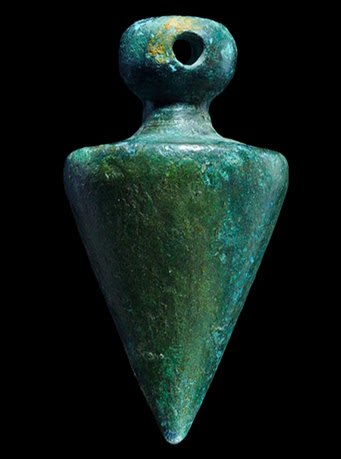
Image #3: plummet or plumb bob of a Roman mason (1st – 3rd century AD); the ones used by carpenters and masons do have a pointed end although the ones used for depth sounding are normally in the shape of a bell;  “plumb” is derived from Latin plumbum, -ī [2/n]: lead, hence plumbārius, -ī [2/m]: plumber

līnea, -ae [1/f]: refers to any form of line or string or thread, including fishing-line, and is also attested as referring to a plumbline used by carpenters and masons

[iii] tabulātus, -a, -um: boarded, having a floor > tabulātum, -ī [2/n]: flooring

  • constrātum, -ī [2/n]: any flooring made of planks; Petronius makes specific reference to constrātum nāvis meaning the deck of a ship

[iv] forus, -ī [2/m]: gangway of a ship; Comenius uses the word to refer to openings through the deck of a ship

[v] cursitō, -āre [1]: run around; this verb has a suffix: –(i)tō; this suffix denotes a frequentative action i.e. one that is performed more than once:

  • dictitō, -āre [1]: repeat, maintain i.e. keep saying something
  • clāmitō, -āre [1]: yell i.e. not a single shout but a prolonged action
  • vēnditō, -āre [1]: offer something, again and again, for sale

18.06.25: topic; ships [4]; Comenius XC; a Merchant ship (1)

Key vocabulary discussed in earlier posts is highlighted but not discussed. Comenius goes into considerable detail about the parts of 17th century vessels, which may appear quite specialised, but many of the Latin words are common and were all used in relation to ships. I have omitted a couple of small sections where the vocabulary is too rare to be of any value.

[1]

A Merchant-ship │ Nāvis onerāria

A ship is driven onward not by oars, but by the sole force of the winds.

Nāvigium impellitur, nōn rēmīs, sed sōlā vī ventōrum.

[i] Image #1: late 17th century Dutch cargo vessel, described as a nāvis mercātōria, the term used by Plautus:

Ībō in Pīraeum, vīsam ecquae advēnerit / in portum ex Ephesō nāvis mercātōria │ To the Piraeus will I go; I'll go see whether any merchant-ship has come into harbour from Ephesus.

[ii] vīs, vīs [3/f] can be misread, especially in the plural

the word means ‘force’, ‘power’, ‘strength’, ‘violence’, but it is often used in the plural: vīrēs (strength; physical force) and looks similar to virī (men) but they are completely different words

Image #2: vīs is also an example of a defective noun which refers to a noun where not all the case endings are attested in Classical Latin; the English verb “can” is defective since there is no infinitive “to can”, “to be able” being used instead of the original Anglo-Saxon infinitive cunnan (Modern German: können)

[iii] impellō, -ere, impulī, impulsus [3]: drive, push forward

Nāvigium impellitur │ a ship (vessel) is pushed / driven forward

[2]

In it is a mast set up, fastened with shrowds, on all sides to the main-chains, to which the sail-yards are tied, and the sails to these, which are spread open, to the wind, …

In illō mālus ērigitur, firmātus fūnibus, undique ad orās nāvīs, cui annectuntur antennæ, hīs, vēla quæ expanduntur, ad ventum ...

The beak is in the fore-deck. │ Rōstrum est in prōrā.

[i] Passives:

Mālus ērigitur │ a mast is set up

firmātus ¦ fūnibus │fastened by /with ropes

vēla expanduntur │ the sails are spread open

annectuntur antennae │ the sail-yards are tied

[ii] Careful!

mālus, -ī [2/m]: mast of a ship

mālus, -ī [2/f]: apple tree

malus, -a, -um: evil, bad

mālum, -ī [2/n]: apple

malum, -ī [2/n]: evil, misfortune, wrongdoing

[iii] shrowds (archaic) = shrouds = the ropes that are tied around a mast = Latin: fūnis, -is [3/m], the general word for a rope or a cord

[iv] antenna (CL: antemna), -ae [1/f]: sail-yard, the horizontal spar or shaft to which a sail is attached on a sailing vessel, used to spread and support the sail 

Image #3: antenna from: A school dictionary of Greek and Roman antiquities (Smith, William, Sir, 1813-1893)

[v] It’s interesting that in the 17th century, English is still using the word “beak” or “beakhead” i.e. the literal translation of Latin rōstrum which refers to the protruding part of the foremost section of a sailing ship

[vi] An extract from Livy describing Scipio’s tactics during a naval battle:

Scīpiō … onerāriārum quadruplicem ōrdinem prō mūrō adversus hostem opposuit │ Scipio … placed four lines of transport (ships) as a bulwark (“wall”) against the enemy.

The passage goes on to describe how Scipio prevented this line of transport ships from being broken in battle:

malīs antemnīsque ¦ dē nāve in nāvem ¦ trāiectīs ac validīs fūnibus velut ūnō inter sē vinculō inligātīs

with masts and (sail-)yards crosswise ¦ from ship to ship ¦ lashed together with stout ropes as if by a single cable (vinculum, -ī [2/n]: chain, link, cord i.e. anything used for binding).