Tuesday, April 8, 2025

06.07.25: Level 2; Sonnenschein: Rōbur et Aes Triplex [1](ii); listening

[1]

[Tum Marcus "ō gentem fortem et admīrābilem Britannōrum!" inquit. "Nam insigne erat facinus quod contrā Rōmānōs, victōrēs orbis terrārum, tam fortiter et nōnnumquam prosperē pugnāvērunt. Nōn mīrum est, sī Rōmānī victōriam reportāvērunt." Nōs sententiam Marcī comprobāvimus.]

[i] To which people – the Romans or the Britons – do the following statements refer?

admirable

victorious

distinguished deed

sometimes successful

world conquerers

[ii] What do the others think of Mark’s opinion?

[2]

[Sed iam nōna hōra erat, cum Alexander, digitō ad orientem monstrāns, "Nōnne nāvēs procul ā lītore spectātis?" inquit. Et patruus meus "Ita est" inquit; "nam illīc est statiō tūta nāvibus. Sed illae nāvēs, ut putō, nāvēs longae sunt ex classe Britannicā; nam pars classis nostrae nunc in fretō Gallicō est."]

[i] In what direction does Alexander point? (1)

[ii] Where are the ships and why are they there? (3)

[iii] What kind of ships does the writer’s uncle think they are? (2)

[iv] Why does he think that? (2)

[3]

[Tum ego "eugē, optimē!" inquam; "nāvem longam adhūc nōn spectāvī. Sed nōn tam grandēs sunt quam putāvī." "Pergrandēs sunt," inquit patruus meus "sed procul ā lītore sunt; omnēs lāminīs ferreīs, nōnnullae arietibus vel turribus armātae sunt."]

[i] Why is the writer happy? (1)

[ii] What does he say about the size of the ships? (2)

[iii] What explanation does the uncle give for that? (2)

[iv] How does the uncle describe the ships? (3)

06.07.25: Level 2; Sonnenschein: Rōbur et Aes Triplex* [1](i); text and exercises

Tum Marcus "ō gentem fortem et admīrābilem Britannōrum!" inquit. "Nam insigne erat facinus quod contrā Rōmānōs, victōrēs orbis terrārum, tam fortiter et nōnnumquam prosperē pugnāvērunt. Nōn mīrum est, sī Rōmānī victōriam reportāvērunt." Nōs sententiam Marcī comprobāvimus. Sed iam nōna hōra erat, cum Alexander, digitō ad orientem monstrāns, "Nōnne nāvēs procul ā lītore spectātis?" inquit. Et patruus meus "Ita est" inquit; "nam illīc est statiō** tūta nāvibus. Sed illae nāvēs, ut putō, nāvēs longae sunt ex classe Britannicā; nam pars classis nostrae nunc in fretō Gallicō est." Tum ego "eugē, optimē!" inquam; "nāvem longam adhūc nōn spectāvī. Sed nōn tam grandēs sunt quam putāvī." "Pergrandēs sunt," inquit patruus meus "sed procul a lītore sunt; omnēs lāminīs ferreīs, nōnnullae arietibus vel turribus armātae sunt."

* The title of the text - rōbur et aes triplex – is a quotation from the Roman poet Horace which symbolises great strength and courage and used here to refer both to the Ancient Britons in their battles with the Romans and to the modern British war-ships.

illī rōbur et aes triplex / circā pectus erat (Horace: Odes 1.3) │ Oak and brass of triple fold / Encompass'd sure that heart, … [He had a heart encased in oak and triple bronze, …]

rōbur, rōboris [3/n]: oak tree; strength

aes, aeris [3/n]: brass

triplex, triplicis: triple; three-fold

** statiō, satiōnis [3/f]: (here) roadstead, a partly sheltered area near the shore where ships can anchor

[i] Vocabulary review: match the Latin and English

adhūc

ariēs, arietis [3/m]

comprobō, -āre, -āvī, -ātus [1]

eugē

facinus, facinoris [3/n]

grandis, -e

illīc

insignis, -e

mīrus, -a, -um

nōnnumquam

orbis, -is [3/m] terrārum

pergrandis, -e

prosperus, -a, -um

sententia, -ae [1/f]

turris, -is [3/f]

tūtus, -a, -um

approve; big; deed / action; distinguished; favourable / successful; globe; hurray / bravo!; opinion; over there; ram; safe; sometimes; still / thus far; tower / turret; very big; wonderful / surprising

[ii] Find the Latin:

  1. pointing ¦ with (his) finger ¦ to the east
  2. over there is a safe roadstead for the ships
  3. as I think i.e. in my opinion
  4. they’re not as big as I thought
  5. some are armed with towers


05.07.25: Level 1; Road to Latin [6]; Vīlla Rōmāna; notes and exercises

[i] The enclitic [a small group of letters attached to the end of a word] -ne is used in questions to show a "yes or no" question but the speaker cannot anticipate what the answer will be. It is attached to the most important word of the question for emphasis, usually the verb, and this important word is placed at the beginning of the question.

Labōratne agricola? │ Is the farmer working?

Habetne domina ancillās? │  Does the mistress have female slaves?

[ii] The word nōnne is used to introduce questions to which the speaker expects the answer to be "yes"

Nōnne agricola labōrat? │ Surely the farmer is working? / The farmer is working, isn't he?

Nōnne vīlla Rōmāna columnās habet? │  The Roman villa has columns, doesn’t it? /  Surely the Roman villa has columns?

[iii] The question word num is used to introduce questions to which the speaker expects the answer to be "no"

Num agricola laborat? │ Surely the farmer isn’t working? / The farmer isn't working, is he?

Exercise [1]

  1. Estne vīlla Rōmāna?
  2. Quālis vīlla Corneliāna est?
  3. Habetne vīlla Rōmāna multam terram?
  4. Nōnne vīlla Rōmāna columnās habet?
  5. Num casa columnās habet?
  6. Quid vīlla Corneliāna habet?
  7. Nōnne vīlla Corneliāna est magna?
  8. Num est vīllā parvā?
  9. Habetne domina ancillās?
  10. Nōnne ancillae labōrant?
  11. Nōnne Tullia fīliās habet?
  12. Num puellae stant?
  13. Nōnne agricolae labōrant?
  14. Quid agricolae amant?
  15. Quid nautae amant?

Unit 3; Grammar Exercise

Supply the proper case endings:

  1. Tullia fili___ bon___ amat.
  2. Silva pulchra domin___ Rōmā___ dēlectat.
  3. Fēmin___ vīll___ et ancill___ habet.
  4. Ancill___ labōrant quod domin___ amant.
  5. Vīll___ magn___ est pulchr___.
  6. Agricolae silv___ amant.
  7. Terra et silva agricol___ dēlectant.
  8. Dēlectatne aqua naut___?
  9. Nōnne fenestra est apert___?
  10. Num casae sunt pulchr___?

05.07.25: Level 1; Road to Latin [5]; Vīlla Rōmāna; reading and vocabulary

[Review of the Nominative and Accusative; Latin Questions with "-ne," "nonne" and "num"]

Estne vīlla Americāna? Vīlla nōn est Americāna. Vīlla est Rōmāna. Vīlla Rōmāna casās parvās et multam terram habet. Vīlla Rōmāna est Vīlla Corneliāna. Vīlla Corneliāna est longa et lāta. Nōnne vīlla Corneliāna est magna et pulchra? Vīlla Corneliāna est magna et pulchra. Vīlla columnās habet. Num casa parva columnās habet? Casa parva columnās nōn habet.

Quis est fēmina? Tullia est fēmina. Nōnne Tullia est Rōmāna? Certē Tullia est Rōmāna. Tullia domina est. Domina multās ancillās habet. Ancillae labōrant. Habetne Tullia fīliās? Tullia fīliās habet. Cornēlia et Secunda fīliae sunt. Stantne Cornēlia et Secunda? Puellae nōn stant sed fēmina stat.

Labōrantne agricolae? Agricolae labōrant. Nōnne terra agricolās dēlectat? Terra agricolās dēlectat. Agricolae et terram et silvam amant. Num terram nautae amant? Terram nautae nōn amant. Nautās nōn terra sed aqua dēlectat. Nōnne vīlla Corneliāna et Tulliam et fīliās dēlectat? Villa Corneliāna et Tulliam et fīliās dēlectat.

agricola: farmer

ancilla: slave woman

aqua: water

casa: cottage; hut; shed; little house

certē: certainly; surely; indeed

columna: column

Cornēliāna: belonging to Cornelius; Cornelius'

domina: mistress

fīlia: daughter

labōrat: he/she/it works

labōrant: they work

lāta: wide: broad

multa: much

multae: many

nauta: sailor

pulchra: beautiful; handsome; pretty

Secunda: Secunda (second daughter of Cornelius)

silva: forest; woods

terra: land: earth

Tullia: Tullia (wife of Cornelius)

vīlla: villa; farm; country estate

Friday, March 28, 2025

04.07.25: Level 3; the ablative absolute [12]: practice (4)

Complete the Latin translations with the words listed below. Note the different ways the ablative absolute construction can be conveyed in English.

  1. The teacher got angry because the boy was shouting in school. │ __________ in ludō __________, magister īrātus factus est.
  2. Since the boys are shouting in school the teacher is getting angry. │ __________ in ludō __________, magister īrātus fit.
  3. As the thief is running away, Sextus shouts in a loud voice. │ __________ __________, Sextus magnā vōce clamat.
  4. With Titus greeting (them), the boys enter the changing room. │ __________ __________, puerī in apodyterium ineunt.
  5. Since Caesar is coming, everybody is afraid. │ __________ __________, omnēs timent.
  6. Although the leader is encouraging his soldiers, the enemies are coming. │ __________ mīlitēs eius __________, hostēs veniunt.
  7. While the soldier was watching the river, the enemies seized the camp. │ __________ flūmen __________, hostēs castra cēpērunt.

aspiciente; Caesare; clamante; clamantibus; confugiente; duce; fūre; hortante; mīlite; puerīs; puerō; salūtante; Titō; veniente


____________________

  1. Puerō in ludō clamante, magister īrātus factus est.
  2. Puerīs in ludō clamantibus, magister īrātus fit.
  3. Fūre confugiente, Sextus magnā vōce clamat.
  4. Titō salūtante, puerī in apodyterium ineunt.
  5. Caesare veniente, omnēs timent.
  6. Duce mīlitēs eius hortante, hostēs veniunt.
  7. Mīlite flūmen aspiciente, hostēs castra cēpērunt.

04.07.25: Level 3; the ablative absolute [11]: practice (3)(ii)

Here are the same ablative absolute phrases again but, this time, as part of complete sentences. Complete the Latin translations with the words below.

  1. As the sun was rising, the lady summoned her maidservants. │ __________ __________, mātrōna ancillās arcessīvit.
  2. As the prisoner was running in the street, all the citizens were terrified. │ __________ in viā __________, omnēs cīvēs terrēbantur.
  3. Because I am strong [with my being strong], my boys do not fear the darkness. │ __________ __________, puerī meī nōn timent tenebrās.
  4. Since he was weeping, there was nothing that we had been able do. │ __________ __________, erat nihil, quod potuerāmus facere.
  5. Since the soldiers are fortifying the camp, we will be saved. │__________ castra __________, servābimur.
  6. While the enemies were going through the streets of the country, the people of the towns and cities were silent. │ __________ per viās terrae __________, populī oppidōrum urbiumque tacuērunt.
  7. While the guards were sleeping, Ulysses captured the horses │ __________ __________, Ulixēs equōs cēpit.
  8. With the citizens talking / While the citizens are talking, I cannot hear you. │ __________ __________, tē audīre nōn possum.
  9. With the queen seeing the danger, the soldiers destroyed her temple. │ __________ perīculum __________, mīlitēs templum eius dēlēvērunt.

captīvō; cīvibus; currente; cūstōdibus; dormientibus; eō; euntibus; flente; inimīcīs; loquentibus; mē; mīlitibus; mūnientibus; oriente; rēgīnā; sōle; valente; vidente


____________________

  1. Sōle oriente mātrōna ancillās arcessīvit.
  2. Captīvō in viā currente, omnēs cīvēs terrēbantur.
  3. Mē valente, puerī meī nōn timent tenebrās.
  4. Eō flente, erat nihil, quod potuerāmus facere.
  5. Mīlitibus castra mūnientibus, servābimur.
  6. Inimīcīs per viās terrae euntibus, populī oppidōrum urbiumque tacuērunt.
  7. Cūstōdibus dormientibus, Ulixēs equōs cēpit.
  8. Cīvibus loquentibus tē audīre nōn possum.
  9. Rēgīnā perīculum vidente, mīlitēs templum eius dēlēvērunt.

04.07.25: Level 3; the ablative absolute [10]: practice (3)(i)

Translate the ablative absolute phrases literally i.e. with X ¦ Y-ing

  1. puerō ¦ dormiente │ with the boy sleeping
  2. captīvō in viā currente
  3. cūstōdibus dormientibus
  4. cīvibus loquentibus
  5. sōle oriente
  6. rēgīnā perīculum vidente
  7. inimīcīs per viās euntibus
  8.  valente
  9. eō flente
  10. mīlitibus castra mūnientibus
  11. leōne adveniente ¦ omnēs cīvēs fugiunt.

____________________

  1. with the captive / prisoner running in the street
  2. with the guards sleeping
  3. with the citizens talking
  4. with the sun rising
  5. with the queen seeing the danger
  6. with the enemies going through the streets
  7. with me / my being strong
  8. with him weeping
  9. with the soldiers fortifying the camp
  10. with the lion approaching, all the citizens flee

04.07.25: Level 3; the Labours of Hercules; [V] The Arcadian Stag and the Erymanthian Boar

[V] THE ARCADIAN STAG AND THE ERYMANTHIAN BOAR

Postquam Eurystheō mors Hydrae nūntiata est, summus terror animum eius occupāvit. Itaque iussit Herculem capere et ad reportāre cervum quendam; nam minimē cupīvit tantum virum in rēgnō suō tenere. Hic autem cervus dīcēbātur aurea cornua et pedēs multō celeriōrēs ventō habēre. Prīmum Herculēs vestigia animālis petīvit, deinde, ubi cervum, ipsum vidit, omnibus vīribus currere incēpit. Per plūrimōs diēs contendit nec noctū cessāvit. Dēnique postquam per tōtum annum cucurrerat — ita dīcitur — cervum iam dēfessum cēpit et ad Eurystheum portāvit.

Tum vērō iussus est Herculēs aprum quendam capere quī illō tempore agrōs Erymanthiōs vāstābat et hominēs illīus locī magnopere perterrēbat. Herculēs laetē negōtium suscēpit et in Arcadiam celeriter recēpit. Ibi mox aprum repperit. Ille autem, simul atque Herculem vidit, statim quam celerrimē fugit et metū perterritus in fossam altam sēsē abdidit. Herculēs tamen summā cum difficultāte eum extrāxit, nec aper ūllō modō sēsē liberāre potuit, et vīvus ad Eurystheum portātus est.

[1] Itaque (Eurystheus) iussit Herculem … ad reportāre cervum quendam │ Therefore, (Eurystheus) ordered Hercules … to bring a certain stag back to him; the reflexive pronoun is used since Eurystheus want the stag brought back to himself.

celeriter recēpit │ literally: he took himself back = he withdrew / retreated

sēsē abdidit │ hid itself; nec aper … sēsē liberāre potuit │ nor was the boar able to free itself

sēsē = sē

More information on reflexive pronouns:

https://adckl.blogspot.com/2024/08/280924-level-2-ora-maritima-24-and-25-7.html

[2] cervus dīcēbātur … habēre │ the stag was said ¦ to have

[3] pedēs [i] multō celeriōrēs ¦ [ii] ventō │ feet [i] much faster ¦ [ii] than the wind

[i] ablative of degree of difference

[ii] ablative of comparison

https://adckl.blogspot.com/2025/03/110623-level-3-summary-of-of-uses-of.html

[4] quam celerrimē fugit │ he fled as quickly as possible

quam + superlative adverb = as [quickly, slowly etc.] as possible

https://adckl.blogspot.com/2024/10/111224-level-2-degrees-of-comparison-21.html

[5] vestīgium, -ī [2/n]: footprint; trace; track (of an animal)

[6] suscipiō, -ere, suscēpī, susceptus [3-iō]: undertake

[7] summā cum difficultāte │ with the greatest difficulty; ablative of manner:

https://adckl.blogspot.com/2025/02/210525-level-3-summary-of-of-uses-of_37.html


03.07.25: Level 2; Sonnenschein: Britannia Pācāta [4](ii): listening

[1]

["Sed in Cantiō, ubi quattuor rēgēs Britannīs praeerant, nōndum fīnis erat pugnandī. Britannī castra Rōmāna ad mare sita fortiter oppugnant; sed frustrā. Rōmānī victōrēs. "]

In which order are the following mentioned?*

failed attempt

location of the Roman camp

fighting unfinished

victory

the rulers of Kent

[2]

["Intereā multae ex cīvitātibus Britannicīs pācem ōrant. Trinobantibus Caesar novum rēgem dat, et pācem confirmat. Itaque propter tot clādēs, propter fīnēs suōs bellō vastātōs, maximē autem propter dēfectiōnem tot cīvitātum, Cassivellaunus de condiciōnibus pācis dēlīberat. "]

[i] What did many tribes do during this time? (1)

[ii] How did Caesar establish peace (2)

[iii] For which three reasons did Cassivellaunus consider peace terms? Which of these was the main reason? (4)

[3]

["Caesar pācem dat; Cassivellaunum vetat Trinobantēs bellō vexāre, et tribūtum Britannīs imperat. Tum cōpiās suās cum magnō numerō obsidum et captīvōrum in Galliam reportat. Britannī fortiter sed frustrā prō ārīs et focīs suīs pugnāverant."]

Complete each statement with a short phrase:

[i] Caesar forbade Cassivellaunus from __________.

[ii] Caesar imposed  __________.

[iii] Caesar returned to Gaul with __________.

[iv] The Britons had fought bravely for  __________.

____________________

*[1] 

failed attempt [4]

location of the Roman camp [3]

fighting unfinished [2]

victory [5]

the rulers of Kent [1]

Sed [1] in Cantiō, ubi quattuor rēgēs Britannīs praeerant, [2] nōndum fīnis erat pugnandī. Britannī [3] castra Rōmāna ad mare sita fortiter oppugnant; [4] sed frustrā. [5] Rōmānī victōrēs.

03.07.25: Level 2; Sonnenschein: Britannia Pācāta [4](i): text, exercise

"Sed in Cantiō, ubi quattuor rēgēs Britannīs praeerant, nōndum fīnis erat pugnandī. Britannī castra Rōmāna ad mare sita fortiter oppugnant; sed frustrā. Rōmānī victōrēs. Intereā multae ex cīvitātibus Britannicīs pācem ōrant. Trinobantibus Caesar novum rēgem dat, et pācem confirmat. Itaque propter tot clādēs, propter fīnēs suōs bellō vastātōs, maximē autem propter dēfectiōnem tot cīvitātum, Cassivellaunus de condiciōnibus pācis dēlīberat. Caesar pācem dat; Cassivellaunum vetat Trinobantēs bellō vexāre, et tribūtum Britannīs imperat. Tum cōpiās suās cum magnō numerō obsidum et captīvōrum in Galliam reportat. Britannī fortiter sed frustrā prō ārīs et focīs suīs pugnāverant."

Note: prō ārīs et focīs suīs

Literally: they fought for their alters and hearths (fireplaces) but the expression was used to refer to everything that people held dear to them

[i] Vocabulary review: match the Latin and English

āra, -ae [1/f]

cīvitās, cīvitātis [3/f]

clādēs, -is [3/f]

dēlīberō, -āre, -āvī, -ātus

focus, -ī [2/m]

frustrā

imperō, -āre, -āvī, -ātus [1]: (here) impose

intereā

maximē

obses, obsidis [3 m/f]

ōrō, -āre, -āvī, -ātus

pāx, pācis [3/f]

praesum, praeesse

tot

vetō, -āre, -uī, vetitus [1]

vexō, -āre, -āvī, -ātus [1]

disaster; deliberate / consider / ponder; be in command; altar; (here) impose; especially; forbid; hearth / fire-place; hostage; in vain; meanwhile; trouble / harrass; tribe / city (-state) / kingdom; peace; pray / beg for; so many

[ii] Find the Latin

[1] there was not yet an end to the fighting

[2] the camp … situated by the sea …

[3] many of the tribes

[4] … territory… laid waste

[5] Caesar imposes a tribute on the Britons

[6] with a large number


Thursday, March 27, 2025

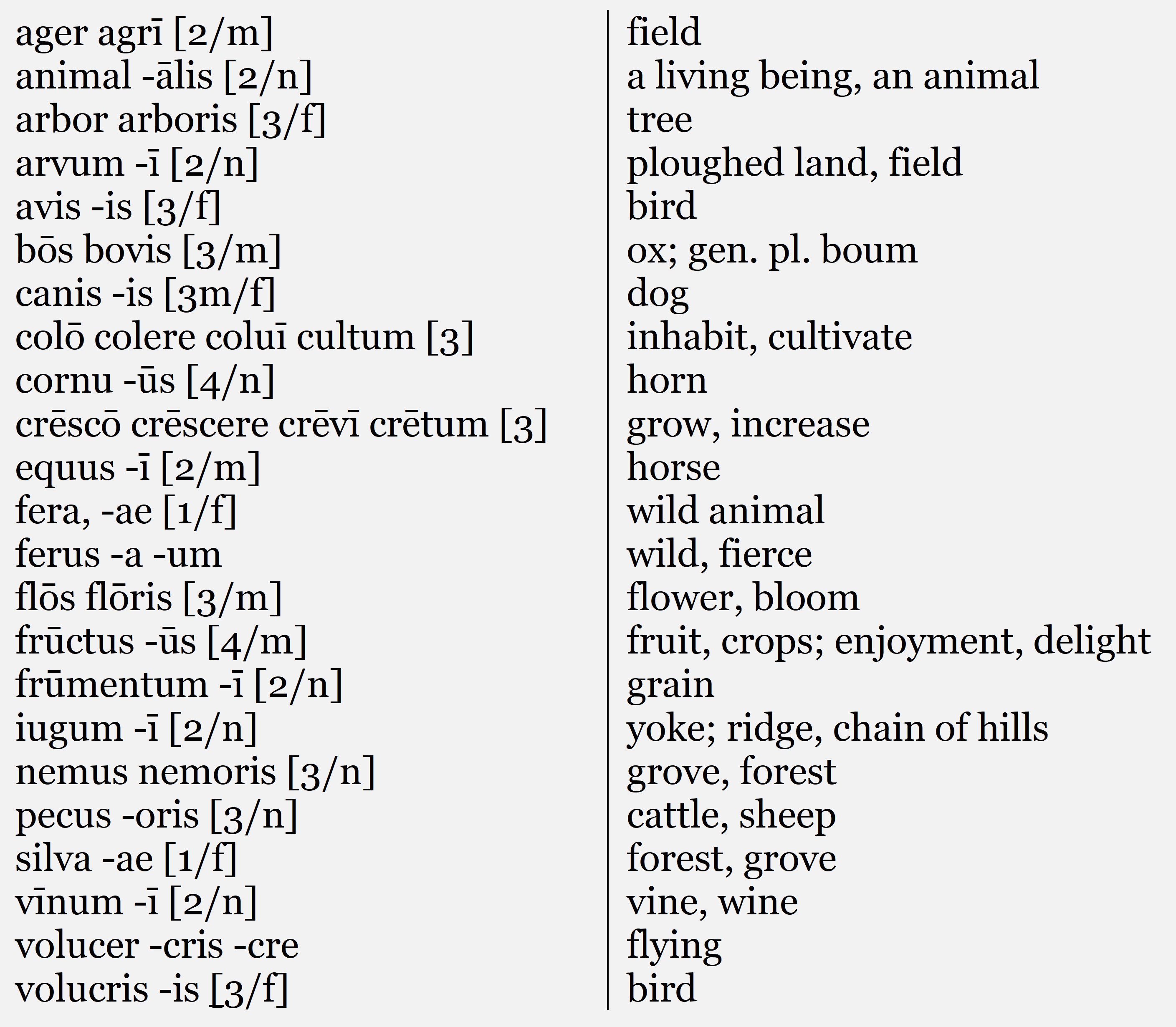
02.07.25: Topical Vocabulary [2]: animals and plants

a living being, an animal

bird (2 words)

cattle, sheep

dog

field

flower, bloom

flying

forest, grove

fruit, crops; enjoyment, delight

grain

grove, forest

grow, increase

horn

horse

inhabit, cultivate

ox; gen. pl. boum

ploughed land, field

tree

vine, wine

wild animal

wild, fierce

yoke; ridge, chain of hills

Label the images; more than one word can be used with most pictures.


02.07.25: Level 1; Road to Latin [4]; Schola Rōmāna I; Schola Rōmāna II; notes and exercises

Schola Rōmāna I

Exercise [1]

  1. Quālis est schola Rōmāna?
  2. Quālis est schola Americāna?
  3. Cūr schola Rōmāna iānuam nōn habet? [cūr = why?]
  4. Cūr scholā antīquā fenestram nōn habet?
  5. Quid schola Americāna habet?
  6. Quālem mēnsam schola Americāna habet? [quālem = what kind of?]
  7. Quem schola antīqua dēlectat? [quem = whom?]
  8. Quem schola Rōmāna dēlectat?
  9. Cūr schola antīqua magistram Americānam dēlectat?
  10. Cūr schola antīqua puellam Rōmānam dēlectat?

Notes: Notes: Schola Rōmāna I

In the sentence Schola Rōmāna iānuam nōn habet, what is the subject? Are the words schola and iānuam in this sentence used in the same way? How is iānuam used?

In the English sentence, He strikes the ball, ball is said to receive the action of the verb strikes. In the same way in the sentence He has the ball or He admires the ball, we say that ball receives the action of the verbs has and admires. In all of these sentences he is the subject of the verb and ball is the direct object, often simply called the object of the verb.

When we see an expression like he strikes or he praises, we think at once what does he strike? or whom does he praise? Such verbs, which need a direct object to make the sentence complete are called transitive verbs. But not all verbs are transitive. Sentences like he smiles or I agree are complete without a direct object. Such verbs are called intransitive verbs.

In the Latin sentence quoted above Schola Rōmāna iānuam nōn habet, the word iānuam is the direct object of habet. Find other direct objects in the story. What endings does each of these words have? Does each represent one thing or more than one?

The word that receives the action of a transitive verb is called the direct object of the verb and is in the Accusative Case. Notice that the ending of the Accusative singular is -am

Schola Rōmāna II

Exercise [2]

  1. Quās scholae dēlectant?
  2. Quālis est schola Rōmāna?
  3. Quālēs sellās schola antīqua habet? [quālēs = accusative plural: what kind of?]
  4. Quālēs sellās schola nova habet?
  5. Quid schola Americāna habet?
  6. Quās schola Rōmāna dēlectat? [quās = accusative plural: whom?]

Notes: Schola Rōmāna II

In the sentence Scholae magistram et puellās dēlectant, how is the word magistram being used? In what case and number is it? How is the word puellās being used? If both magistram and puellās are used as direct objects, in what case are they? Why are the endings different? Find other words being used as plural direct objects. What ending do they have? The ending of the Accusative Plural is -ās

Accusative Singular: puellam

Accusative Plural: puellās

Unit 02; Grammar Exercise

Supply the proper case endings:

  1. Puell_____ American_____ scholam Rōman_____ amant.
  2. Schol_____ aperta magistr_____ (sing.) dēlectat.
  3. Schol_____ sellās parv_____ habent.
  4. Magistra est bōn_____; puellae sunt bōn_____.
  5. Antīqua schola et magistr_____ et discipul_____ dēlectat.

02.07.25: Level 1; Road to Latin [3]; Schola Rōmāna I; Schola Rōmāna II; reading and vocabulary

[First Declension, Accusative Case]

Schola Rōmāna I

Schola est schola Rōmāna. Parva est schola Rōmāna sed magna est schola Americāna. Schola Romana iānuam nōn habet quod schola est aperta. Antīqua schola fenestram nōn habet quod schola nōn est tēcta. Antīqua schola mēnsam nōn habet. Schola Americāna mēnsam magnam habet. Schola antīqua magistram Americānam dēlectat. Schola Rōmāna Iūliam et Corneliam dēlectat. Cūr schola antīqua magistram Americānam dēlectat? Schola antīqua magistram Americānam dēlectat quod schola est aperta.

Schola Rōmāna II

Scholae magistram et puellās dēlectant. Antīqua schola Rōmāna est. Nova schola Americāna est. Schola antīqua longās sellās habet. Schola nova parvās sellās habet. Schola Rōmāna neque iānuam neque fenestram habet. Schola Americāna et iānuās et fenestrās habet. Antīquae scholae sunt apertae; sed novae scholae sunt tēctae. Schola Rōmāna puellās Americānās dēlectat quod puellae Americānae scholās apertās amant.

amat: he/she/it loves; likes

amant: they love; like

antīqua: old; ancient

cūr: why

dēlectat: he/she/it delights; pleases

dēlectant: they delight; please

et...et: both...and

habet: he/she/it has

habent: they have

longa: long

neque: and … not; nor; neither

neque...neque: neither...nor

nova: new; fresh;  recent; modern

quod: because

Rōmāna: Roman

tēcta: enclosed; covered

01.07.25: Level 3; the ablative absolute [9]: with the present active participle

So far, we have looked at the ablative absolute with the perfect passive participle expressing ‘after / when / since something was / has been / had been done’. However, the ablative absolute can also be used with the present active participle which conveys two actions happening at the same time. The literal translation is with X ¦ Y-ing but, as before, there are more fluent alternatives.

  • with [1] the boy ¦ [2] sleeping

[i] Begin with the nominative singular:

[1] boy [2] sleeping

> [1] puer [2] dormiēns i.e. the present active participle from the verb dormiō, -īre: sleep

[ii] Transfer both words into the ablative case:

> [1] puerō [2] dormiente = ablative absolute = literally: with X ¦ Y-ing = with the boy sleeping = while (since) the boy is / was sleeping

[i] Puerō dormiente, ¦ [ii] servus pecūniam abstulit. │ [i] With the boy sleeping / while (since) the boy was sleeping ¦ [ii] the slave stole the money.

The participle ends in -e rather than -ī in the ablative singular.

  • with [1] the boys ¦ [2] sleeping

[i] Begin with the nominative singular:

[1] boys [2] sleeping

> [1] puerī [2] dormientēs i.e. the present active participle from the verb dormiō, -īre: sleep

[ii] Transfer both words into the ablative case:

> [1] puerīs [2] dormientibus = ablative absolute = literally: with X ¦ Y-ing = with the boy sleeping = while (since) the boy is / was sleeping

[ii] Puerīs dormientibus ¦ [ii] servus pecūniam abstulit. │ [i] With the boys sleeping / while (since) the boys were sleeping ¦ [ii] the slave stole the money.

Again, tense sequence will come into play in translation:

[i] Dominō dormiente ¦ [ii] servī effugiunt │ [i] With the master sleeping / while (since) the master is sleeping, [ii] the slaves escape.

[i] Dominō dormiente ¦ [ii] servī effūgērunt│ [i] With the master sleeping  / while (since) the master was sleeping, [ii] the slaves escaped.

Examples giving different possible translations; note the tense sequences in the translations in the last three examples.

  1. Servō in agrō labōrante … │ While the slave is / was working in the field …
  2. Feminā epistulam scribente … │While / since / although the woman is / was writing a letter …
  3. Canibus in viā lātrantibus    │ Because the dogs are / were barking in the street …
  4. Senātōribus ōrātiōnem Cicerōnis audientibus … │ As the senators are / were listening to Cicero’s speech …
  5. Agricolīs pontem trānseuntibus…. │ Since the farmers are / were crossing the bridge …
  6. Puerō lacrimante, pater nihil facit. │ Although the boy is crying, the father does nothing.
  7. Ancillā cēnam parante, domina in cubiculō dormiēbat. │ While the maid was preparing dinner, the mistress was sleeping in the bedroom.
  8. Multīs hostibus urbem oppugnantibus cīvēs fortēs dē salūte nōn dēspērāvērunt. │ Although many enemy were attacking the city, the brave citizens did not despair of (their) safety.

01.07.25: Level 3; the ablative absolute [8]: tense sequences

The absolute construction + perfect passive participle refers to an action which took place before the action of the main verb . Regardless of the tense of the main verb in Latin, the absolute construction will always be the same. This, however, is not the case when translating the phrase into English since English sequences the tenses. This is not obvious if the basic “with X having been Y-ed” construction is maintained, but it will be obvious if a relative clause is used.

  • Urbe captā, hostēs templa dēlēvērunt.

> With the city having been captured, the enemy destroyed the temples.

> After the city had been captured, the enemy destroyed the temples.

  • Verbīs poētae audītīs, puerī fēlīcēs erant.

> With the words of the poet having been heard, the boys were happy.

> After the words of the poet had been heard, the boys were happy.

But the translation of the ablative absolute may not be the equivalent of an English past perfect tense i.e. had:

  • Librō populō scrīptō, omnēs nōbilēs auctōrem laudant.

> With the book having been written for the people, the nobles praise the author.

> Since the book was / has been written for the people, the nobles praise the author.

  • Praedā istīus agricolae inventā, agrī tibi erunt.

With that farmer’s loot having been found, you will have the fields.

> Because that farmer’s loot was / has been found, you will have the fields.

  • Aliquis ad āram templī nōs dūcet, auxiliō dē deīs petītō.

> Somebody will lead us to the altar with help from the gods having been asked for.

> Somebody will lead us to the altar of the temple, because help from the gods was / has been asked for.

  • Negōtiō factō, nunc domī sumus.

> With the task having been done, we are now at home.

> Since the task was / has been done, we are now at home.

01.07.25: Level 3; the ablative absolute [7]: to whom does it refer?

[1] (After) having read the letter [2] she was very touched.

[1] can only refer to [2] i.e. the subject of the sentence.

Now look at a similar sentence in Latin:

[1] Litterīs acceptīs ¦ [2] imperātor valdē īrātus est.

= [1] with the letter having been received, [2] the general got really angry

= [1] after / when / since the letter had been received, [2] the general got really angry

There is no grammatical connection between [1] and [2]; there is no implication that it was the general who received it. Context, however, may allow such a translation. In the first two examples below (both quoted in Dickinson), the ablative absolute is obviously referring to Caesar even though that is not directly stated:

Caesar, acceptīs litterīs, nūntium mittit (Caesar) │ Having received the letter [literally: with the letter having been received], Cæsar sends a messenger.

Quibus rēbus cōgnitīs Caesar apud mīlitēs cōntiōnātur (Caesar) │ Having learned this [literally: with these thing having been learned], Cæsar makes a speech to the soldiers.

Look, however, at the following examples:

Urbe dēlētā, cīvēs fūgērunt.

**Having destroyed the city** the citizens fled.” It is highly unlikely that the citizens destroyed their own city! Therefore, the original translation of the ablative absolute – with no connection to the subject – would be the appropriate one:

  • When / after / since the city had been destroyed, the citizens fled.
  • The city had been destroyed and the citizens fled.

Equō vēnditō agricola domum rediit.

This is a good example where it is down to context:

[1] Either: After / when / since the horse had been sold, the farmer returned home. / The horse had been sold and the farmer returned home.

[2] Or: Having sold the horse, the farmer returned home.

In general, when translating the ablative absolute – especially when you are still getting to grips with it – it is better to stick with [1] because [1] is always correct whereas [2] could be a misinterpretation of the Latin.

01.07.25: Level 3; the Labours of Hercules; [IV] Slaying the Lernean Hydra

[IV] SLAYING THE LERNEAN HYDRA

Deinde Herculēs ab Eurystheō iussus est Hydram occīdere. Itaque cum amicō Iōlāō contendit ad palūdem Lernaeam ubi Hydra incolēbat. Hoc autem mōnstrum erat serpēns ingēns quae novem capita habēbat. Mox is mōnstrum repperit et summō cum perīculō collum eius sinistrā manū rapuit et tenuit. Tum dextrā manū capita novem abscidere incēpit, sed frustra labōrābat, quod quotiēns hoc fēcerat totiēns alia nova capita vidēbat. Quod ubi vidit, statuit capita ignī cremāre. Hōc modō octō capita delēvit, sed extrēmum caput vulnerārī nōn potuit, quod erat immortāle. Itaque illud sub ingentī saxō Herculēs posuit et ita victōriam reportāvit.

[1] Iōlaō, abl. of Iolaus, the hero's best friend.

[2] palūs, palūdis [3/f]: marsh; swamp

[3] reperiō, -īre, repperī, repertus [4]: find (out); discover

[4] … quotiēns hoc fēcerat totiēns alia nova capita vidēbat.

… however often / however many times (whenever) he did that, just as often he would see other new heads.

[5] … quotiēns hoc fēcerat totiēns alia nova capita vidēbat. Quod ubi vidit, … │ … however many times he did that, just as often he would see other new heads. And when he saw that, ….

Refer to the previous post on connecting relatives; quod is not related to a specific person or thing in the previous sentence but to the action described i.e. the continual regrowth of the heads.

[6] extrēmum caput vulnerārī nōn potuit │ the furthest head could not be injured

vulnerarī: passive infinitive

Wednesday, March 26, 2025

27.03.25: Vincent; the verdict of a dog

[1] literal translation

Tē īnspicit oblīquīs oculīs et sollicitātur. │ He observes / looks upon you with sidelong eyes and is made anxious / disturbed

inspiciō, -ere, inspēxī [3-iō]: examine, inspect, consider

obliquus, -a, -um: sidelong; slanting i.e. the dog is not looking directly, but with uncertainty or suspicion out the corner of his eye

Omnibus ipse placet, iūdicat ille simul. │ Everybody likes him [literally: he himself is pleasing to everyone], at the same time, he judges / passes judgement

ipse [m], ipsa [f], ipsum [n]: himself, herself, itself

simul: at the same time; Engl. simultaneously

[2] less literal but I’ve tried to keep as close as possible to the original meaning and mood:

Observing you with eyes askance and

Anxious look he’s liked

By all - and all by him are meanwhile

Judged.

30.06.25: Level 2; Sonnenschein: Britannia Pācāta [3](ii): listening

[1]

["In parte flūminis Tamesae ubi fīnēs Cassivellaunī erant ūnum tantum vadum erat. Quō cum Caesar adventāvit, cōpiās hostium ad alteram rīpam flūminis collocātās spectāvit. "]

The following statements are false. Correct them.

[i] None of the territory of the Cassivellauni was by the river.

[ii] The river had several shallow parts.

[iii] Caesar observed the enemy on the same side.

[2]

["Rīpa autem sudibus acūtīs firmāta erat; et Britannī multās sudēs sub aquā quoque occultāverant. Sed Caesar hostibus instāre nōn dubitāvit. Aqua flūminis profunda erat, et mīlitēs capite solum ex aquā exstābant; "]

Complete each statement with a single word or short phrase:

[i] The river was defended by __________ which were __________ under the water.

[ii] Caesar did not hesitate to __________.

[iii] Because the water was __________ only the __________ of the Romans were visible.

[3]

["sed Rōmānī sē aquae fortiter mandāvērunt, et Britannōs in fugam dedērunt. "]

[i] How did the Romans deal with the depth of the water? (2)

[ii] What happened to the Britons? (1)

[4]

["'Oppidum' Cassivellaunī nōn longē aberat, inter silvās palūdēsque situm, quō Britannī magnum numerum hominum, equōrum, ovium, boum, congregāverant. Locum ēgregiē et natūrā et opere firmātum Caesar ex duābus partibus oppugnāre properāvit: oppidum expugnāvit et dēfensōrēs fugāvit."]

[i] Where was the town of the Cassivellauni? (3)

[ii] What had the Britons gathered there? (5)

[iii] Why was the place very well defended? (2)

[iv] Describe Caesar’s attack and the outcome. (3)

30.06.25: Level 2; Sonnenschein: Britannia Pācāta [3](i): text, exercises

"In parte flūminis Tamesae ubi fīnēs Cassivellaunī erant ūnum tantum vadum erat. Quō cum Caesar adventāvit, cōpiās hostium ad alteram rīpam flūminis collocātās spectāvit. Rīpa autem sudibus acūtīs firmāta erat; et Britannī multās sudēs sub aquā quoque occultāverant. Sed Caesar hostibus instāre nōn dubitāvit. Aqua flūminis profunda erat, et mīlitēs capite solum ex aquā exstābant; sed Rōmānī sē aquae fortiter mandāvērunt, et Britannōs in fugam dedērunt. 'Oppidum' Cassivellaunī nōn longē aberat, inter silvās palūdēsque situm, quō Britannī magnum numerum hominum, equōrum, ovium, boum, congregāverant. Locum ēgregiē et natūrā et opere firmātum Caesar ex duābus partibus oppugnāre properāvit: oppidum expugnāvit et dēfensōrēs fugāvit."

Vocabulary

sudis, -is [3/f]: stake; log

īnstō, -āre, īnstitī [1]: pursue

palūs, palūdis [3/f]: marsh; swamp

Note

Quō: can be a question word or a conjunction meaning ‘to / in which place’:

…, inter silvās palūdēsque situm, quō Britannī magnum numerum hominum … congregāverant │ … situated between the forest and marshes, in which place (where) the Britons had gathered together a large number of men …

However, it can also refer to the previous sentence:

Quō cum Caesar adventāvit …│ And when Caesar arrived at that place / there

[i] Vocabulary review: match the Latin and English

acūtus, -a, -um

alter, -a, -um

bōs, bovis [3 m/f]

collocō, -āre, -āvī, -ātus [1]

congregō, -āre, -āvī, -ātus [1]

dubitō, -āre, -āvī, -ātus [1]

ēgregiē

expugnō, -āre, -āvī, -ātus [1]

exstō, -āre [1]

firmō, -āre, -āvī, -ātus [1]

mandō, -āre, -āvī, -ātus [1]

profundus, -a, -um

rīpa, -ae [1/f]

situs, -a, -um

tantum

vadum, -ī [2/n]

bank (of a river); commit; deep; excellently; gather; head of cattle (e.g. cow, bull, ox); hesitate / doubt; only; place; shallow water; sharp; situated / positioned; stand out; strengthen; fortified; take by storm; the other (of two)

[ii] Find the Latin

[1] he observed the troops positioned on the other side

[2] the bank had been fortified ¦ by sharp stakes

[3] the Romans had committed themselves to the water

[4] a large number … of cattle

[5] the place, … naturally  defended

[6] from two sides (directions)